TLDR Meaning Explained: What It Stands For & How to Use It
If you spend any time on the internet or reading corporate emails, you have likely seen four specific letters summarizing a massive wall of text. But what is the exact tldr meaning, and why has it become so popular?
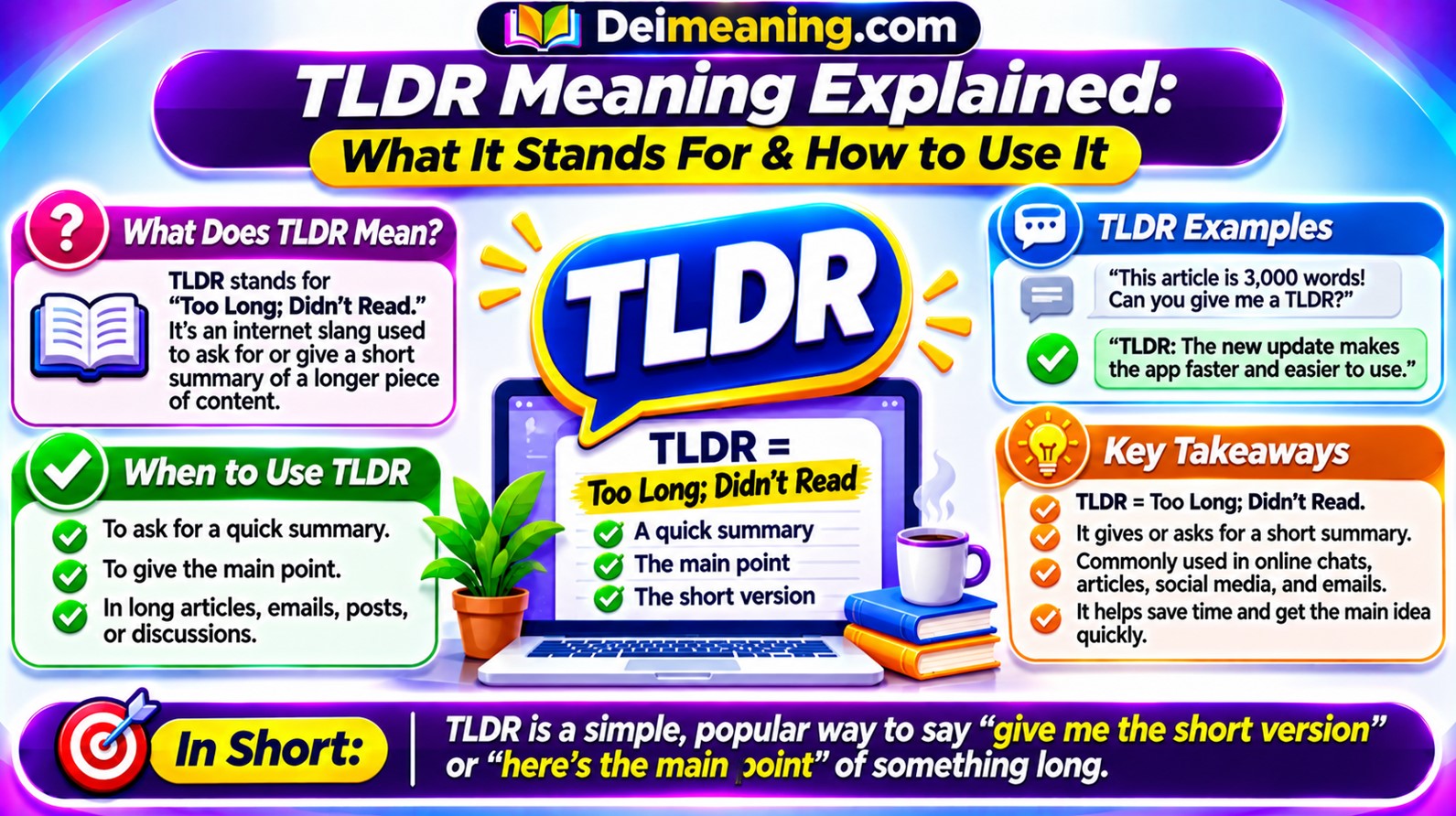
In short, TLDR stands for “Too Long; Didn’t Read.” It is an acronym used to signal a brief summary of a much longer text. Whether you are scrolling through a detailed Reddit thread, reading a software update, or checking a lengthy message from your boss, a TLDR provides the bottom line without the fluff.
What started as a sarcastic internet dismissal has completely transformed. Today, understanding the tldr meaning is essential for effective digital communication. People use it as a noun, a verb, and a highly effective formatting tool.
In this comprehensive guide, we will break down the true tldr meaning, explore its internet origins, show you how to use it in professional settings, and compare it to other popular communication acronyms.
The Exact TLDR Meaning Explained
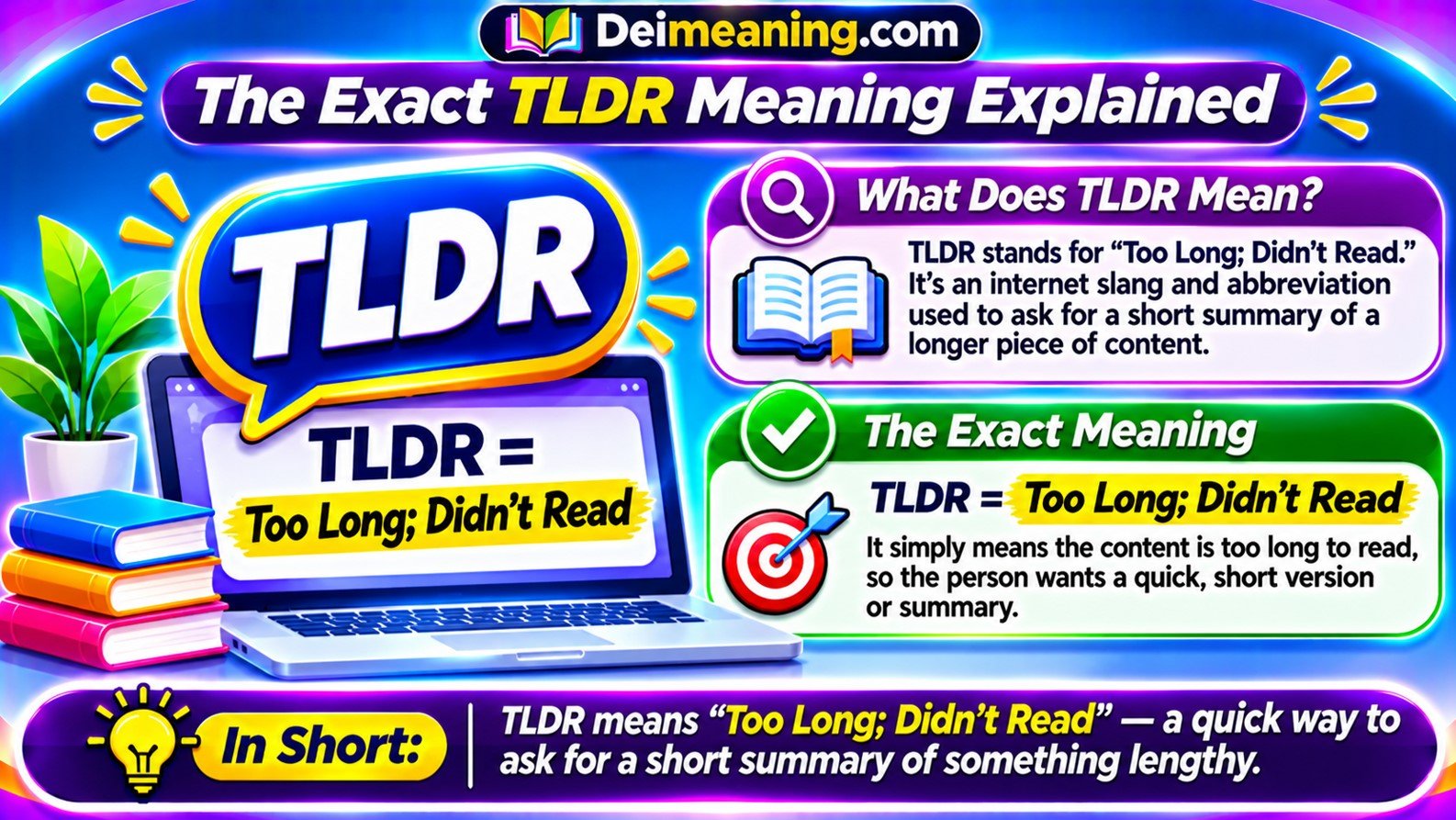
At its core, the tldr meaning is simple: Too Long; Didn’t Read.
However, its modern application goes far beyond its literal translation. Depending on the context, this versatile acronym serves several unique purposes in modern writing.
1. As a Summary Indicator
Most commonly, writers place “TLDR” at the very top or bottom of a long document. When used this way, the tldr meaning translates to: “Here is the short version of what I wrote below.” It respects the reader’s time by offering the main takeaway instantly.
2. As a Sarcastic Reply
In casual forums or social media, a user might reply to a massive, unformatted block of text with a simple “TLDR.” In this context, the tldr meaning is literal and slightly rude. It tells the original poster: “You wrote too much, and I refused to read it.”
3. As a Noun
You will often hear professionals use the term as a noun. For example, a manager might say, “Can you send me the TLDR of that marketing report?” Here, the tldr meaning becomes synonymous with an executive summary.
Learn More: DEI Meaning
Grammar and Punctuation: TLDR vs. TL;DR
You might see this acronym spelled with or without a semicolon. Both TLDR and TL;DR are correct. The semicolon represents the natural pause between the two clauses (“Too Long” and “Didn’t Read”). However, as the internet leans toward faster typing, dropping the punctuation has become the standard convention.
The History and Origin of TLDR
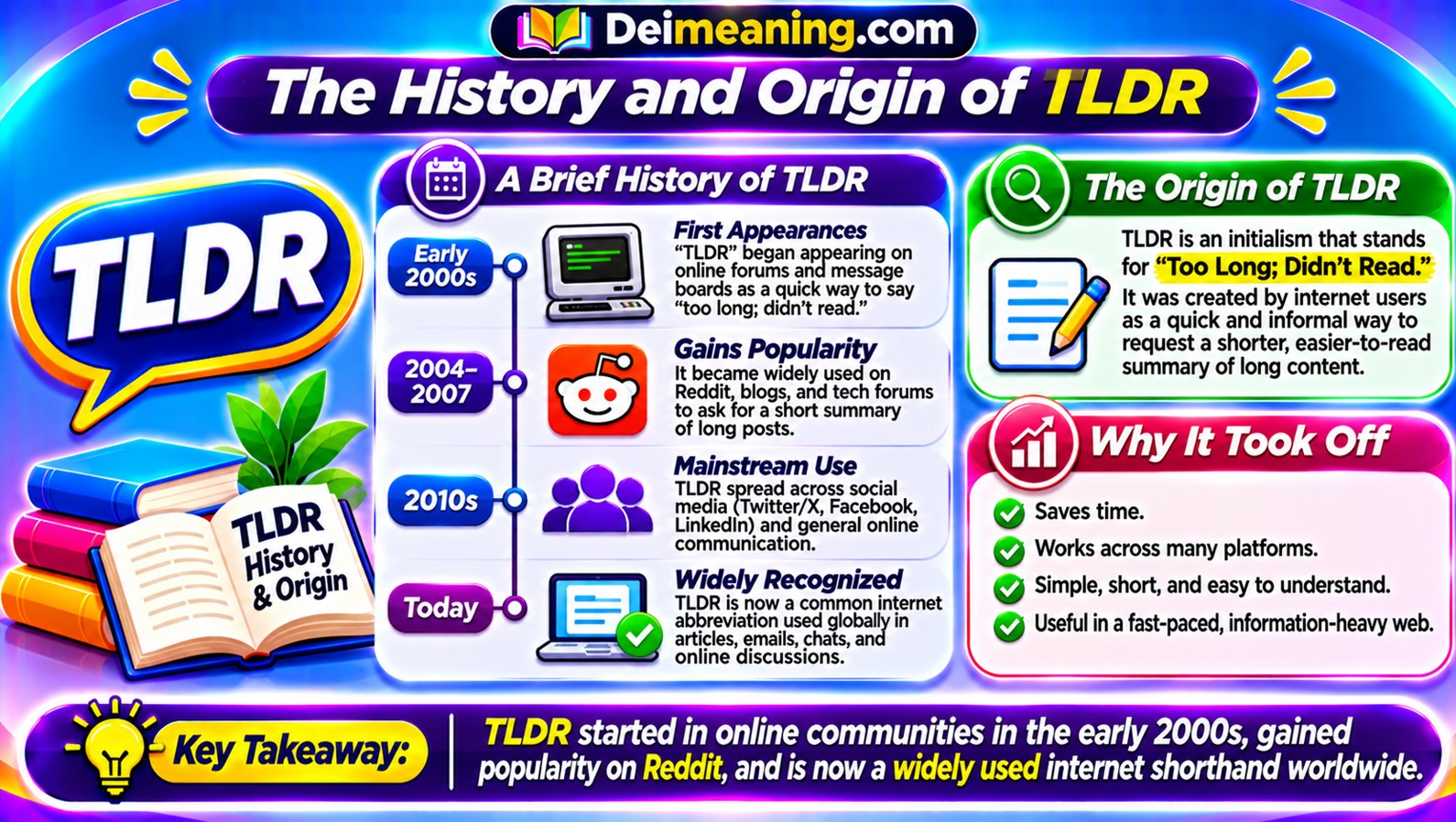
To fully grasp the tldr meaning, we have to look back at the early days of internet culture. The acronym did not originate in a corporate boardroom; it was born in the trenches of early web forums.
The Usenet and Forum Era (Early 2000s)
Linguists and internet historians trace the earliest uses of TLDR back to roughly 2002 on platforms like Something Awful and Usenet. Early internet users had a low tolerance for rambling posts, often referred to as “walls of text.”
When someone posted a tedious rant, other users would simply reply “TL;DR.” It was a badge of internet sass. It meant the writer failed to keep their audience’s attention.
The Reddit Expansion (2010s)
The tldr meaning shifted dramatically when it hit Reddit. Reddit encourages long, detailed stories, especially in communities like r/AskReddit or r/relationships.
Instead of waiting for commenters to insult them, original posters started getting ahead of the joke. They began adding a “TLDR” at the bottom of their own lengthy stories. This evolutionary step changed the acronym from an insult into a helpful courtesy.
Official Dictionary Recognition (2013 & 2018)
The transition from internet slang to established English vocabulary happened relatively fast. Oxford Dictionaries Online officially added the acronym in 2013. Five years later, in 2018, Merriam-Webster added it to their database, cementing the tldr meaning as a recognized part of the modern English language.
How to Use TLDR in Modern Communication
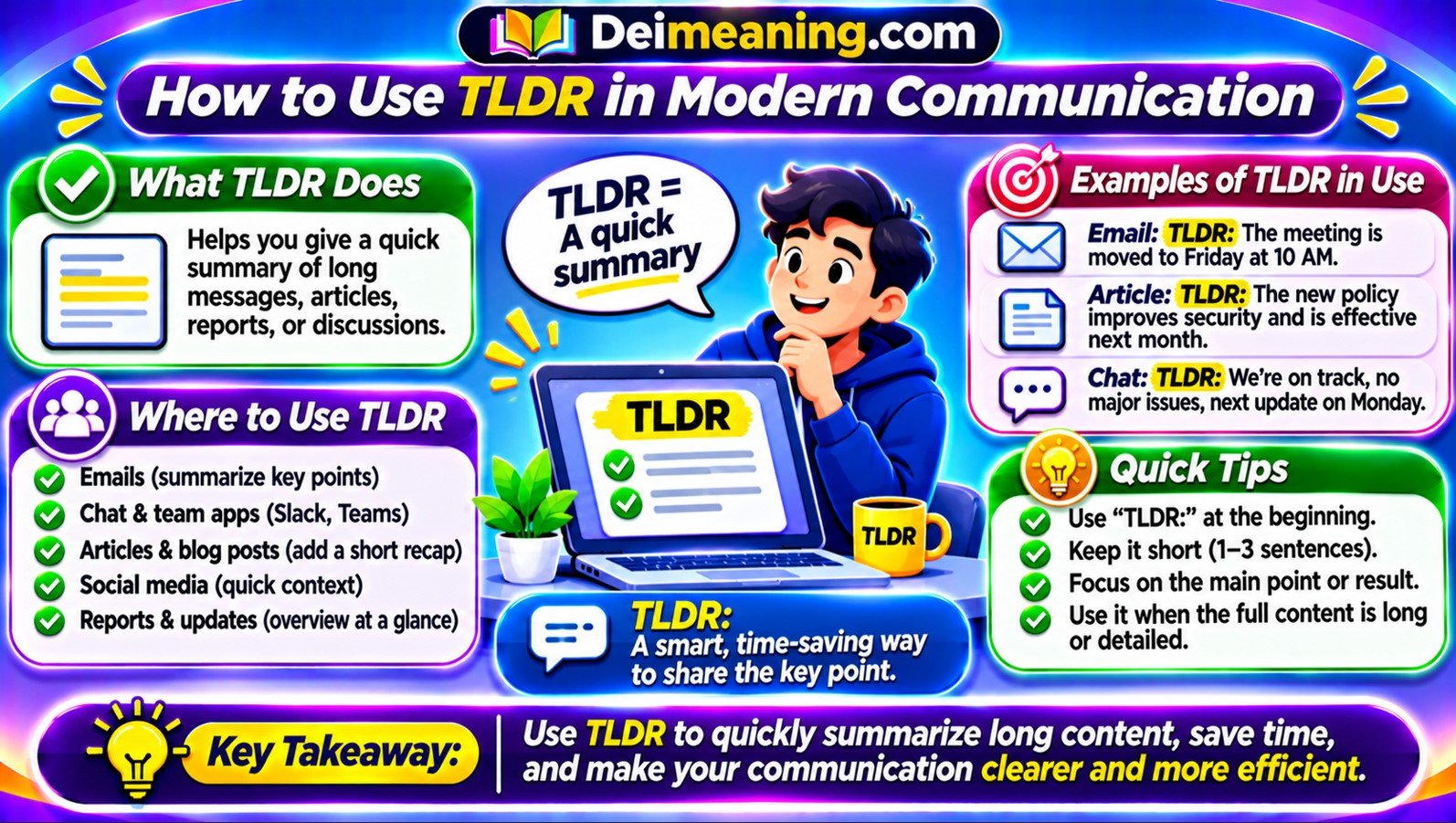
Understanding the tldr meaning is only half the battle. Knowing when and how to use it effectively is what separates average writers from great communicators.
TLDR in Business and Emails
In the corporate world, attention is currency. Executives, managers, and clients receive hundreds of emails a day. They do not have time to read five paragraphs detailing a project delay.
When writing professional emails, place your TLDR at the very top.
- Keep it brief: One or two sentences maximum.
- State the action: Tell the reader exactly what you need them to do.
- Format clearly: Use bold text to make the summary pop.
TLDR on Social Media and Blogs
Content creators frequently utilize the tldr meaning to improve user engagement. On platforms like X (formerly Twitter) or LinkedIn, a long thread might end with a TLDR tweet to wrap up the main ideas.
In SEO content writing, a TLDR section at the top of an article acts as an instant hook. It provides immediate value, reducing bounce rates and keeping mobile readers satisfied.
TLDR in Tech and Journalism
Tech newsletters and news aggregators have built entire business models around the tldr meaning. Publications like The Hustle or Morning Brew specialize in taking complex financial or tech news and breaking it down into bite-sized, readable chunks.
Click Here: Vox Populi Vox Dei Meaning
Comparing TLDR to Other Acronyms
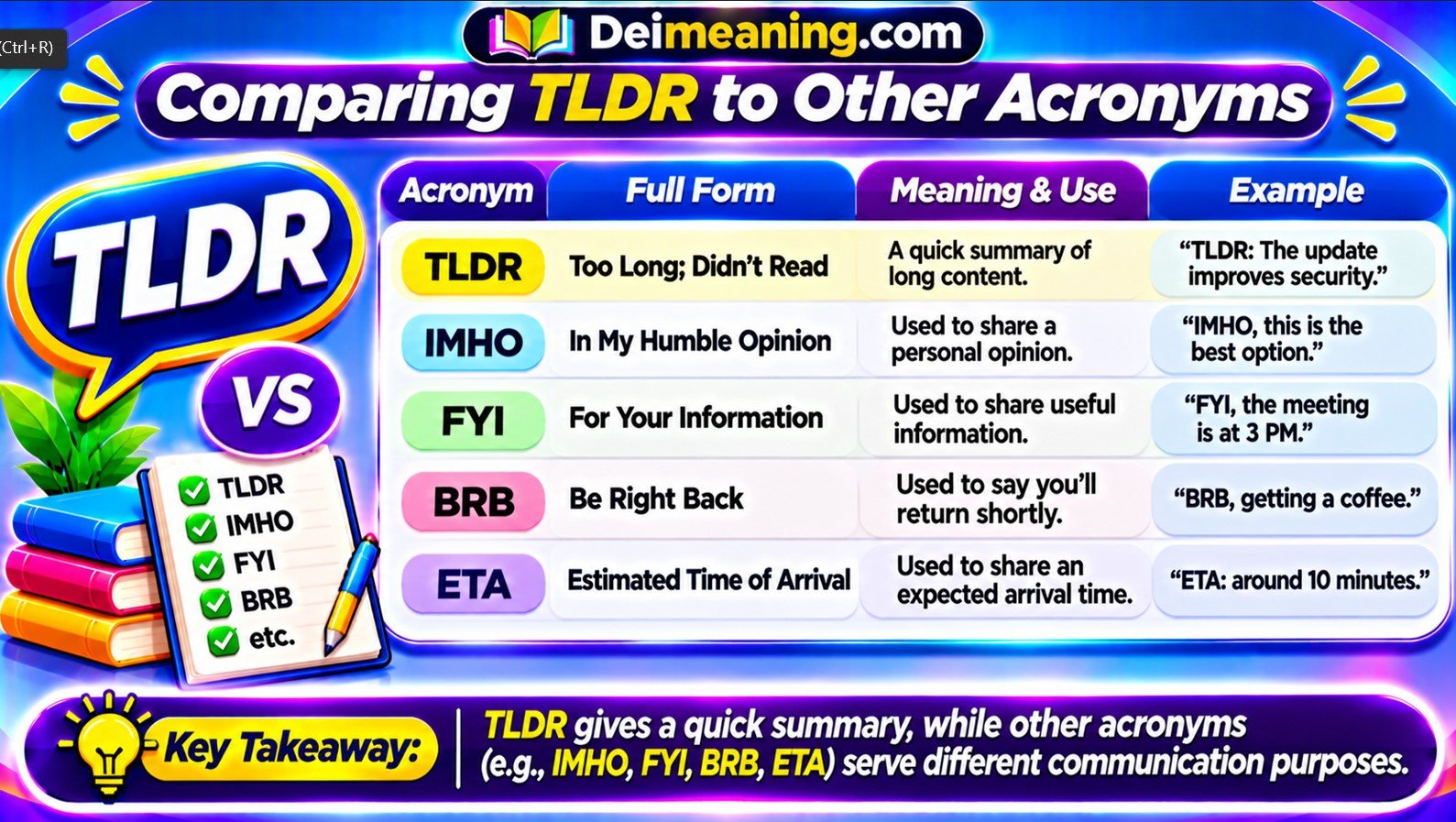
The tldr meaning shares space with a few other popular acronyms. Depending on your industry, you might want to use a different term to achieve the same result.
Here is a quick breakdown of how TLDR stacks up against its communication cousins.
| Acronym | What it Stands For | Best Context to Use It | The Core Difference |
| TLDR | Too Long; Didn’t Read | Tech, Reddit, Casual Business | Versatile; used as a noun, verb, or format tool. |
| BLUF | Bottom Line Up Front | Military, Government, Corporate | highly formal; strictly placed at the very beginning of a document. |
| ICYMI | In Case You Missed It | Social Media, Newsletters, Slack | Used for past events or recap announcements. |
| Exec Sum | Executive Summary | Formal Proposals, Pitch Decks | Traditional business term; usually a full page long rather than a single sentence. |
While the tldr meaning is closely related to BLUF, TLDR remains far more popular in casual tech and startup cultures.
The Pros and Cons of Using TLDR
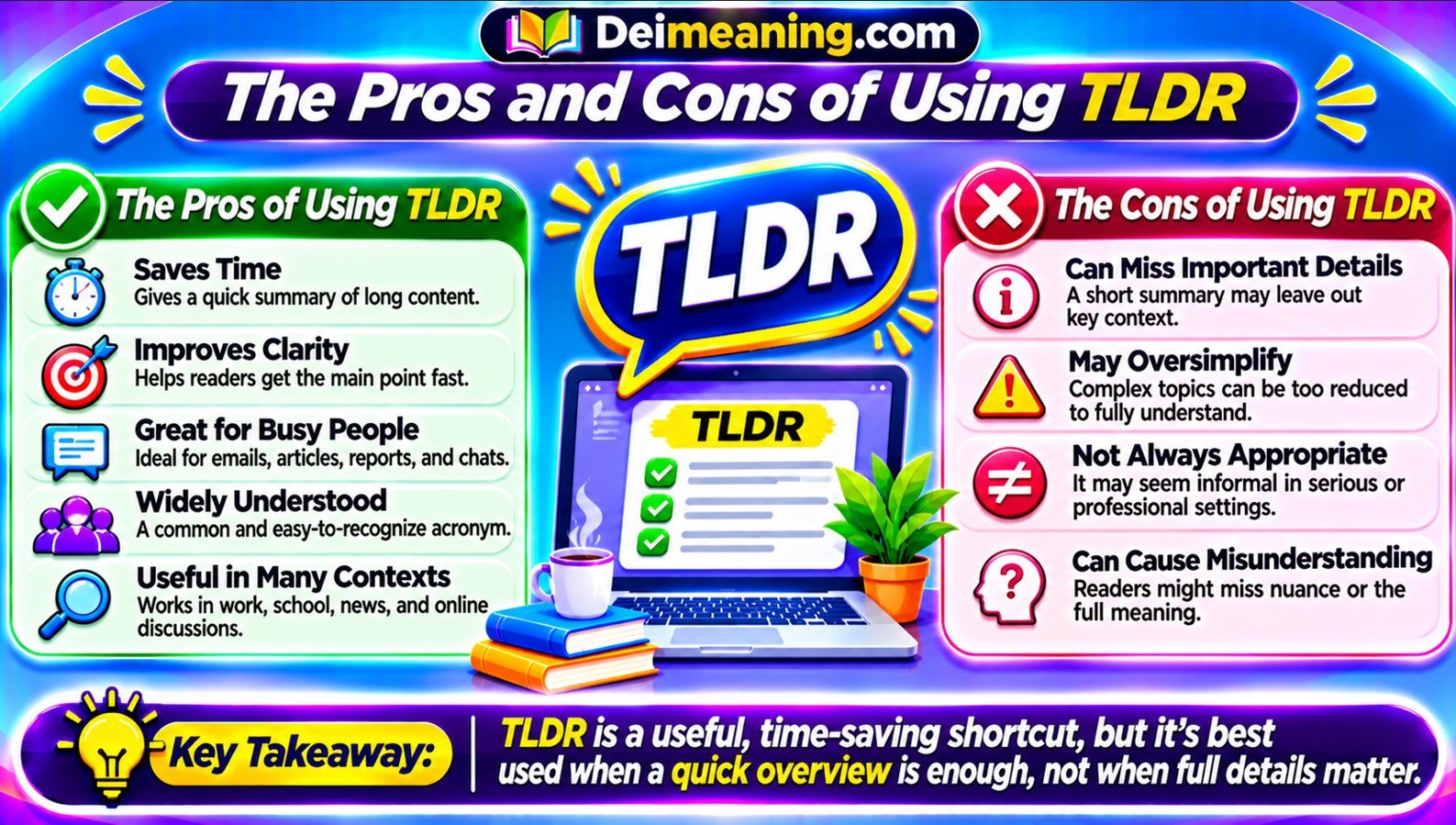
Should you use TLDR in every message you send? Not necessarily. While understanding the tldr meaning is helpful, applying it correctly requires situational awareness.
Pros of Using TLDR
- Saves Massive Amounts of Time: Readers can grasp your core concept in three seconds instead of three minutes.
- Forces Clear Writing: Creating a summary forces the writer to identify their most important point.
- Increases Accessibility: Mobile users reading on tiny screens appreciate getting the main point without endless scrolling.
- Reduces Miscommunication: By clearly stating the bottom line, you leave less room for misinterpretation.
Cons of Using TLDR
- Can Appear Unprofessional: In highly traditional industries (law, banking), the casual tldr meaning might come across as flippant.
- Encourages Skimming: If you put a summary at the top, readers might skip the nuanced details in the body of your text.
- Can Be Used Rudely: Replying “TLDR” to someone’s heartfelt or serious message is highly dismissive and aggressive.
Real-World Examples of TLDR
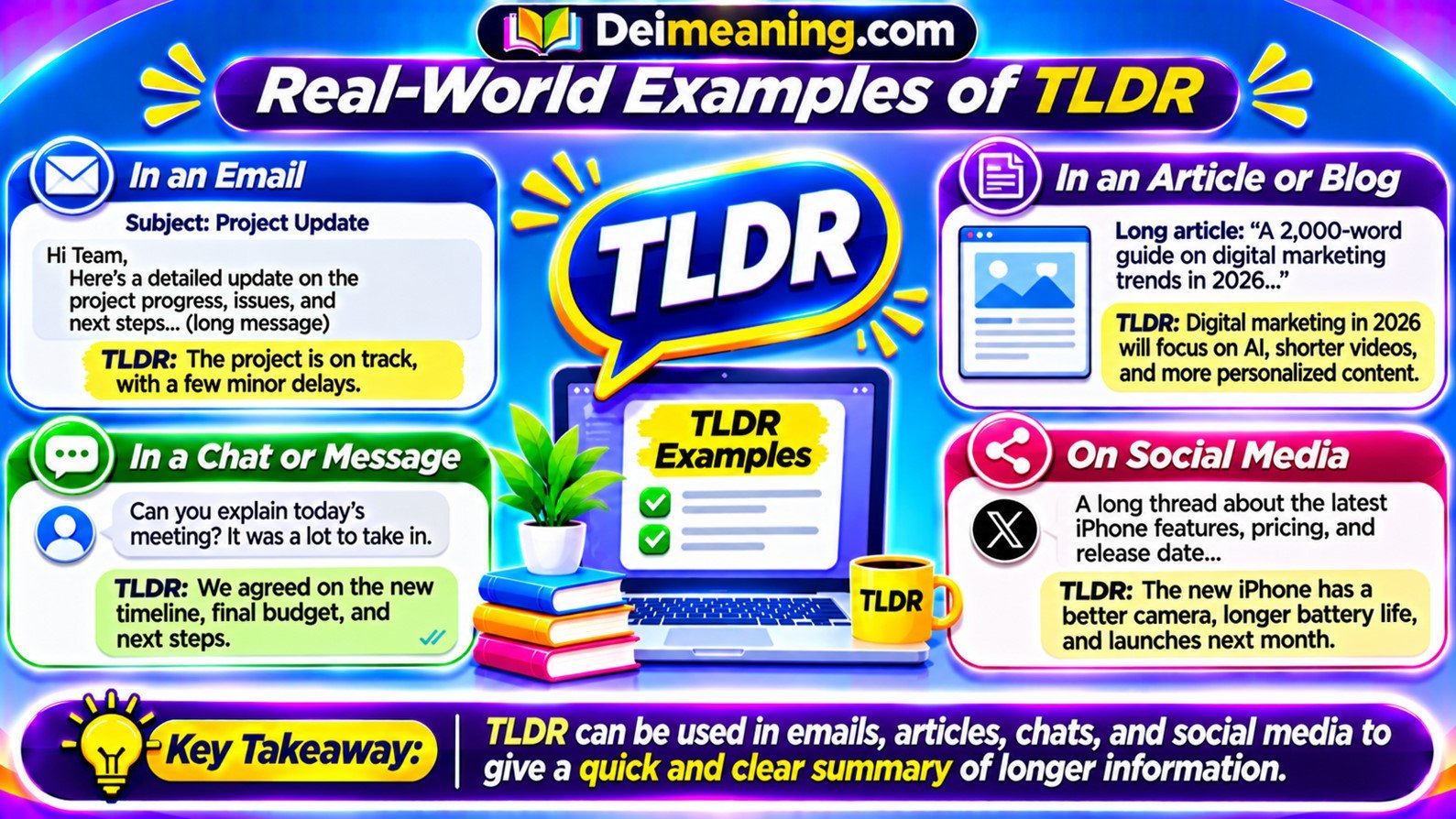
To truly master the tldr meaning, let’s look at a few practical examples of how it is used in the wild.
Example 1: The Corporate Email
Subject: Q3 Marketing Budget Revisions
TLDR: We are cutting the Facebook ad budget by 15% and reallocating those funds to TikTok influencer campaigns starting next Monday.
Full Message:
Hi Team,
After reviewing our performance metrics for the first half of the quarter, it is clear that our cost-per-acquisition on Facebook has skyrocketed. Meanwhile, our organic experiments on TikTok are yielding high engagement… (continues for three paragraphs).
Example 2: The Reddit Post
(A user posts a massive, 1,000-word story about a disastrous date involving a lost dog, a flat tire, and a spilled cup of coffee).
TLDR at the bottom: My date’s dog ran away, I got a flat tire chasing it, and I ruined my favorite shirt, but we are going out again next week.
Example 3: The Dismissive Reply
User 1: (Posts a massive, unformatted 500-word rant about why a specific video game is fundamentally flawed).
User 2: TL;DR. Use paragraph breaks next time.
Read More: Nonchalant Meaning
Frequently Asked Questions (FAQ)
Here are the most common questions people ask when researching the tldr meaning.
1. Is it rude to say TLDR?
It depends entirely on how you use it. If you provide a TLDR for your own writing, it is incredibly polite and helpful. If you reply “TLDR” to someone else’s writing, it is considered rude and dismissive, as you are openly telling them you ignored their thoughts.
2. Where should I put the TLDR: at the top or the bottom?
Originally, internet culture placed the TLDR at the bottom of a post as a reward for scrolling. Today, business and email etiquette dictate placing it at the very top so the reader sees the summary immediately.
3. What does BLUF mean compared to TLDR?
BLUF stands for “Bottom Line Up Front.” It is a military communications framework. The core difference is tone. BLUF is highly professional and formal, whereas the tldr meaning stems from internet slang.
4. Can I use TLDR in an academic paper?
No. You should avoid using internet acronyms in academic, legal, or highly formal writing. Instead of a TLDR, use an Abstract or an Executive Summary.
5. What is the opposite of TLDR?
While rare, the acronym TS;WM (Too Short; Want More) is sometimes considered the opposite. Another adjacent acronym is WOT (Wall of Text), which describes the very thing a TLDR tries to prevent.
6. Do I need to use the semicolon in TL;DR?
No. While the original spelling included the semicolon to separate the phrases, standardizing it as simply “TLDR” is completely acceptable and heavily preferred in modern typing.
7. How long should a TLDR be?
A good summary should be punchy. Keep it between one and three sentences. If your TLDR requires its own paragraph breaks, it is no longer a summary—it is just another long text.
8. Is TLDR capitalized?
Generally, yes. Because it is an acronym, standard grammar rules suggest capitalizing all four letters (TLDR). However, in casual texting, you will often see it fully lowercased (tldr).
Conclusion
The evolution of the tldr meaning is a fascinating case study in how internet culture shapes the way we communicate. What began as a snarky forum insult twenty years ago is now an essential tool for effective corporate communication, content creation, and everyday messaging.
Remember, in an era where digital distractions are everywhere and attention spans are shrinking, getting straight to the point is a superpower. Providing a quick summary shows that you respect your reader’s time.
So, here is our final TLDR for this article: The tldr meaning is “Too Long; Didn’t Read.” Use it as a brief summary at the top of emails or articles to give your readers the bottom line instantly, but avoid using it as a reply to others unless you intend to be sarcastic.
By mastering the art of the summary, you will ensure your messages are always read, understood, and appreciated.