DEI Meaning in Politics: What Diversity, Equity, and Inclusion Really Mean Today
Turn on any cable news network, scroll through social media, or listen to a stump speech on the campaign trail, and you will hear three letters repeated constantly: DEI.
For decades, the phrase belonged quietly to human resources departments and university admissions offices. Today, understanding the DEI meaning in politics is essential for anyone trying to make sense of modern American elections, Supreme Court rulings, and corporate boardroom battles.
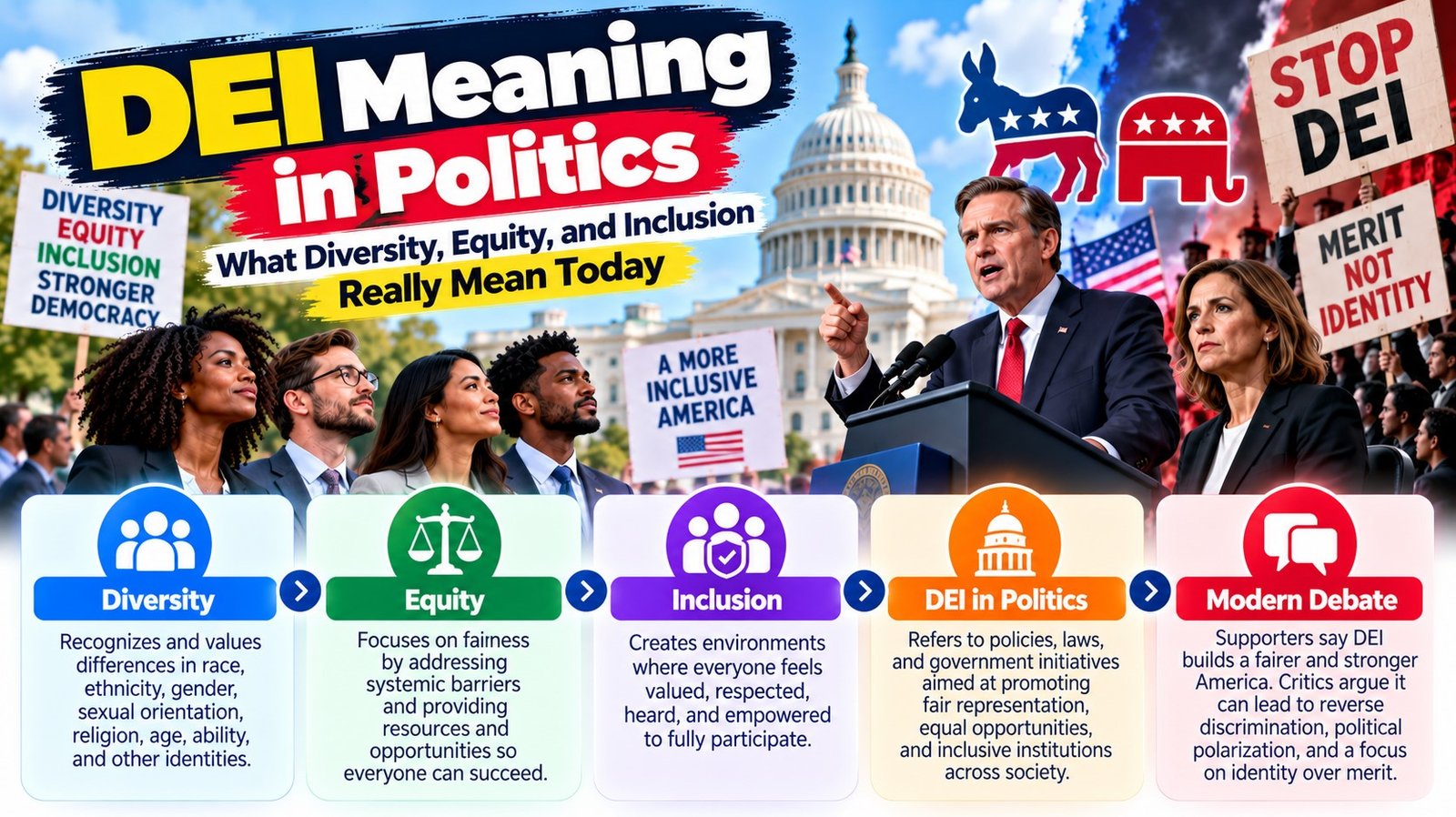
In the political arena, DEI stands for Diversity, Equity, and Inclusion. However, those three words carry vastly different definitions depending on which side of the political aisle holds the microphone. To supporters, DEI represents a necessary framework to fix historical unfairness and make sure every American gets a fair shot. To critics, it represents a system of reverse discrimination that puts group identity ahead of individual merit.
This guide breaks down the origins of DEI, how it transformed from a workplace training tool into a massive political battleground, the laws reshaping its future, and how both major political parties use it to rally voters.
What Does DEI Stand For? Breaking Down the Core Pillars
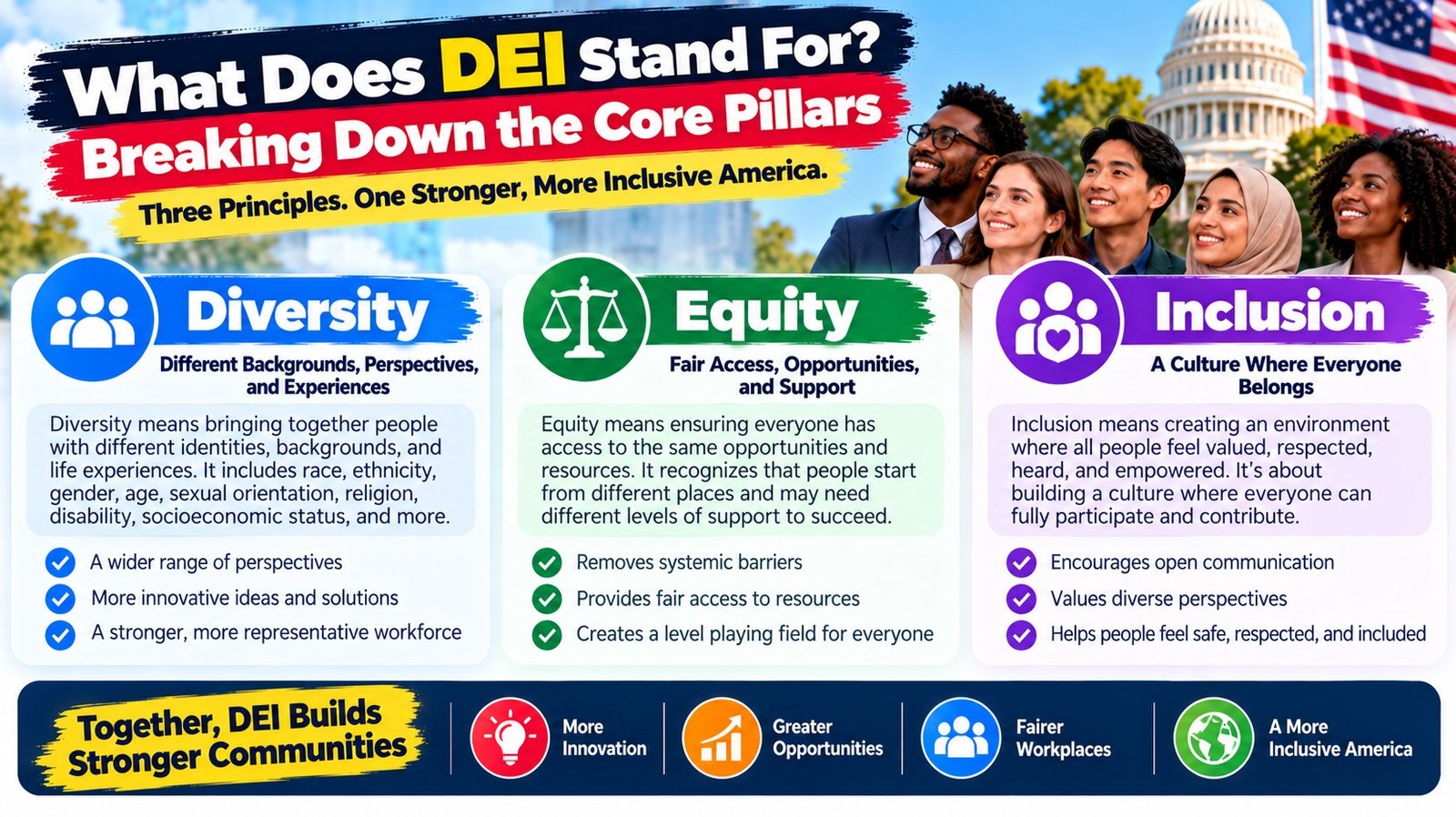
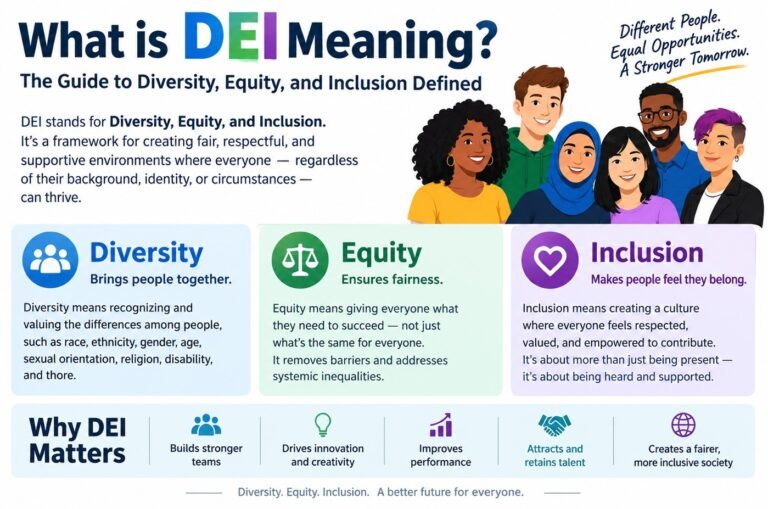
To grasp why politicians argue over this acronym, you first need to understand what the three words mean in policy terms. While people often lump them together as a single buzzword, each letter represents a distinct step in how organizations and governments manage people.
Learn More: Body Count Meaning
1. Diversity (The “Who”)
Diversity refers to the physical and social makeup of a group, workplace, school, or government body. It measures the presence of differences within a given setting. In American politics and law, diversity encompasses several categories:
- Race and ethnicity
- Gender and gender identity
- Sexual orientation
- Age and generation
- Socioeconomic status (income and class)
- Physical and mental ability
- Military veteran status
- Religious beliefs and political viewpoints
In short, diversity asks: Who is in the room?
2. Equity (The “How”)
Equity is the most debated letter in the acronym. Many people confuse equity with equality, though they operate differently in public policy.
- Equality means giving every single person the exact same resources and opportunities, regardless of where they start.
- Equity recognizes that people do not all start from the same place. It means adjusting resources and removing specific barriers so that everyone has a fair chance to succeed.
For example, an equality policy gives every school district the exact same funding per student. An equity policy gives extra funding to low-income or rural school districts that lack basic computers or experienced teachers. In politics, this distinction sparks fierce debates over whether the government should guarantee equal opportunities or engineer equal outcomes.
3. Inclusion (The “Experience”)
Inclusion measures how well different people are integrated into an environment once they arrive. An organization can hire a diverse workforce on paper, yet still fail at inclusion if certain groups are left out of key meetings, passed over for promotions, or made to feel unwelcome.
Inclusion asks: Now that everyone is in the room, does everyone have a voice at the table?
How DEI Entered the Political Arena: A Brief History
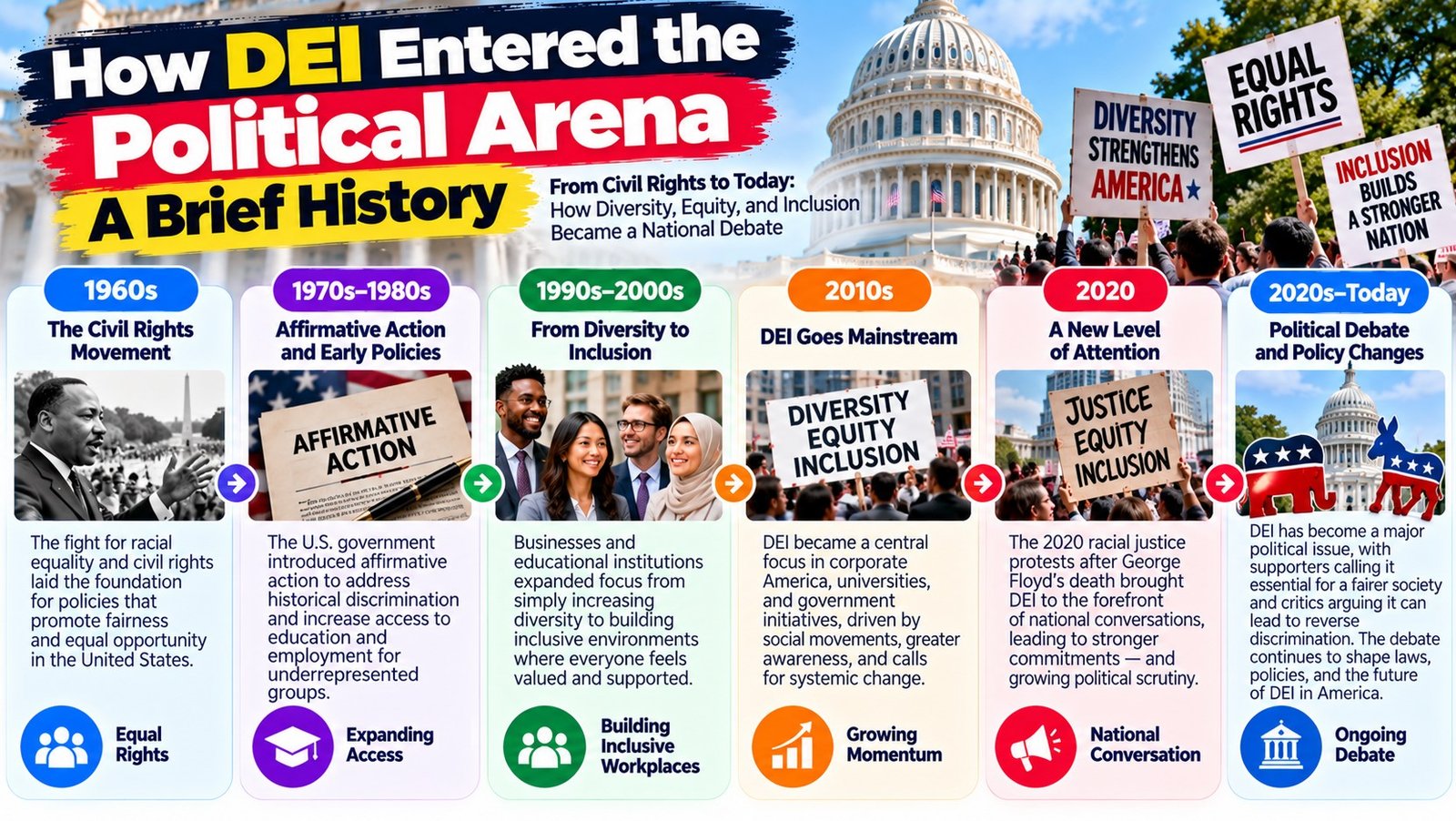
DEI Meaning in Politics did not appear overnight. Its roots stretch back sixty years to the height of the Civil Rights Movement, evolving through four major eras of American law and culture.
The 1960s: Civil Rights and Affirmative Action
The legal foundation for modern diversity programs began with the Civil Rights Act of 1964, signed by President Lyndon B. Johnson. Specifically, Title VII of the act outlawed employment discrimination based on race, color, religion, sex, or national origin.
A year later, Johnson issued Executive Order 11246. This order required government contractors to take “affirmative action” to ensure they hired and treated workers fairly without regard to race or national origin. In its earliest form, this meant casting a wider net for job applicants and removing obvious legal barriers.
The 1970s to 1990s: Corporate Multiculturalism
As women and minorities entered the corporate workforce in larger numbers, companies noticed high turnover rates among these new hires. Furthermore, a 1978 Supreme Court case (Regents of the University of California v. Bakke) ruled that while strict racial quotas in college admissions were unconstitutional, schools could still consider race as one factor among many to build a “diverse student body.”
During the 1980s and 1990s, private consultants began offering diversity training to Fortune 500 companies and federal agencies. The focus shifted from simply obeying anti-discrimination laws to celebrating “multiculturalism” and preventing workplace harassment lawsuits.
The 2010s: The Rise of Modern DEI
By the 2010s, the language shifted again. Academic researchers and human resources leaders argued that diversity alone wasn’t changing who held power at the top of companies and government agencies. They added Inclusion and Equity to the framework. Chief Diversity Officers (CDOs) became standard executive positions in major corporations, universities, and federal departments.
2020 to Present: The Political Explosion
Two major events turned DEI Meaning in Politics into a household political term:
- The Summer of 2020: Following the murder of George Floyd, millions of Americans marched against systemic racism. Corporations pledged billions of dollars to racial equity initiatives, universities instituted mandatory anti-racism courses, and the Biden administration signed Executive Order 13985, embedding equity goals across the entire federal government.
- The Conservative Backlash (2021–2026): Conservative lawmakers, think tanks, and media figures began scrutinizing these new programs. Having successfully campaigned against Critical Race Theory (CRT) in public K-12 schools, conservative strategists broadened their focus to DEI in universities, corporations, and the military. By the 2024 and 2026 election cycles, DEI had become a central dividing line in American politics.
Why Is DEI So Controversial in American Politics?
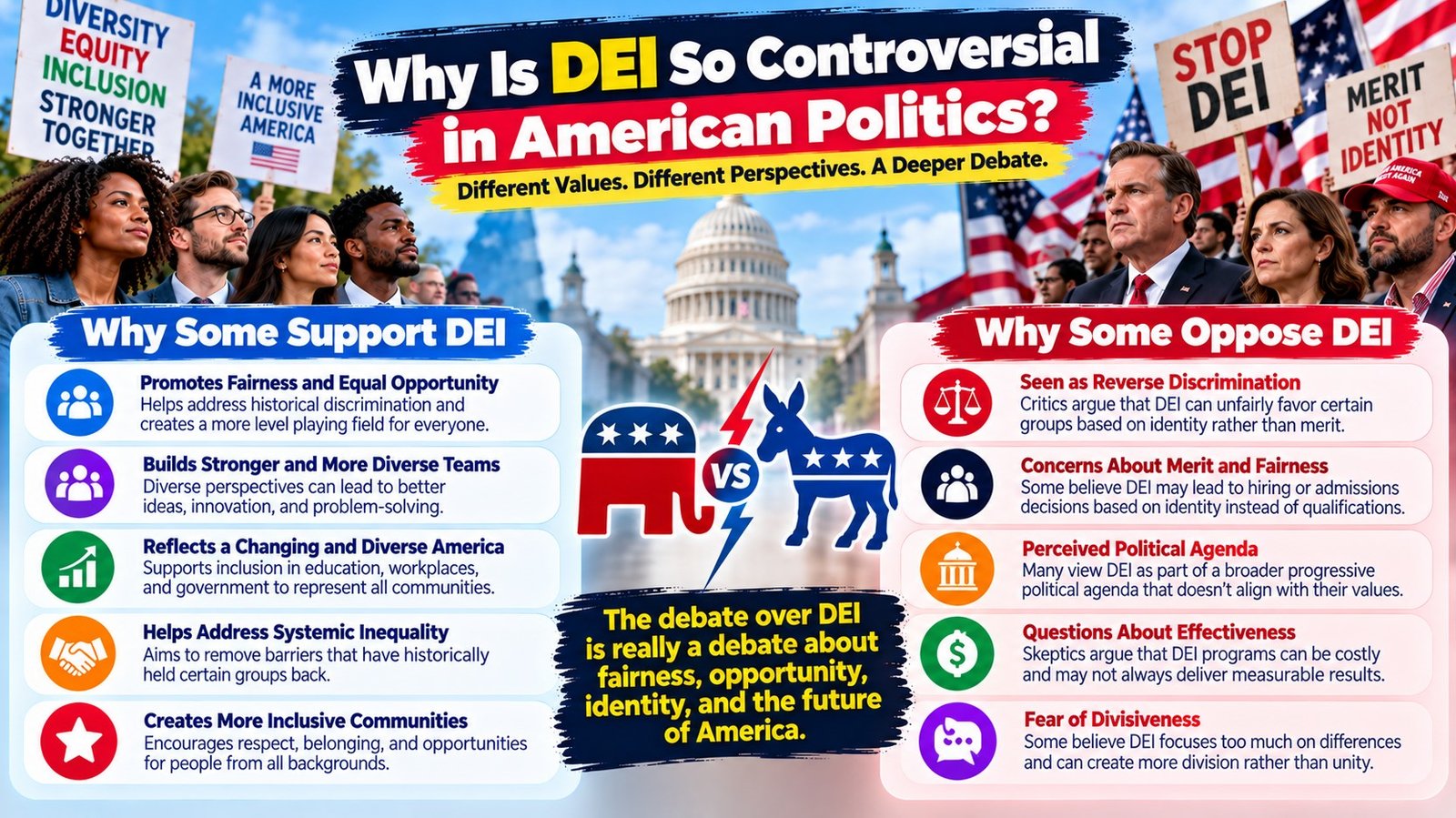
At the heart of the DEI debate is a fundamental disagreement about how American society works—and whether systemic racism and sexism still hold people back today.
The Debate Over Meritocracy
Critics argue that America should operate as a pure meritocracy—a system where people advance strictly based on their individual skills, test scores, work ethic, and achievements. From this viewpoint, factoring race, gender, or identity into hiring, promotions, or school admissions undermines merit and lowers standards.
Supporters counter that pure meritocracy is currently a myth because the playing field has never been level. They point out that centuries of legal segregation, redlining (denying mortgages to minority neighborhoods), and unequal school funding created massive wealth and opportunity gaps. Moreover, they point to long-standing practices like legacy admissions (giving preference to children of wealthy alumni) and nepotism as proof that institutions have never relied on merit alone.
The Question of “Reverse Discrimination”
Opponents of political DEI Meaning in Politics policies often cite Dr. Martin Luther King Jr.’s famous call to judge people by “the content of their character, not the color of their skin.” They argue that modern equity programs divide Americans into fixed categories of “oppressors” and “oppressed,” resulting in reverse discrimination against white and Asian American applicants.
Defenders of DEI respond that ignoring race entirely—often called colorblindness—simply freezes existing inequalities in place. As Supreme Court Justice Ketanji Brown Jackson wrote in 2023, “Deeming race irrelevant in law does not make it irrelevant in life.”
Speech, Training, and Ideological Conformity
Another flashpoint involves mandatory workplace trainings and university diversity statements. In several public universities, job applicants for professor roles were required to write essays detailing their personal commitment to DEI before their academic research was even reviewed. Critics labeled these requirements political loyalty oaths that punish conservative or independent thinkers.
Click Here: What is DEI Meaning?
The Left vs. Right Perspective on DEI
In modern campaign rhetoric, Democrats and Republicans use the term DEI in completely different ways.
| Issue Area | The Progressive / Democratic View | The Conservative / Republican View |
| Core Definition | Diversity, Equity, and Inclusion—a tool to ensure fair representation and remove systemic barriers. | “Division, Exclusion, and Indoctrination”—a political ideology that enforces group quotas over individual talent. |
| View on Systemic Bias | Historical and institutional biases still affect hiring, healthcare, policing, and education today. | Legal discrimination ended in the 1960s; modern disparities stem from individual choices, family structure, or class, not systemic racism. |
| Role of Government | Federal and state agencies should actively audit programs for equity and fund underserved communities. | Government should be strictly colorblind, enforcing existing anti-discrimination laws without favoring any demographic group. |
| Corporate Policies | Companies perform better when boards and workforces reflect the diverse public they serve. | Companies should focus strictly on profits and shareholder value, staying out of social engineering (“woke capitalism”). |
| Education | Universities need diverse classrooms and inclusive curricula to prepare students for a global economy. | Universities should focus on core academic subjects, free inquiry, and standardized test scores rather than identity politics. |
DEI vs. Affirmative Action vs. Equal Opportunity
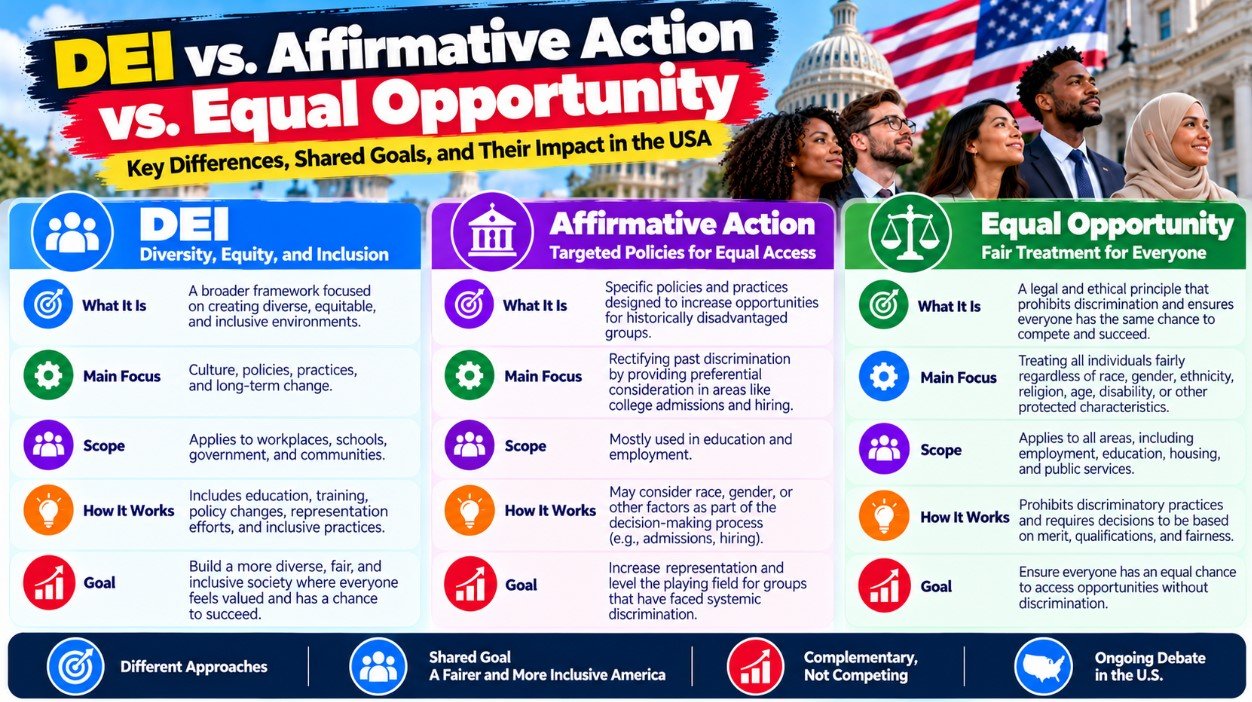
Because politicians and commentators frequently mix up these terms on television, voters often assume they mean the same thing. In legal and policy terms, they are very different.
+——————————————————————-+
| 1. EQUAL EMPLOYMENT OPPORTUNITY (EEO) |
| The Legal Baseline: “Do not discriminate.” |
| Enforced by the EEOC. Applies to almost all US employers. |
+——————————————————————-+
|
v
+——————————————————————-+
| 2. AFFIRMATIVE ACTION |
| The Targeted Remedy: “Take proactive steps to include.” |
| Historically used in college admissions (now restricted) |
| and federal contracting compliance. |
+——————————————————————-+
|
v
+——————————————————————-+
| 3. DIVERSITY, EQUITY, AND INCLUSION (DEI) |
| The Cultural & Organizational Framework: |
| Broad internal policies—mentorship, recruiting outreach, |
| employee resource groups, and workplace culture initiatives. |
+——————————————————————-+
Equal Employment Opportunity (EEO)
EEO is the law of the land. Enforced by the federal Equal Employment Opportunity Commission (EEOC), these laws make it illegal to fire, refuse to hire, or harass someone because of their race, sex, religion, age, or disability. EEO is preventative—it sets the legal floor for what employers cannot do.
Affirmative Action
Affirmative Action refers to specific legal mandates or admissions policies designed to remedy past discrimination. In higher education, this meant considering race as a “plus factor” in admissions—a practice the Supreme Court struck down in 2023. In federal contracting, it refers to tracking applicant demographics to ensure qualified minorities, women, and veterans are in the hiring pool.
DEI
DEI is a broad organizational strategy rather than a single law. It includes things like recruiting at Historically Black Colleges and Universities (HBCUs), creating Employee Resource Groups (ERGs) for working mothers or veterans, offering unconscious bias training, and making sure buildings and websites are accessible to people with disabilities.
How the Supreme Court Reshaped the DEI Landscape
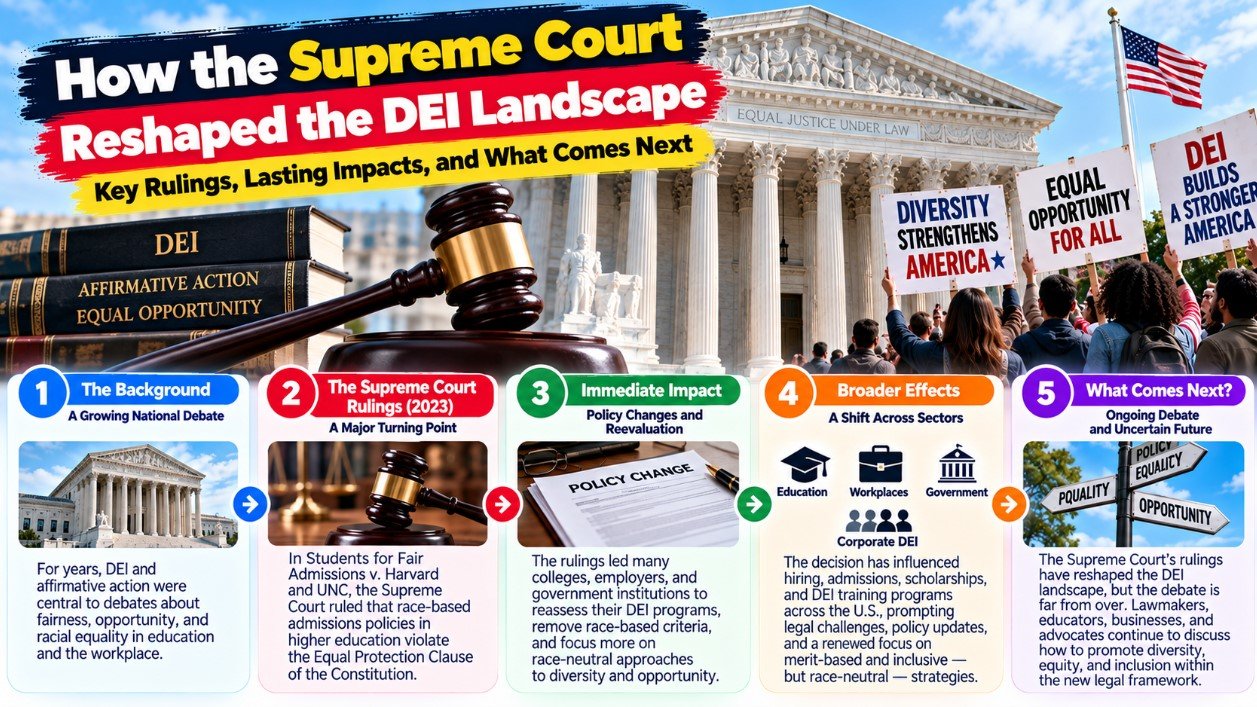
The political debate over DEI Meaning in Politics moved rapidly from cable news into federal courtrooms, resulting in landmark decisions that changed American law.
1. Students for Fair Admissions v. Harvard and UNC (2023)
In June 2023, the U.S. Supreme Court issued a historic 6–3 ruling that effectively ended race-conscious affirmative action in college admissions. The Court ruled that Harvard and the University of North Carolina violated the Equal Protection Clause of the 14th Amendment by using race as a factor in deciding which students to admit.
While the ruling only applied directly to colleges and universities, its political shockwaves hit corporate America and government agencies immediately. Conservative legal groups used the ruling’s logic to challenge corporate diversity fellowships, minority-owned business grants, and government contracting programs.
2. Muldrow v. City of St. Louis (2024)
In April 2024, a unanimous Supreme Court ruled that a police sergeant who was transferred to a less prestigious job because she was a woman did not have to prove the transfer caused “significant” economic harm—only that it caused some harm under Title VII.
Legal scholars immediately noted that this lowers the bar for employees suing over workplace policies. If a company uses a DEI program that sidelines, transfers, or denies a training opportunity to an employee based on race or sex, that employee now has an easier path to winning a Title VII discrimination lawsuit.
3. Challenges to Targeted Grants (The Fearless Fund Case)
In 2024, a federal appeals court blocked the Fearless Fund, an Atlanta-based venture capital firm, from running a grant contest open exclusively to Black female entrepreneurs. The court ruled that the contest likely violated Section 1981 of the Civil Rights Act of 1866, a post-Civil War law that prohibits racial discrimination in making and enforcing contracts. Following the ruling, the fund permanently shut down the grant program, prompting dozens of major corporations to rewrite their own minority grant and fellowship rules to open them to applicants of all backgrounds.
State-Level Battles: Red States vs. Blue States
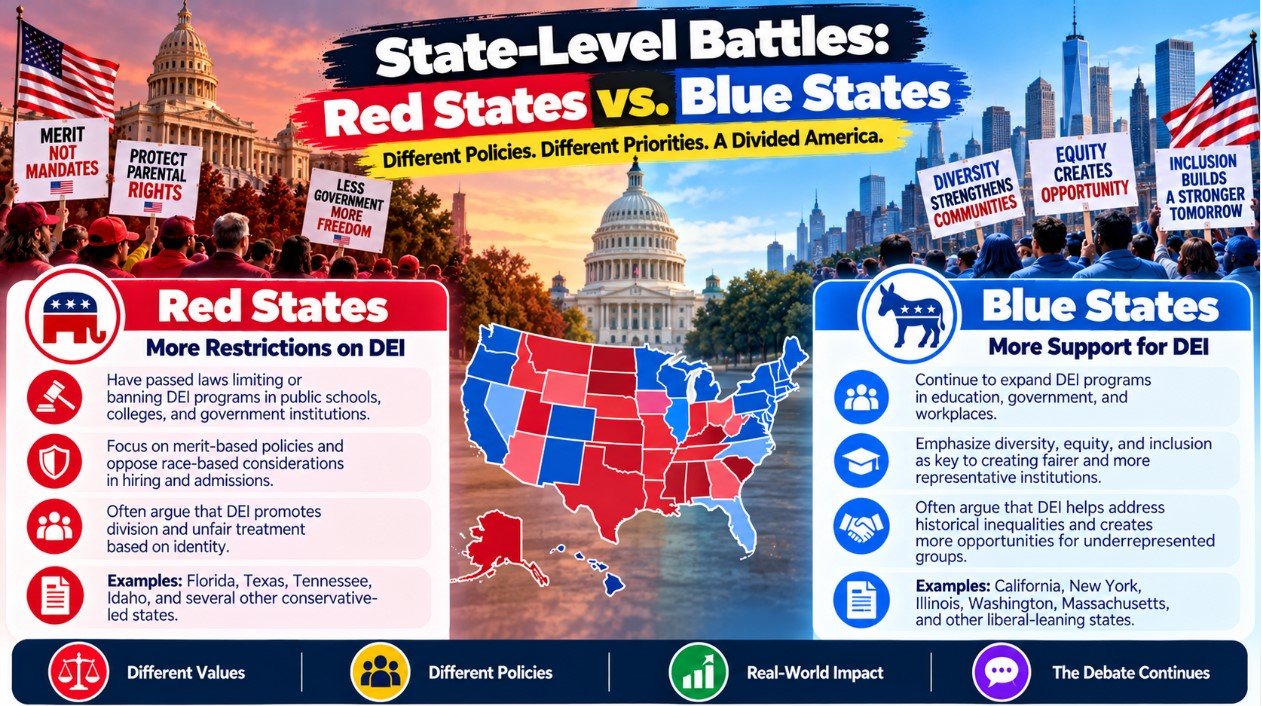
How DEI affects your daily life depends heavily on which state you live in. Across the United States, state legislatures have moved in opposite directions.
The Red State Crackdown
Led by governors like Ron DeSantis in Florida and Greg Abbott in Texas, more than a dozen Republican-led states have passed laws banning or defunding DEI Meaning in Politics offices in public universities and state agencies.
- Texas (Senate Bill 17): Signed into law to take effect in 2024, this bill forced all public universities in Texas to shut down their DEI offices, ban mandatory diversity training for students and staff, and stop asking job applicants for diversity statements.
- Florida (Senate Bill 266): Blocked state colleges from spending state or federal funds on DEI programs, leading the University of Florida to eliminate all DEI positions and redirect the money toward faculty recruitment.
- Utah, Alabama, Iowa, and North Carolina: Passed sweeping legislation dismantling university DEI bureaucracies, replacing them with generalized “student success” centers available to all students regardless of background, and requiring campuses to maintain “institutional neutrality” on controversial political topics.
The Blue State Defense
Conversely, Democratic-led states such as California, New York, Illinois, and Washington have doubled down on DEI initiatives.
- Public Education: Several blue states have added ethnic studies requirements to high school graduation standards and expanded funding for campus diversity offices.
- Pay Transparency and Board Diversity: While California’s earlier laws mandating racial and gender quotas on corporate boards were struck down by courts, Democratic legislatures continue passing strict pay-data reporting laws. These laws require companies to publicly disclose what they pay workers broken down by race and gender to expose wage gaps.
- State Contracting: Blue states actively maintain procurement goals that direct a percentage of state infrastructure and service contracts to minority-, women-, and veteran-owned businesses.
Click Now: Pookie Meaning
The Corporate Shift: From DEI to MEI and Belonging
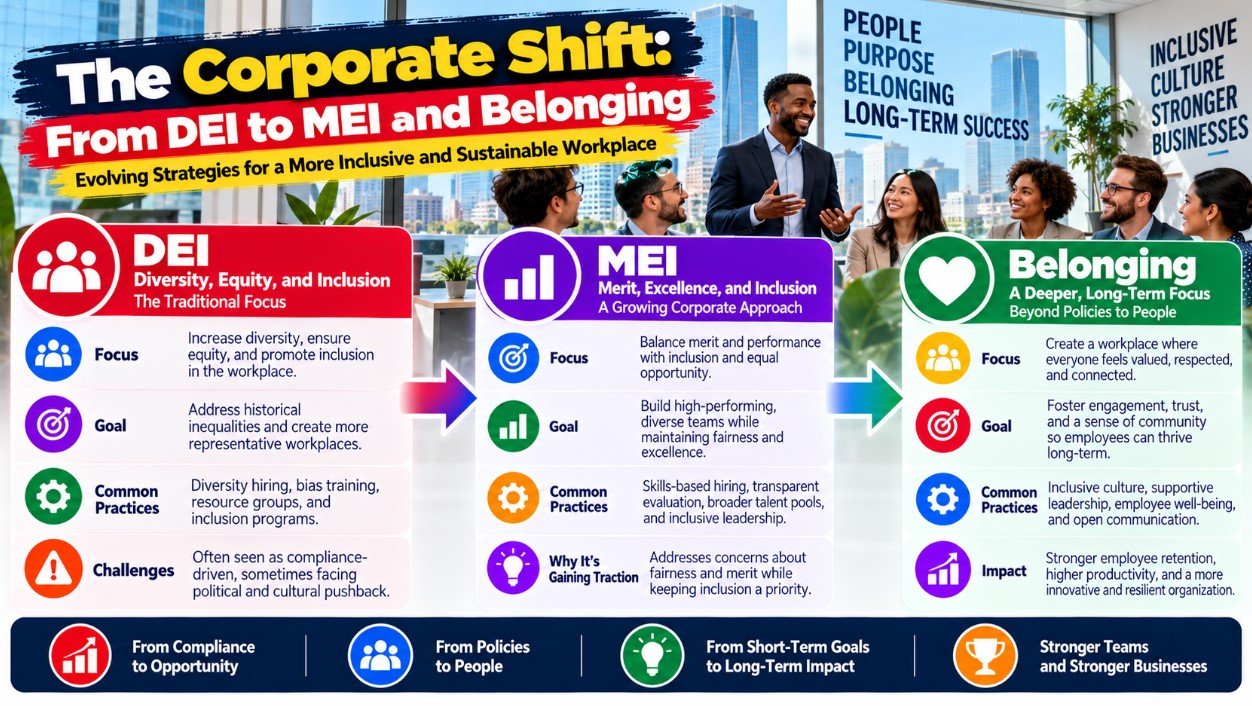
Caught between progressive employees, conservative boycotts, activist shareholders, and shifting federal rules, American corporations have quietly overhauled how they talk about and practice DEI.
Starting in 2024 and accelerating through 2025 and 2026, major household names—including Tractor Supply, John Deere, Harley-Davidson, Lowe’s, Ford, Molson Coors, Boeing, Walmart, and Meta—scaled back or restructured their public DEI Meaning in Politics commitments.
THE CORPORATE SHIFT IN REAL TIME:
[Traditional DEI]
- Public demographic hiring targets
- Mandatory unconscious bias training
- Participation in external activist scoring indexes (e.g., HRC)
|
v
[Modern “Bridge” Frameworks: Inclusion, Belonging, or MEI]
- Focus on skills-based hiring (removing 4-year degree requirements)
- Open mentorship programs available to all employees
- Merit, Excellence, and Intelligence (MEI) standards
What Companies Are Changing
- Dropping the Acronym: Many human resources departments have retired the “DEI” label altogether because of its political baggage. Instead, they use terms like “Inclusion and Belonging,” “Talent Engagement,” or “Workplace Culture.”
- Adopting MEI (Merit, Excellence, and Intelligence): Popularized by tech executives and venture capitalists in Silicon Valley, MEI has emerged as a competing framework. Companies adopting MEI pledge to hire and promote strictly based on measurable output and test performance, removing demographic targets altogether.
- Skills-Based Hiring: One area where both political parties actually agree is skills-based hiring. Both state governments (under Republican and Democratic governors alike) and major corporations have dropped four-year college degree requirements for thousands of jobs. This opens doors for working-class Americans of all races without using racial preferences, satisfying both equity goals and meritocracy principles.
Pros and Cons of DEI Policies in Public Life
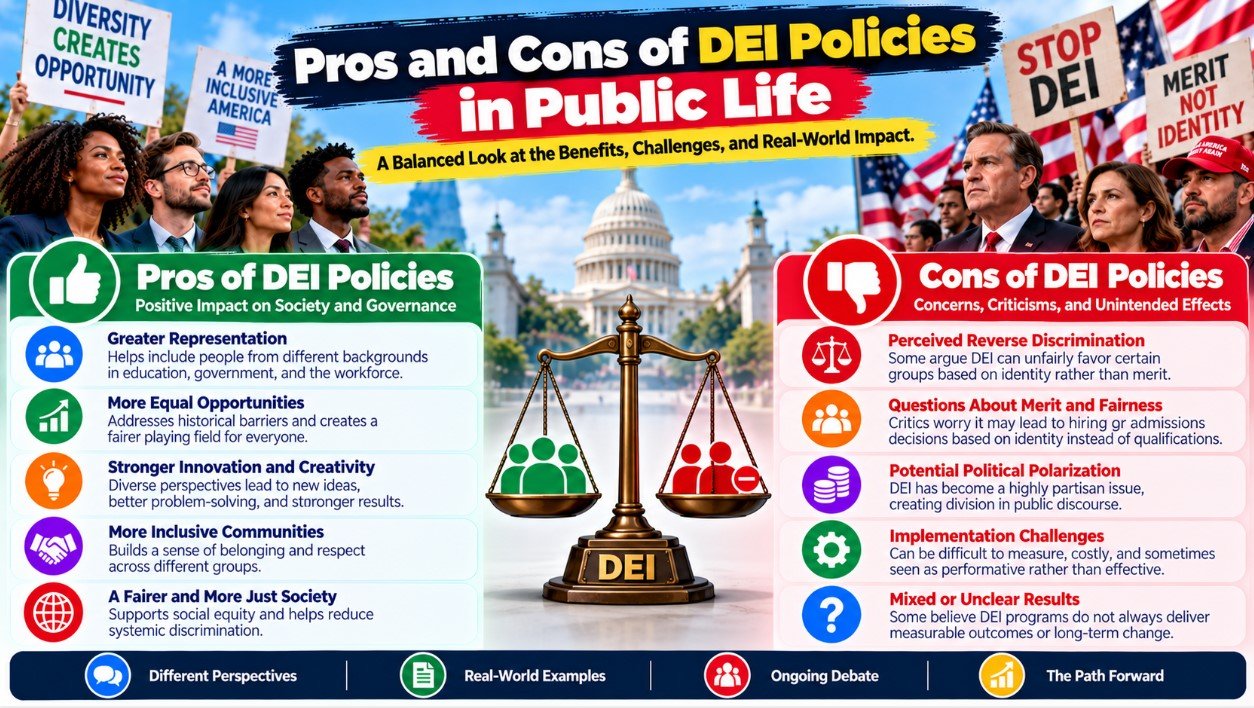
To understand why voters are split down the middle in public opinion polls, it helps to look at the strongest arguments on both sides of the issue.
The Pros (Arguments in Favor of DEI)
- Wider Talent Pools: By recruiting at community colleges, HBCUs, and veteran groups rather than the same handful of elite schools, organizations discover talented workers they used to overlook.
- Better Decision-Making in Government and Business: Studies by management firms like McKinsey & Company have long argued that teams with diverse backgrounds and life experiences spot blind spots faster than groups where everyone thinks and looks alike.
- Accessibility for Disabled and Neurodivergent Americans: DEI isn’t just about race and gender. DEI offices pushed for remote work options, wheelchair ramps, closed captioning, and sensory-friendly workspaces that help millions of disabled Americans hold steady jobs.
- Support for Military Veterans and Working Parents: Under the DEI umbrella, companies created paid parental leave policies, nursing rooms for mothers, and transition programs helping military veterans translate combat skills into civilian careers.
The Cons (Arguments Against DEI)
- Divisive Workplace Culture: Research by sociologists like Frank Dobbin (Harvard) and Alexandra Kalev (Tel Aviv University) found that mandatory diversity trainings often backfire. When employees feel blamed or lectured during mandatory sessions, resentment grows and workplace hostility actually increases.
- Bureaucratic Bloat and Cost: Critics point out that public universities hired hundreds of six-figure DEI administrators over the past decade while student tuition skyrocketed, diverting money away from classroom teaching and financial aid.
- The “DEI Hire” Stigma: When organizations announce explicitly that they are hiring a specific demographic for a role (such as political appointments or corporate board seats), it can unfairly stigmatize qualified minority and female professionals, making coworkers question whether they earned the job on merit.
- Legal Liability: Programs that tie executive bonuses to demographic quotas or restrict internships to specific racial groups frequently violate Title VII of the Civil Rights Act, exposing taxpayers and companies to costly lawsuits.
How DEI Impacts Everyday Voters
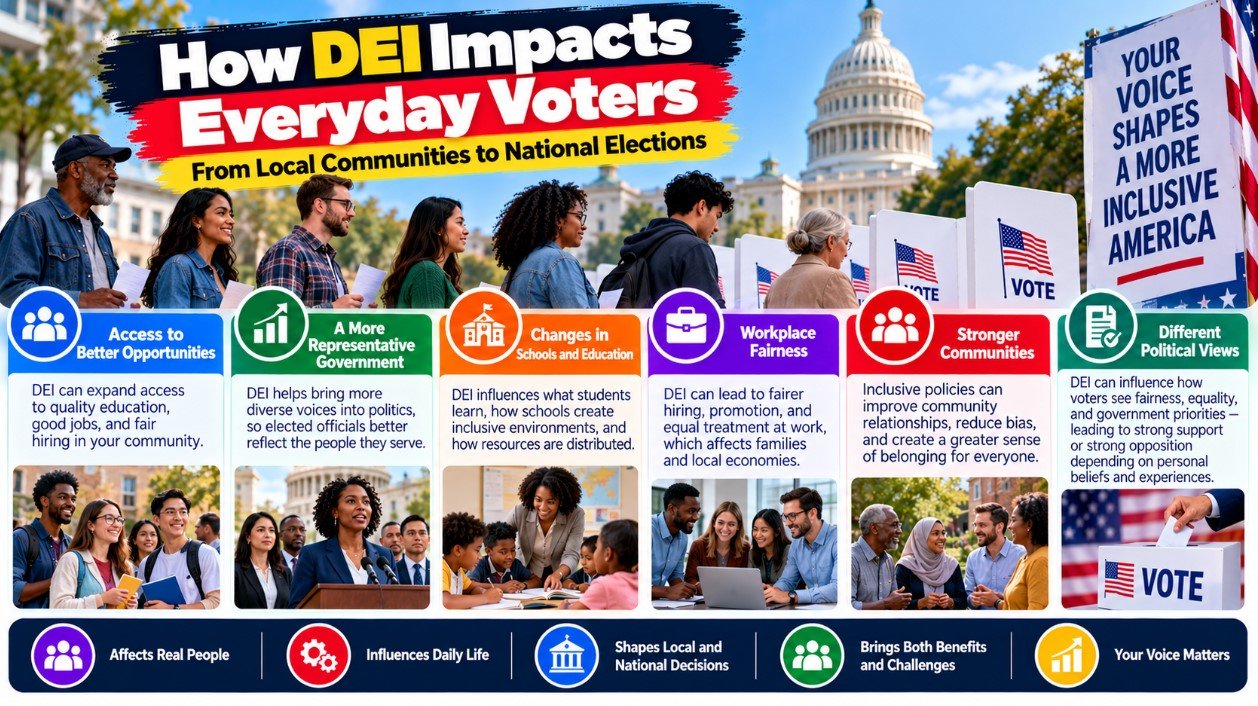
While cable news debates often feel abstract, the political fight over DEI touches daily life in four concrete ways:
- At Work: If you work for a major company or a government agency, the political climate determines whether you attend mandatory cultural training, how your performance is evaluated, and whether job postings require a college degree or focus on practical skills.
- In College Admissions: For high school students applying to selective universities, admission officers can no longer check a racial box to grant admission. However, schools still encourage students to write personal admissions essays about how their background, adversity, or heritage shaped their personal character.
- In K-12 Classrooms: Local school board elections frequently center on DEI policies. These races decide which history books are placed in school libraries, how teachers discuss race and gender in the classroom, and whether schools keep advanced placement (honors) tracks or merge classes in the name of equity.
- On the Ballot: Politicians use DEI as a cultural shorthand. When a conservative candidate promises to “end woke DEI in the military,” they are signaling a return to traditional combat readiness standards. When a progressive candidate promises to “protect DEI Meaning in Politics and equity,” they are signaling a commitment to civil rights, minority representation, and social justice funding.
Frequently Asked Questions (FAQs)
1. What does DEI mean when used as a political insult?
In conservative political slang, calling someone a “DEI hire” or calling a politician a “DEI candidate” is a derogatory way of claiming that the person only got their job because of their race, gender, or sexual orientation rather than their qualifications. Civil rights advocates criticize this phrase, noting that it is often used to dismiss the hard-earned credentials of Black, Hispanic, or female leaders automatically.
2. Is DEI a law in the United States?
No, DEI itself is not a single federal law. Rather, it is a collection of organizational policies, executive orders, and human resources practices. However, all DEI programs must operate within the boundaries of actual federal laws—primarily Title VII of the Civil Rights Act of 1964, the Americans with Disabilities Act (ADA), and the Equal Protection Clause of the U.S. Constitution.
3. What is the difference between DEI andDEIA?
DEIA adds an “A” for Accessibility at the end of Diversity, Equity, and Inclusion. Federal agencies and disability rights advocates began using DEIA to make sure that people with physical, sensory, and cognitive disabilities were explicitly included in workplace fairness plans, rather than treated as an afterthought.
4. Did the Supreme Court ban DEI in private companies?
No. The Supreme Court’s 2023 affirmative action ruling (SFFA v. Harvard) applied to college admissions, not private employers. Private companies can still run DEI programs, recruit widely, and host employee resource groups. However, private employers have always been barred under Title VII from using strict racial or gender quotas in hiring and promotions, and recent court rulings have made it easier for workers to sue if a DEI program crosses the line into discrimination.
5. What is the difference between CRT and DEI?
Critical Race Theory (CRT) is an academic and legal framework originating in the 1970s that examines how laws and legal institutions perpetuate racial inequalities, even without openly racist intent. DEI is a practical management framework used by workplaces, schools, and governments to recruit diverse teams and build inclusive cultures. Critics argue that DEI is simply CRT applied in practice, while supporters note that many DEI initiatives (like veteran hiring or disability access) have nothing to do with academic race theory.
6. Why are some companies dropping their DEI programs?
Companies are scaling back or renaming their DEI programs due to three main pressures:
- Legal risk from conservative law firms suing over targeted fellowships and hiring goals.
- Consumer boycotts organized by online activists targeting brands perceived as overly political.
- Economic cost-cutting, as businesses trim non-revenue-generating human resources roles during corporate restructuring.
7. Does DEI help white women and military veterans?
Yes. Historically and statistically, white women have been among the largest beneficiaries of workplace affirmative action and corporate DEI initiatives, particularly regarding paid family leave, flexible work hours, and leadership mentorship. Furthermore, nearly all corporate and federal DEI frameworks include dedicated hiring pipelines and resource groups for military veterans and people with disabilities.
8. What is “viewpoint diversity” in the DEI debate?
Viewpoint diversity is the idea that schools, universities, newsrooms, and workplaces should include people with different political, religious, and philosophical beliefs—not just people of different races and genders. Many moderate and conservative reformers argue that traditional DEI offices ignored viewpoint diversity, creating ideological echo chambers on college campuses.
9. How do American voters actually feel about DEI according to polls?
Public opinion polling (including recent surveys by Pew Research Center and The Washington Post/Ipsos) shows a nuanced picture. A majority of Americans—around 55% to 60%—say that having diversity and inclusion programs at work is a good thing in principle, and they strongly support broader recruiting and mentorship. At the same time, an overwhelming majority of Americans (including majorities of Black, Hispanic, Asian, and white voters) oppose using race or gender as a deciding factor in hiring, promotions, or college admissions.
The Future of the Debate
Understanding the DEI meaning in politics requires looking past three-letter slogans. At its core, the debate over Diversity, Equity, and Inclusion is the latest chapter in America’s oldest argument: how to live up to the founding promise that all people are created equal.
Over the next several years, the rigid, quota-driven, or ideological versions of DEI that sparked massive court battles and voter pushback will likely continue to fade. In their place, a more durable compromise is emerging across both government and business—one that removes artificial barriers like unnecessary degree requirements, enforces strict anti-discrimination laws equally for every citizen, and focuses on helping talented people from every zip code succeed based on what they can achieve.