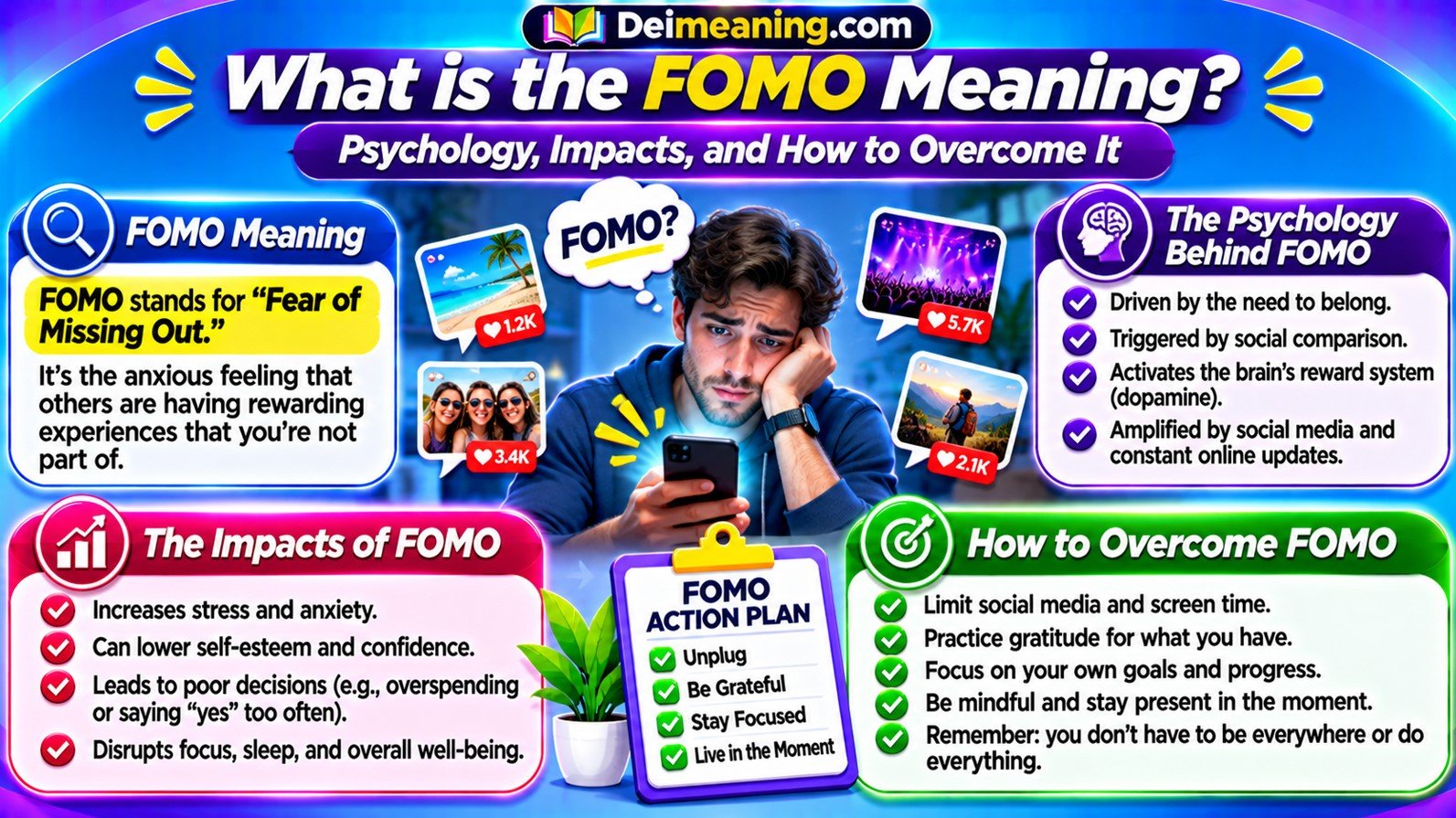
What is the FOMO Meaning? Psychology, Impacts, and How to Overcome It
If you have ever felt a sudden rush of anxiety while scrolling through social media, you are not alone. You might see friends at a party, colleagues getting promotions, or influencers traveling the world, leaving you feeling left behind. To understand what you are experiencing, we need to explore the exact fomo meaning.
At its core, the fomo meaning stands for the “Fear Of Missing Out.” It is that nagging feeling that others are having more fun, living better lives, or experiencing things that you are absent from. While the term sounds modern, the psychology behind the fomo meaning is deeply rooted in human evolution. We are social creatures who historically relied on group inclusion for survival. Today, that survival instinct translates into digital anxiety.
This comprehensive guide will dive deep into the true fomo meaning, exploring its psychological roots, how it affects your daily life, and actionable steps you can take to reclaim your peace of mind.
What is the True FOMO Meaning?
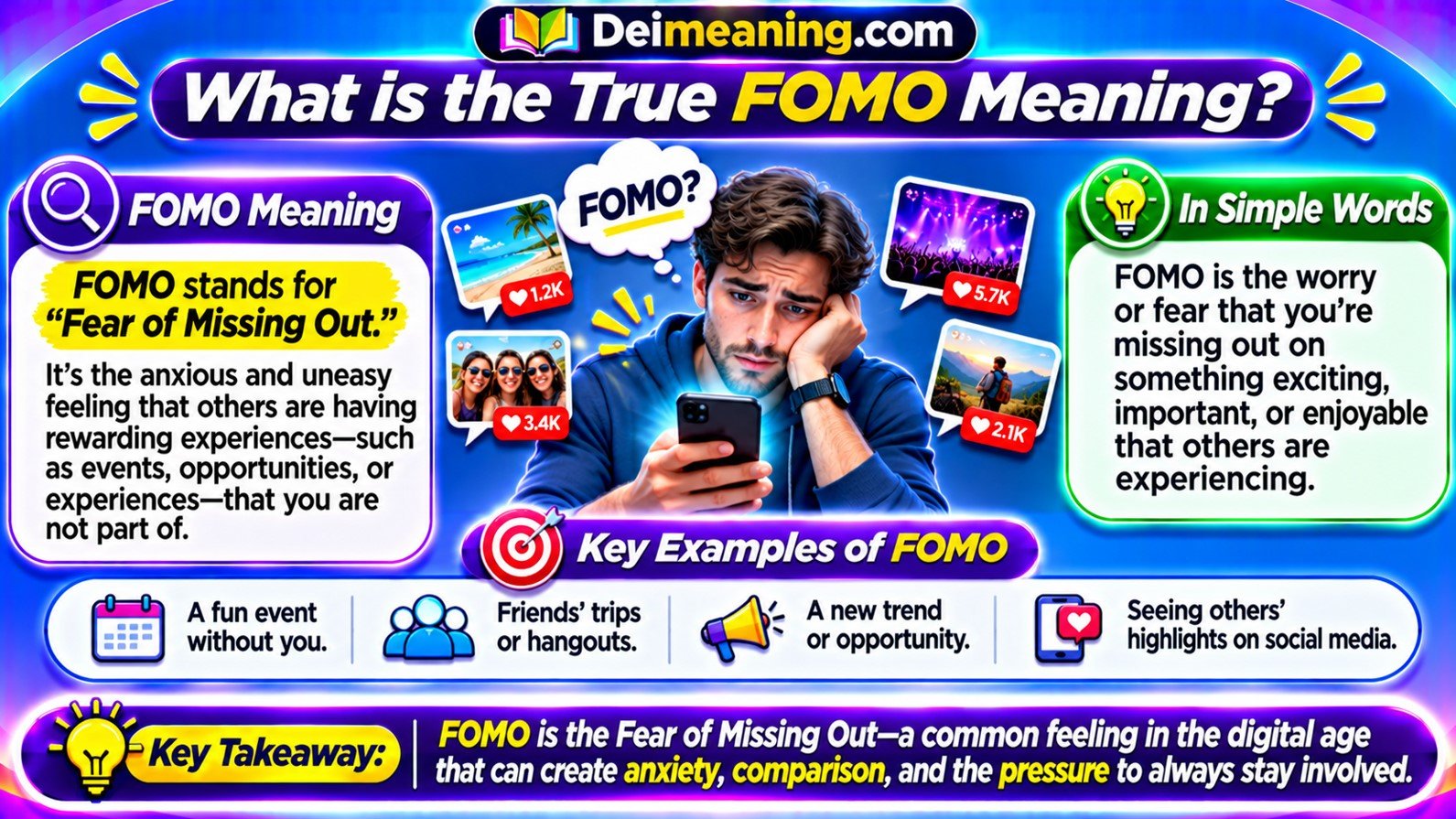
To fully grasp the fomo meaning, we have to look past the simple acronym. It is a pervasive apprehension that others might be experiencing rewarding events from which one is absent.
The Origin of the Term
The modern fomo meaning was first coined in 2004 by Patrick J. McGinnis, an author and venture capitalist. He used the term in an article for the Harvard Business School student newspaper. However, the conceptual fomo meaning has existed for centuries. Ancient philosophers and early psychologists often discussed human envy and the desire for social belonging. McGinnis simply gave this age-old feeling a catchy name that perfectly fit the internet era.
The Psychological Roots
From a clinical perspective, the psychological fomo meaning relates strongly to our need for social connection. According to self-determination theory, human beings require competence, autonomy, and psychological relatedness. When our sense of relatedness is threatened—like when we see peers bonding without us—our brain perceives it as a threat. Therefore, the fomo meaning is not just about jealousy; it is about the fundamental human fear of isolation.
Read More: DEI Meaning
The Science Behind the Fear of Missing Out
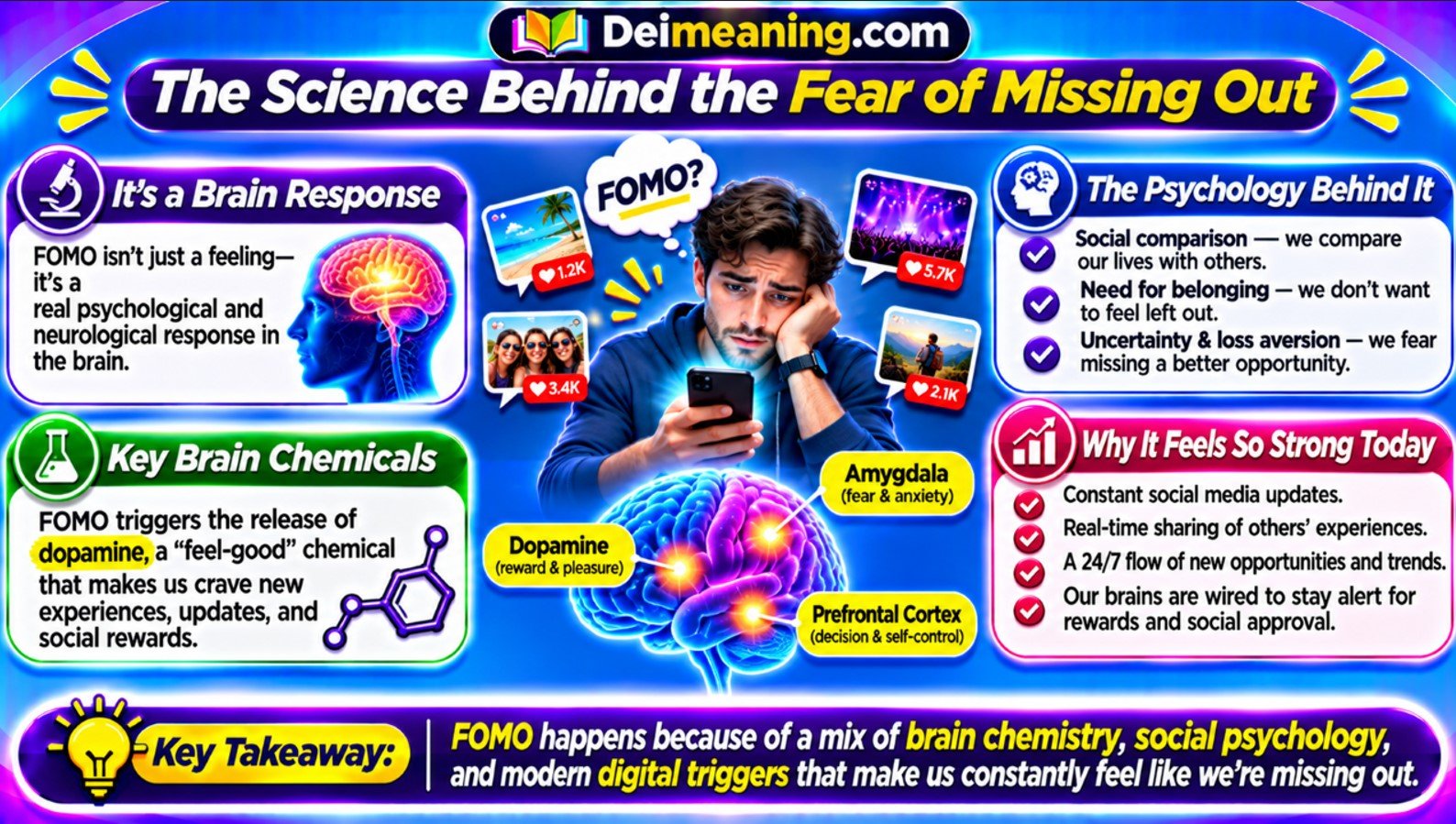
Understanding the fomo meaning requires a look into our neurobiology. What actually happens in your brain when you feel left out?
Dopamine and Reward Systems
When we experience social validation or anticipate a fun event, our brains release dopamine, a neurotransmitter linked to pleasure and reward. Scrolling through Instagram or TikTok creates a dopamine loop. When you see something you are missing, the lack of that expected dopamine hit causes a stress response. The neurobiological fomo meaning revolves around this disrupted reward cycle.
The Amygdala and Social Threat
Your amygdala is the part of the brain responsible for processing fear and threats. In ancient times, being separated from your tribe meant danger. Today, the amygdala cannot easily tell the difference between physical danger and social exclusion. When you explore the deeper fomo meaning, you realize it is literally a survival mechanism misfiring in the modern world.
Recognizing FOMO in Daily Life
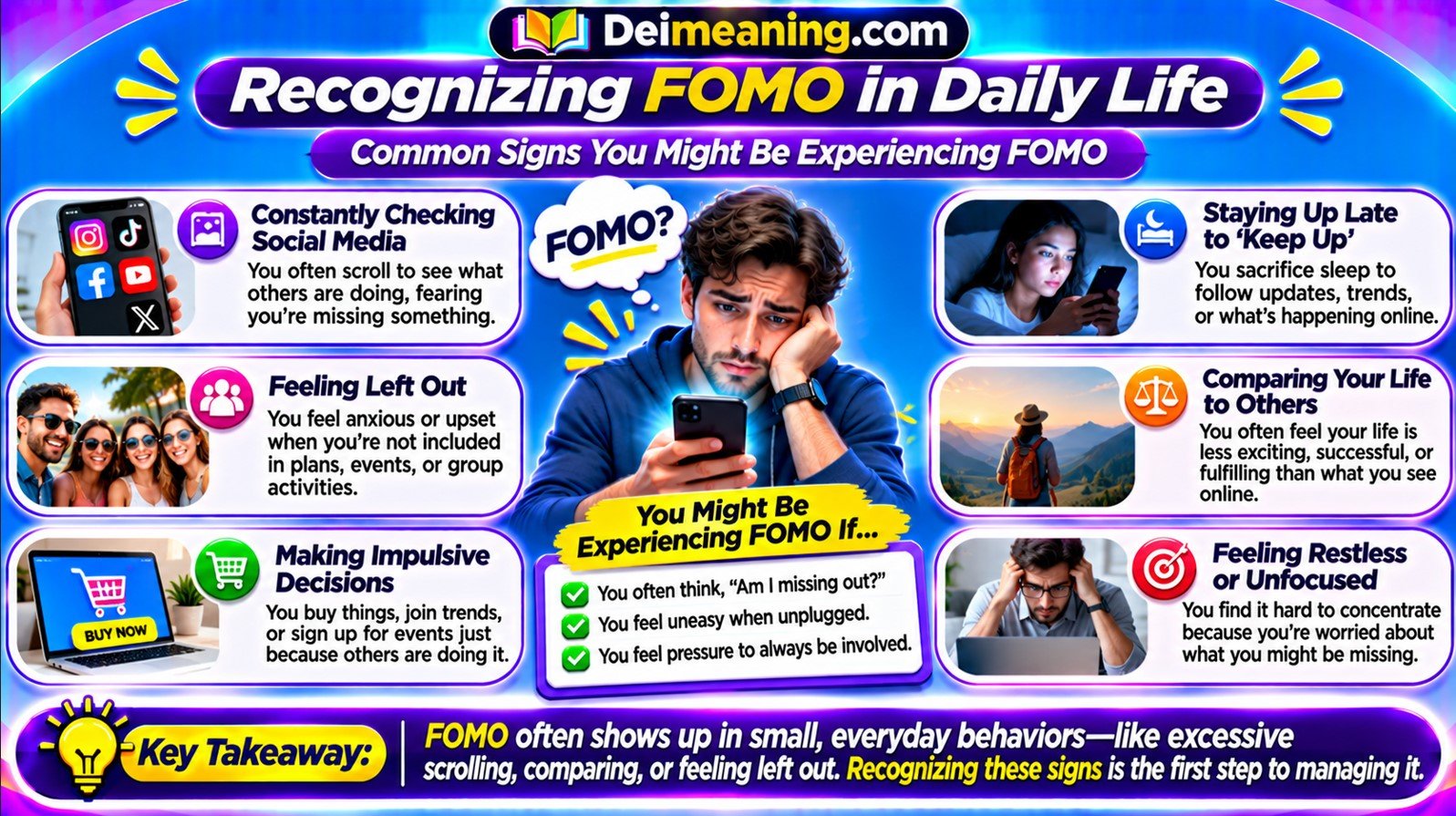
How do you know if you are experiencing this phenomenon? The practical fomo meaning manifests through specific behaviors and emotional signs.
Common Symptoms and Signs
- Obsessive phone checking: Feeling the need to look at your screen the moment you wake up.
- Overcommitting: Saying “yes” to every social invitation, even when you are exhausted, because you fear missing a good time.
- Constant comparison: Measuring your behind-the-scenes life against someone else’s highlight reel.
- Inability to focus: Struggling to enjoy the present moment because you are wondering what is happening elsewhere.
Social Media’s Role
You cannot fully discuss the fomo meaning without talking about social media. Platforms like Facebook, X (formerly Twitter), and Instagram act as catalysts. They provide an endless, real-time feed of what everyone else is doing. This constant barrage of information amplifies the traditional fomo meaning, turning occasional envy into chronic anxiety.
FOMO vs. JOMO: A Comparison
Recently, a counter-movement has emerged: JOMO, or the Joy of Missing Out. To better understand the fomo meaning, it helps to compare it to its exact opposite.
| Feature | FOMO (Fear of Missing Out) | JOMO (Joy of Missing Out) |
| Core Emotion | Anxiety, inadequacy, envy | Contentment, peace, satisfaction |
| Focus | What others are doing | What you are currently doing |
| Social Media Use | Heavy, obsessive scrolling | Intentional, limited, or disconnected |
| Decision Making | Driven by peer pressure | Driven by personal values and needs |
| Mental State | Distracted and stressed | Present and mindful |
Embracing JOMO is often the ultimate goal for those looking to escape the negative grip of the fomo meaning.
Different Types of FOMO
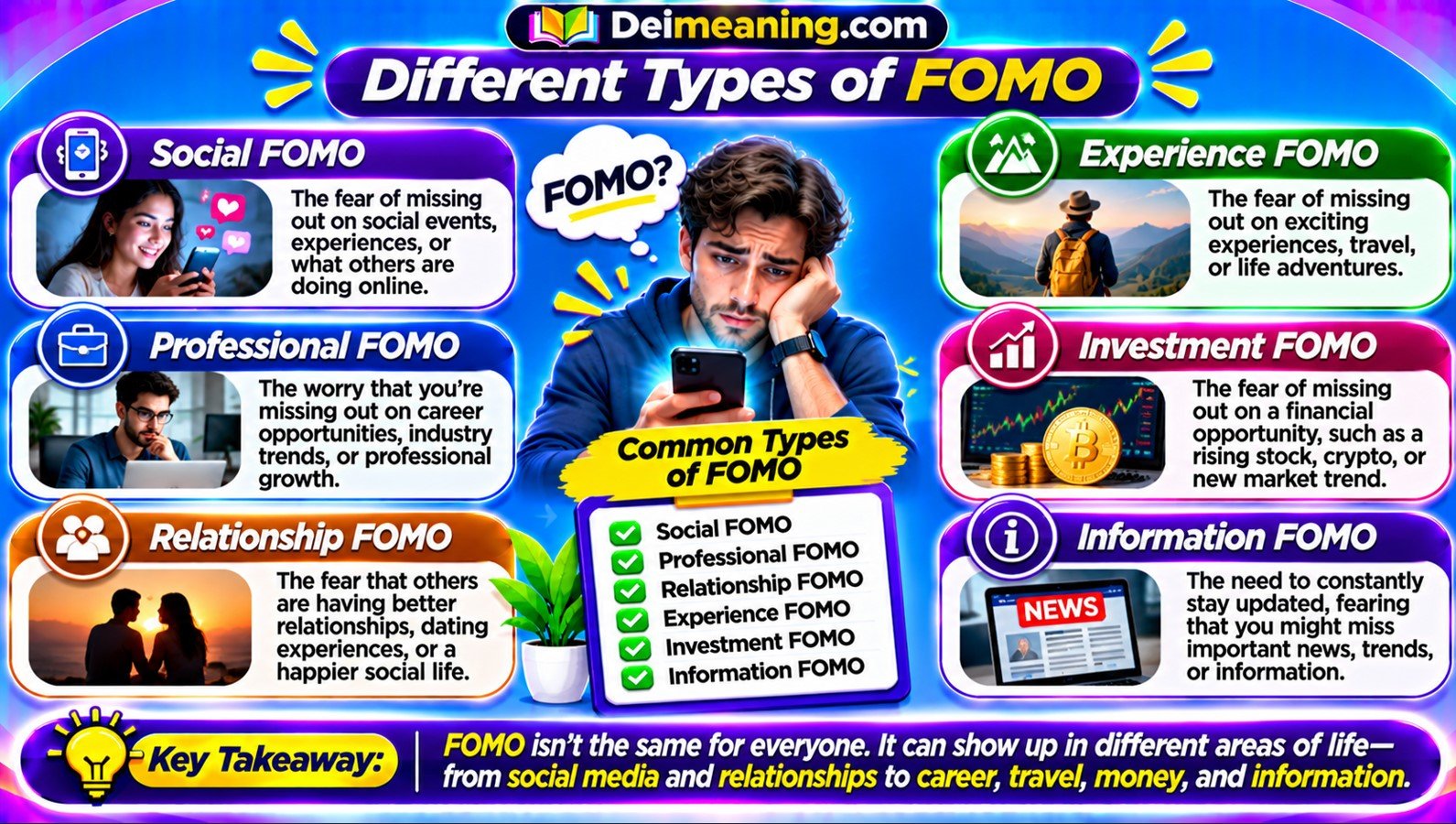
The standard fomo meaning usually applies to social events, but the concept has expanded into several distinct categories.
Social FOMO
This is the classic fomo meaning. It occurs when you miss a party, a wedding, or a casual get-together. You worry that inside jokes are being made or relationships are deepening without you.
Financial and Investment FOMO
In recent years, the financial fomo meaning has exploded, particularly with cryptocurrency and meme stocks. When you hear about a teenager making millions on Bitcoin, the fear of missing out on wealth pushes you to make impulsive, risky financial decisions.
Career and Professional FOMO
This occurs in the workplace. The professional fomo meaning involves anxiety over missing out on key projects, networking events, or promotions. It often leads to severe burnout because professionals refuse to log off or take vacations.
Click Here: DEI Meaning in Politics
The Pros and Cons of FOMO
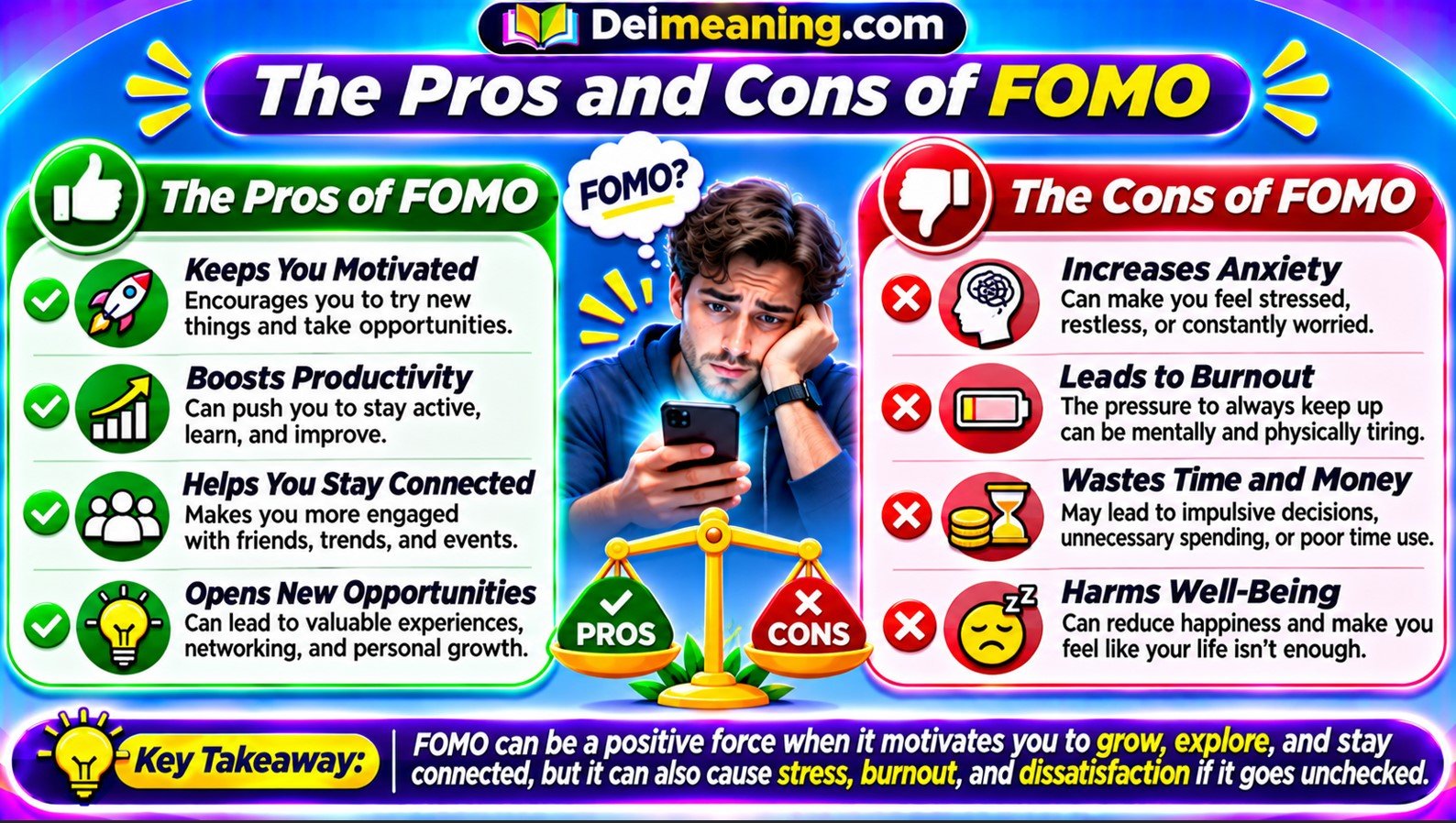
While the fomo meaning carries a mostly negative connotation, this psychological drive actually has two sides.
Pros
- Motivation: A mild fear of missing out can push you to step out of your comfort zone, try new things, and meet new people.
- Networking: It can encourage you to attend industry events and build valuable career connections.
- Awareness: It keeps you informed about cultural trends, news, and social shifts.
Cons
- Chronic Anxiety: Severe symptoms lead to persistent stress and dissatisfaction with your own life.
- Poor Sleep: The need to stay connected often leads to late-night screen time, ruining sleep hygiene.
- Financial Loss: Yielding to investment FOMO can result in buying assets at their peak price, leading to heavy losses.
- Identity Loss: Constantly chasing what others are doing prevents you from discovering what you genuinely enjoy.
How Marketers Use FOMO

In the business world, the fomo meaning is viewed as a powerful psychological trigger to drive sales. Marketers understand the human brain and use this fear to their advantage.
Scarcity Tactics
When you see phrases like “Only 2 items left in stock!” or “Sale ends in 2 hours!”, that is a brand weaponizing the fomo meaning. They are creating artificial urgency, forcing you to buy quickly before you lose the opportunity.
Social Proof
Brands also use social proof to trigger the fomo meaning. Testimonials, influencer endorsements, and pop-ups saying “John from Texas just bought this item” make you feel like everyone else is enjoying a product, and you are being left behind.
Practical Strategies to Overcome FOMO
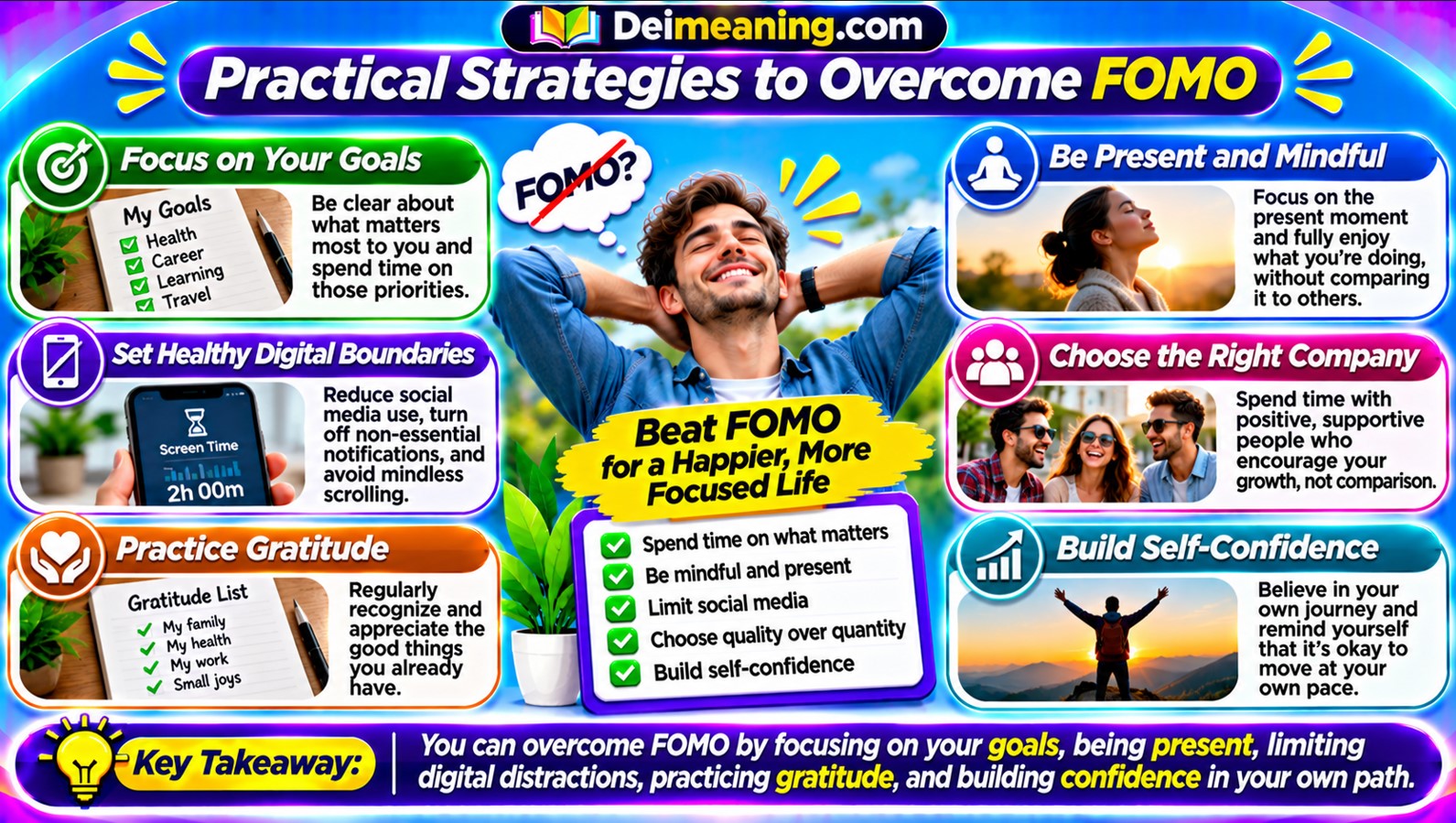
Understanding the fomo meaning is only the first step. The real goal is learning how to manage and overcome it. Here are actionable, proven strategies.
1. Implement a Digital Detox
You do not have to throw away your smartphone, but you should establish boundaries. Use app blockers to limit your time on Instagram and TikTok. By reducing your exposure to the highlight reels of others, you immediately weaken the power of the fomo meaning.
2. Practice Mindfulness
Mindfulness teaches you to anchor yourself in the present moment. When you feel anxiety rising, focus on your immediate surroundings, your breathing, and your current activity. This redirects your brain away from the imagined fomo meaning scenarios playing out in your head.
3. Reframe Your Mindset
Shift your internal dialogue. Instead of thinking, “I am missing a great party,” tell yourself, “I am choosing to rest tonight so I have energy for tomorrow.” Reframing changes the psychological fomo meaning into an empowered choice.
4. Cultivate Real-World Connections
Social media offers the illusion of connection. Combat the fomo meaning by scheduling one-on-one time with a close friend in real life. Deep, meaningful conversations provide the genuine social connection your brain is actually craving.
Learn More: Opus Dei Meaning
Frequently Asked Questions
What is the simple fomo meaning?
The simple fomo meaning is the “Fear of Missing Out.” It is the anxious feeling you get when you believe others are experiencing something positive, fun, or profitable without you.
Who invented the term FOMO?
Patrick J. McGinnis coined the term in 2004 while writing for the Harbus, the student newspaper at Harvard Business School.
Is the fomo meaning considered a real psychological condition?
While not listed in the DSM-5 as a clinical disorder, psychologists widely recognize the fomo meaning as a valid and highly prevalent form of cognitive anxiety driven by social media.
How does FOMO affect teenagers?
Teenagers are highly susceptible to the fomo meaning because peer acceptance is vital during adolescence. It often leads to lower self-esteem, sleep deprivation, and increased rates of depression.
What is the opposite of FOMO?
The opposite is JOMO, which stands for the Joy of Missing Out. It is the feeling of contentment and peace you get when you disconnect and focus on your own present life.
Can the fomo meaning apply to things other than social events?
Yes. The fomo meaning extends to career opportunities, financial investments (like missing out on buying a profitable stock), and consumer purchases.
How can I stop investment FOMO?
To avoid financial FOMO, stick to a strict, pre-planned investment strategy. Do not buy assets based on internet hype or sudden viral trends.
Why does social media cause FOMO?
Social media provides a constant, filtered stream of people’s best moments. This artificial reality distorts your perception, making the fomo meaning stronger because it looks like everyone else is always happy.
Can FOMO be a good thing?
In small, manageable doses, the fomo meaning can serve as motivation. It can encourage you to leave your house, engage with your community, and seize valuable opportunities.
How do I know if my FOMO is out of control?
If your fear of missing out is causing you to lose sleep, spend money you do not have, or feel a constant sense of depression regarding your own life, it is time to seek professional mental health support.
Conclusion
Understanding the true fomo meaning is essential in today’s hyper-connected digital world. What started as a basic human survival instinct—the need to belong to a tribe—has morphed into a constant source of digital anxiety. The fomo meaning reaches into our social lives, our career choices, and our financial decisions.
However, by recognizing the psychological triggers behind the fomo meaning, you can take back control. By limiting your screen time, focusing on genuine real-world connections, and embracing the Joy of Missing Out (JOMO), you can stop comparing your behind-the-scenes life to everyone else’s highlight reel. You cannot be everywhere at once, and once you truly accept the fomo meaning for the illusion that it often is, you can finally start enjoying exactly where you are.