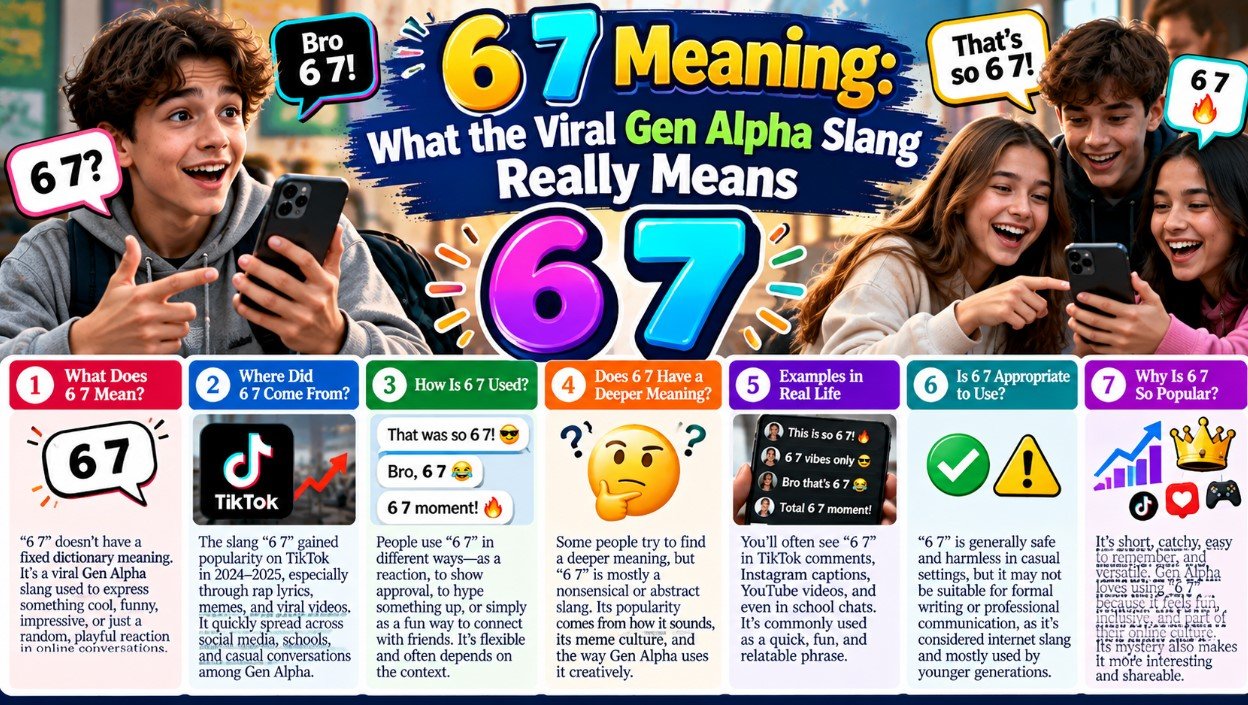
6 7 Meaning: What the Viral Gen Alpha Slang Really Means
If you have heard teenagers shouting “six seven” at school, seen the numbers 6 and 7 appearing in TikTok videos, or noticed people moving their hands while saying the phrase, you are not alone. The expression has become one of the most recognizable examples of modern internet slang.
The 6 7 meaning is surprisingly simple: it usually has no specific definition. Pronounced “six-seven,” rather than “sixty-seven,” this viral expression works as a playful catchphrase, an inside joke, or a reaction to almost anything. Its appeal comes from its connection to music, basketball, short-form videos, and youth culture.
The phrase became especially popular among Generation Alpha and younger members of Generation Z. It spread through TikTok, Instagram Reels, basketball edits, and school conversations. Dictionary.com even selected “67” as its 2025 Word of the Year, highlighting how a seemingly meaningless expression can become a major cultural trend. Source: Dictionary.com
But where did the trend begin? Why do people use it, and does it have a hidden meaning?
This guide explores the origins, common uses, hand gesture, cultural significance, and possible misunderstandings surrounding the six-seven meme.
What Does 6 7 Mean?
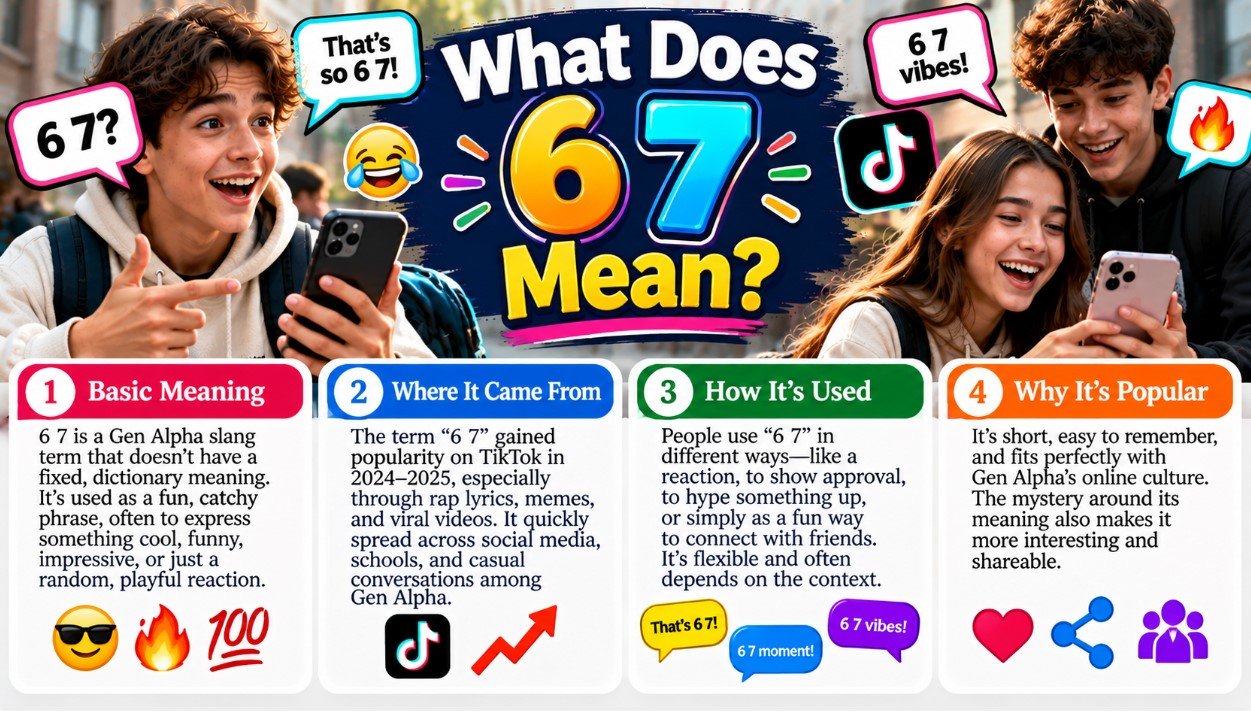
Six-seven is a viral internet slang expression that generally has no fixed meaning. People use it to be funny, join a trend, react to a situation, or show that they understand a popular online joke.
Click Now: DEI Meaning in the USA
Unlike traditional slang, which often replaces a word or communicates a clear idea, 6 7 frequently works without a specific message. Its humor comes from repetition, timing, exaggerated reactions, and shared cultural knowledge.
Depending on the situation, the expression can serve several purposes:
- A random exclamation: Someone shouts “six-seven” simply because the phrase is funny to them.
- An inside joke: Friends repeat it because they recognize the same meme.
- A playful response: A person uses it instead of giving a serious answer.
- A trend reference: Someone says it to show familiarity with popular online culture.
- A vague rating: In some contexts, people interpret it as meaning “so-so” or suggesting that something is average.
The last interpretation is worth understanding. Some users connect the phrase with an uncertain or middle-of-the-road response, often accompanied by a hand movement. However, this is not a universal definition.
For example, imagine a student asks a friend, “How was your weekend?” The friend responds, “Six-seven!” while moving both hands up and down. The response may communicate amusement rather than an actual opinion about the weekend.
The key takeaway: You usually cannot determine what someone means by 6 7 without understanding the surrounding conversation. In many cases, there is no deeper message to decode.
Where Did the 6 7 Trend Come From?
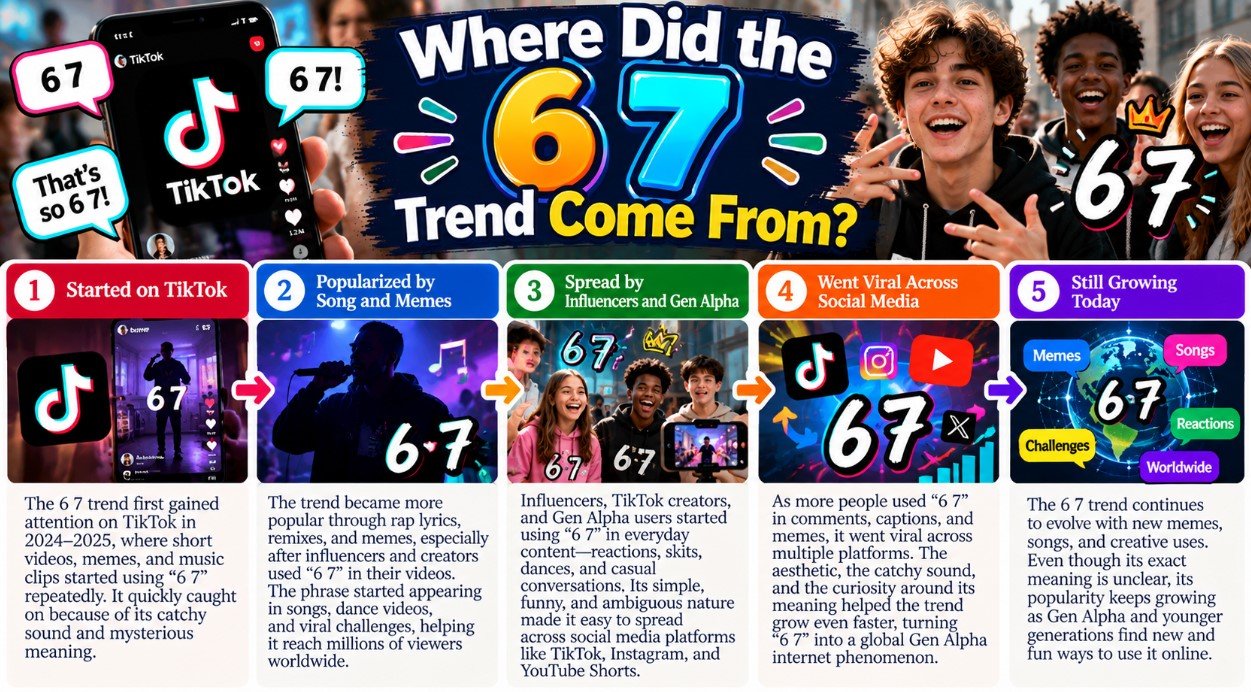
The modern six-seven trend traces back to music and social media rather than a traditional dictionary definition.
1. The song that started the trend
The expression is associated with “Doot Doot (6 7),” a drill-rap song by Philadelphia rapper Skrilla. The track began circulating online in late 2024, and its repeated reference to “6-7” gave social media users a catchy phrase to repeat.
The numbers attracted attention because they were memorable, easy to say, and simple to incorporate into videos. As clips featuring the song circulated, the phrase began taking on a life of its own.
Importantly, the slang meaning did not emerge from a clear explanation in the lyrics. Its later popularity depended heavily on how people used the phrase online.
2. Basketball videos helped it spread
Basketball-related edits played a major role in popularizing the trend. Videos featuring NBA player LaMelo Ball became associated with the phrase because Ball is listed at 6 feet 7 inches tall.
Creators paired basketball highlights with the song, connecting the numbers to the player’s height. This made the expression easier to recognize and encouraged other users to reproduce the format.
The connection helped turn a lyric into a reusable meme. Once viewers recognized the pattern, they could apply it to new basketball clips, jokes, and unrelated situations.
3. Young creators made it a catchphrase
The phrase spread further through livestreams, interviews, short videos, and clips of young people shouting the numbers with an energetic hand gesture.
A viral video featuring a young basketball fan became widely associated with the nickname “67 Kid.” Repeated performances and remixes helped establish the familiar style of saying the phrase.
Eventually, people began using six-seven even when the original song or basketball reference was absent. That shift is typical of internet memes: the original context introduces the joke, but repetition allows the joke to develop independently.
The exact origin of every variation is difficult to establish because social media trends often evolve through thousands of reposts, edits, and user-created videos.
Why Is 6 7 Popular on TikTok?
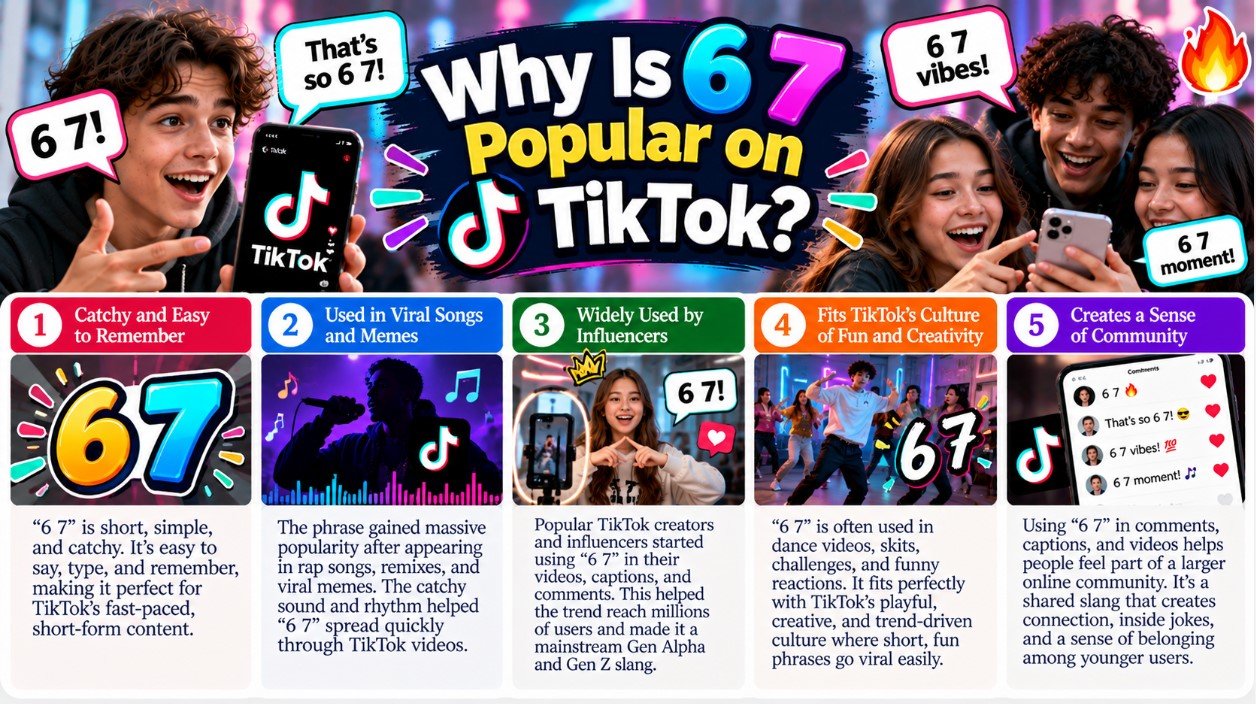
TikTok helped transform six-seven from a recognizable lyric into a widely shared expression. Instagram Reels, YouTube Shorts, and other social platforms also contributed to its reach.
Several features explain its popularity.
It is easy to repeat
The phrase requires little explanation, no special equipment, and almost no preparation. Anyone can say it, imitate the gesture, or include it in a video.
That simplicity makes it suitable for short clips, reaction videos, and group jokes.
It works in different situations
Traditional jokes often need a setup and a punchline. Six-seven can appear in a conversation about sports, school, food, mathematics, or an entirely unrelated subject.
For instance, a video might show the number 67 on a scoreboard before someone suddenly shouts the phrase. The surprise creates the joke.
It creates a sense of belonging
People who recognize the meme understand the reference immediately. Those who do not may feel confused, which can become part of the humor.
This shared recognition is important in online communities. A simple expression can act as a signal that someone follows the same creators, trends, or jokes as their friends.
It is entertaining through repetition
Internet humor often relies on repeating something until it becomes absurd. Six-seven fits this pattern because users can repeat the phrase in increasingly unexpected situations.
The humor does not necessarily depend on the words themselves. Instead, timing, facial expressions, gestures, and the reactions of other people can make the moment entertaining.
What Is the 6 7 Hand Gesture?
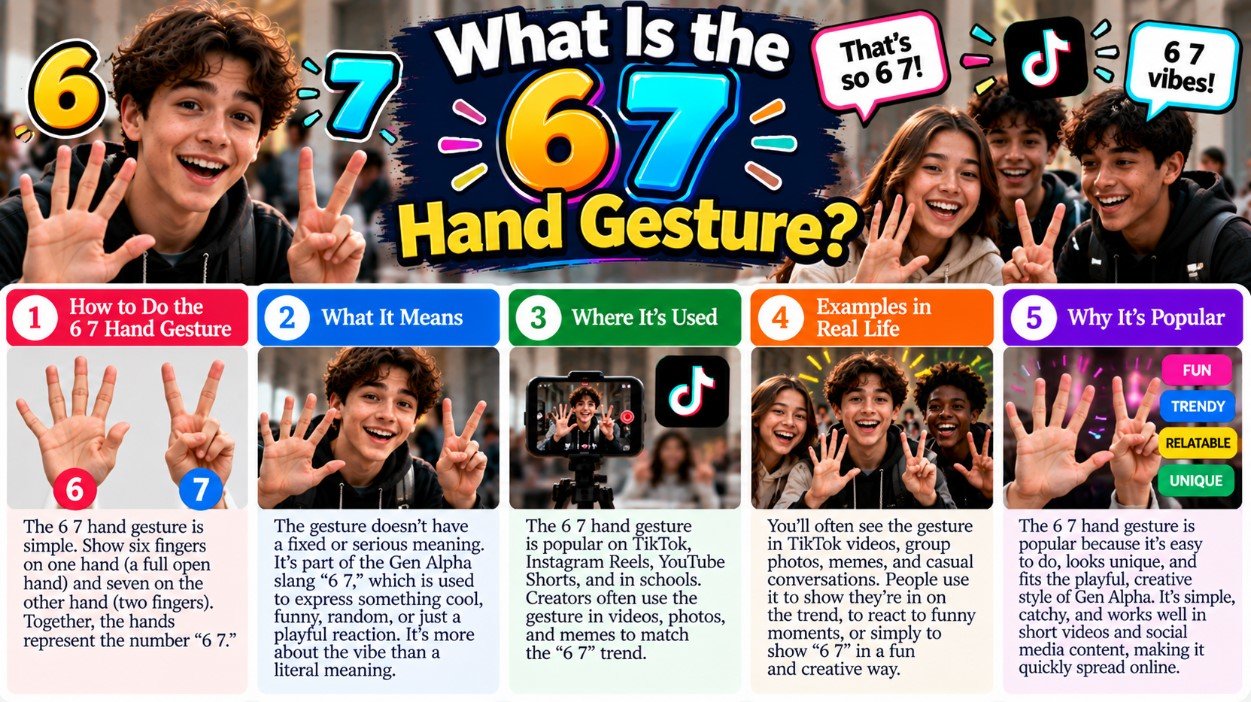
The six-seven meme is often accompanied by a recognizable hand movement.
A person typically raises both hands in front of the body with the palms facing upward. The hands then move alternately up and down, creating a motion similar to balancing two sides of a scale.
The gesture is sometimes used to emphasize the rhythm of the words or suggest an uncertain, middle-ground response.
However, there is no official gesture that every user must follow. Some people move their hands dramatically, others make a smaller motion, and many simply say the phrase without any gesture.
Learn More: Body Count Meaning
What does the gesture represent?
There are two common ways to understand it:
- A visual part of the meme: For many users, the movement is simply recognizable choreography associated with six-seven.
- A suggestion of uncertainty: Some interpret the alternating hands as a way to communicate “so-so,” “maybe,” or something between two options.
Neither interpretation applies to every situation. A person may perform the gesture purely because it is part of the joke.
For example, if someone asks whether a movie was good and receives a six-seven response with the hand movement, the speaker might be suggesting a mixed opinion. If the same phrase is shouted during a basketball game, it may be nothing more than an enthusiastic meme reference.
How Gen Alpha and Gen Z Use 6 7
Although people sometimes describe six-seven as Gen Z slang, it is especially associated with Generation Alpha and younger internet users. These groups often encounter new expressions through video platforms, gaming communities, livestreams, and school friendships.
Here are some common examples of how the phrase may appear.
| Situation | Example | Possible meaning |
| Casual conversation | “How are you today?” “Six-seven!” | A playful or meaningless response |
| Rating something | “Rate this game.” “Six-seven.” | Possibly average or so-so |
| Basketball content | A video shows a player who is 6’7″ | A reference to the meme and player height |
| School humor | Students repeat the phrase during a lesson | An inside joke or attempt to get a reaction |
| Social media comments | Someone writes “67” under a related video | Recognition of the trend |
| Group interaction | Friends say it together | Shared humor and participation |
These examples illustrate possible uses rather than fixed translations.
The same expression can carry different meanings between groups. One friend might use it as a genuine, if vague, rating, while another might say it simply because someone mentioned the number.
Is 6 7 a Gen Z word or a Gen Alpha word?
It is more accurate to describe six-seven as a Gen Alpha-associated internet meme that also spread to Gen Z and older audiences.
Generation labels are not strict boundaries. A trend that begins among younger teenagers can quickly reach college students, adults, celebrities, teachers, and parents through social media.
Consequently, the age of the person using the phrase does not determine its meaning. Context and familiarity with the meme matter more.
Is 6 7 Connected to Basketball?
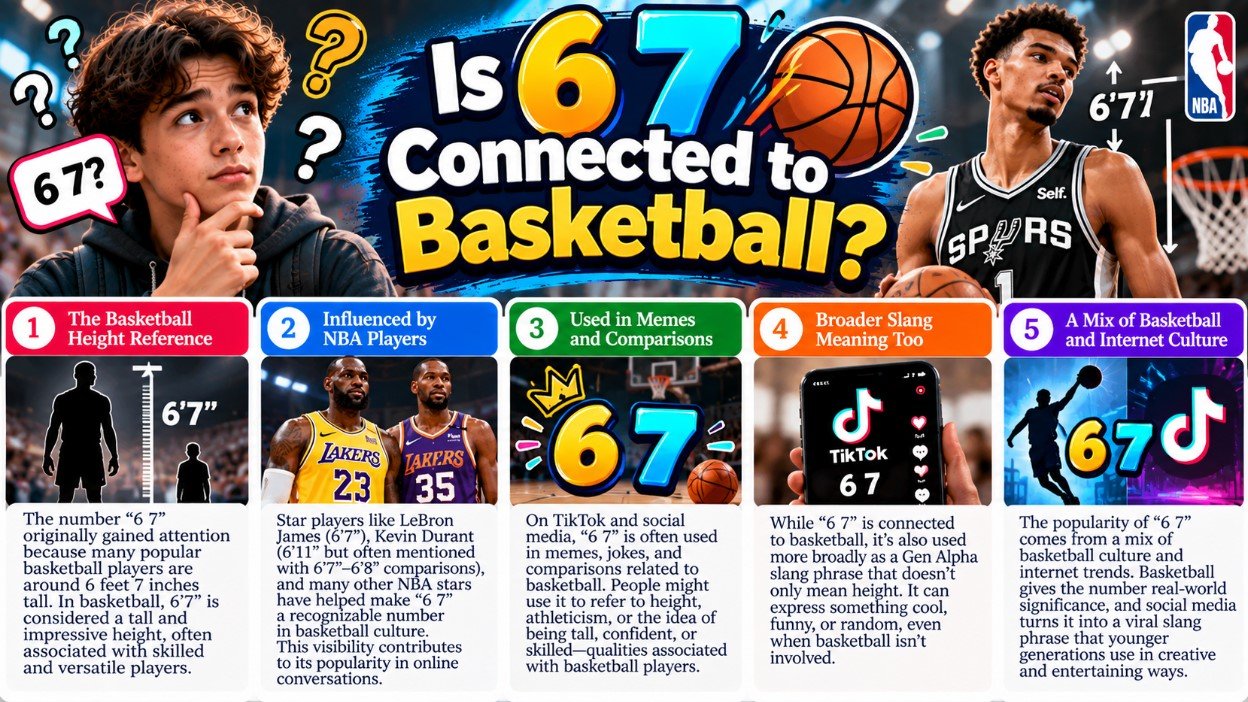
Yes, basketball is an important part of the trend’s online history, although the phrase is not an official basketball term.
The connection comes partly from videos featuring LaMelo Ball, a professional basketball player listed at 6 feet 7 inches tall. Creators used the song and its repeated numbers in edits featuring his highlights.
This association helped viewers connect the expression with basketball culture. The trend subsequently appeared in fan videos, school conversations, sports clips, and other forms of online entertainment.
However, it is important to separate the meme from the actual measurement.
In basketball, 6’7″ means six feet seven inches and describes a person’s height. The slang expression “six-seven” usually refers to the meme, not a measurement.
For example:
- “The player is 6’7″ tall” is a statement about height.
- “Six-seven!” shouted during a funny video may be a meme reference.
- “The final score was 67” is a numerical statement unless the surrounding context suggests a joke.
The numbers alone do not prove that someone is referencing the trend. The speaker’s delivery, the surrounding content, and the audience’s reaction help establish the intended meaning.
Is There a Hidden or Inappropriate Meaning?
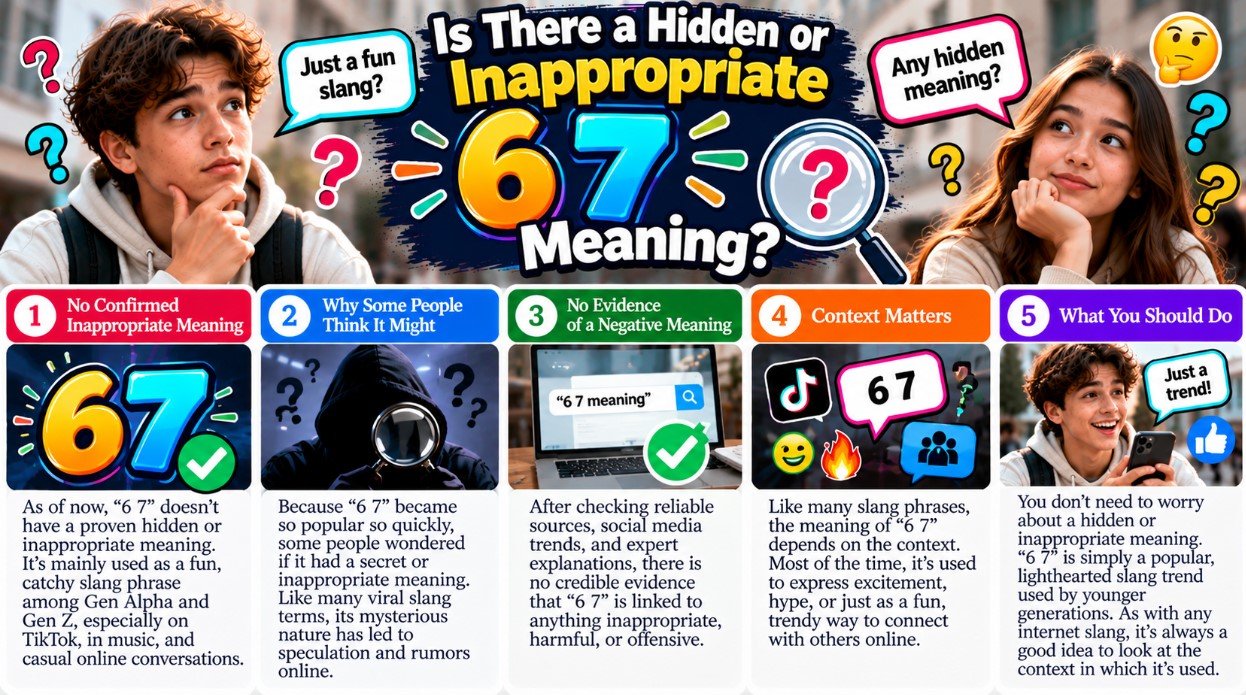
One reason people search for the 6 7 meaning is that unusual internet slang can appear to contain a secret message.
In its common viral form, six-seven is not inherently an offensive or adult expression. It is generally a playful, deliberately ambiguous catchphrase associated with music, memes, and youth culture.
Some online discussions have proposed explanations involving street references, locations, or the original song’s lyrics. However, these interpretations should not be treated as the established meaning of the modern meme.
Skrilla’s lyric helped introduce the phrase, but its widespread use among teenagers does not necessarily carry the original song’s full context. Many people repeat the expression simply because they recognize the trend.
It is also important not to confuse six-seven with other meanings of the same numbers. A reference to a Bible verse, a street address, a score, a date, or a code may have a completely different purpose.
Parents and teachers should judge the actual context rather than assume that every use has a hidden meaning. If the phrase appears in a conversation that includes threatening, discriminatory, or otherwise inappropriate content, evaluate that content separately.
The meme itself does not automatically make a conversation harmful or inappropriate.
Why Do Young People Find 6 7 Funny?
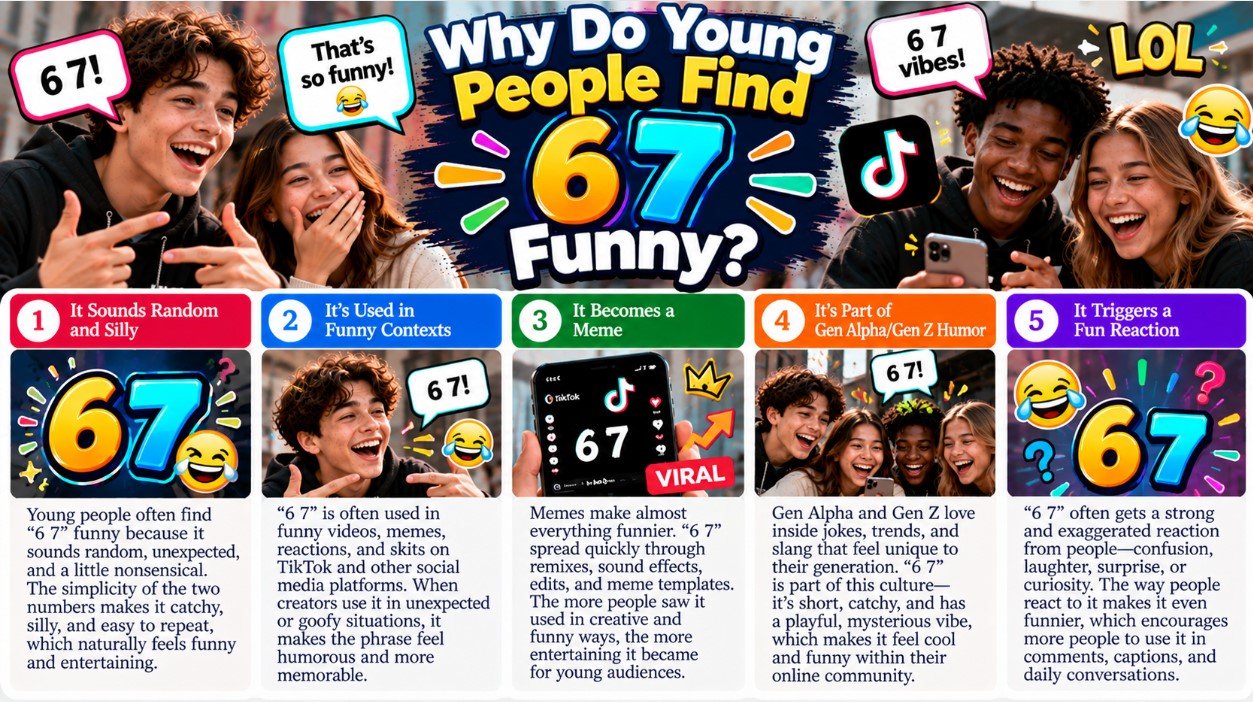
The appeal of six-seven illustrates several features of modern youth culture.
Absurdity is part of the joke
Not every joke needs a logical explanation. Sometimes, a phrase becomes funny because it appears at the wrong moment or because everyone repeats it without explaining why.
Six-seven benefits from this kind of absurd humor. Its lack of a stable definition gives users room to create their own situations around it.
Social reactions add to the entertainment
A teenager may say six-seven because friends laugh, repeat the gesture, or recognize the reference. The response from other people can be more entertaining than the phrase itself.
Likewise, an unexpected outburst may surprise adults who are unfamiliar with the trend. That reaction sometimes becomes part of the joke.
Memes create shared experiences
Online culture moves quickly. A popular sound can spread from a music clip to a basketball edit, then to school conversations and family interactions.
When people recognize the same reference, they gain a small shared experience. The phrase becomes a shortcut for remembering the videos, personalities, and jokes connected to it.
The trend is easy to adapt
Users can insert six-seven into captions, comments, videos, conversations, and reaction formats. Because it does not require a detailed explanation, it can travel across communities with different interests.
Nevertheless, a meme’s popularity does not mean everyone enjoys it. Some people find repeated shouting amusing, while others consider it distracting or annoying.
Pros and Cons of the 6 7 Trend
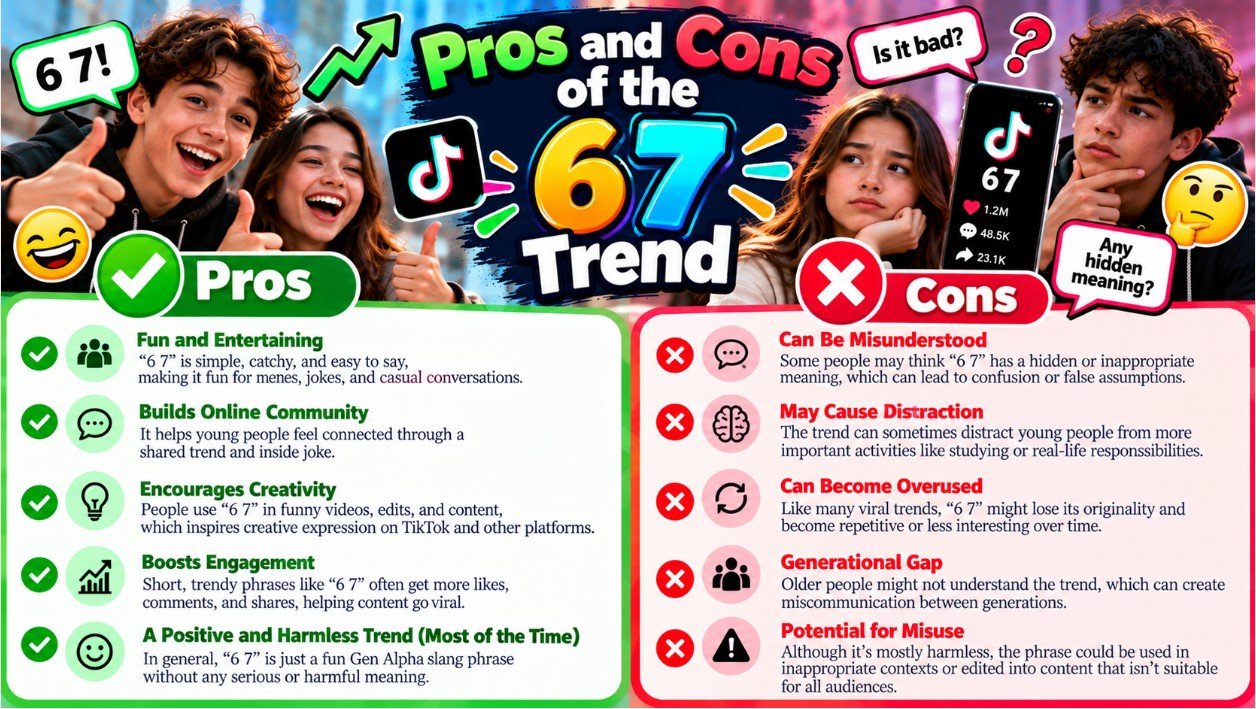
Like many viral expressions, six-seven has both positive and negative sides. Its effects depend on how people use it and where they use it.
Pros
- Encourages social interaction: Friends can share a simple joke without needing a complicated setup.
- Supports creative expression: Content creators can adapt the phrase to sports, comedy, and everyday situations.
- Builds shared cultural knowledge: Recognizing a meme can help people connect with a particular online community.
- Introduces digital culture: Parents and educators can use the trend as an opportunity to discuss how internet language develops.
- Provides light entertainment: In suitable settings, the expression can add humor to an ordinary interaction.
Cons
- Can become repetitive: Hearing the same phrase repeatedly may frustrate people who do not enjoy the joke.
- May interrupt learning: Shouting the expression during lessons can distract students and teachers.
- Can cause misunderstandings: Adults unfamiliar with the meme may interpret it differently from its intended playful use.
- Has little precise meaning: The phrase is not useful when a clear answer or accurate information is required.
- Can encourage attention-seeking behavior: Some users may repeat it excessively to provoke reactions.
The best approach is moderation. A harmless meme can be enjoyable when it fits the setting, but it should not replace respectful communication or interfere with other people’s activities.
How to Respond When Someone Says 6 7
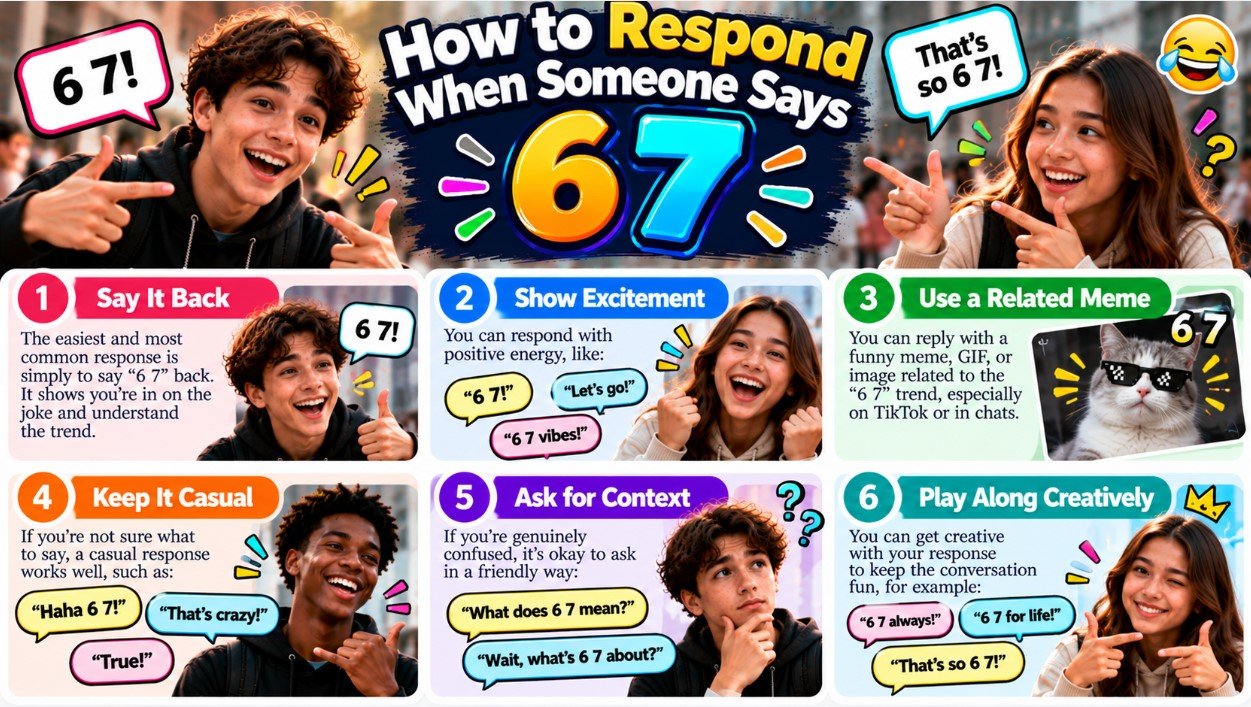
If someone says six-seven and you do not understand the reference, you do not need to memorize every variation of the trend.
A simple response can be enough.
If you are curious: Ask, “Is that the six-seven meme from TikTok?” This invites the person to explain the reference.
If you want to join the joke: You can repeat the phrase or imitate the hand gesture, provided the setting is appropriate.
If you are a parent: Ask your child where they first heard it and what they find funny about it. This can lead to a relaxed conversation about online trends.
If you are a teacher: Set reasonable classroom expectations. Students can enjoy popular slang without interrupting lessons or distracting classmates.
If someone uses it as an answer: Ask for clarification when the question requires a real response. The phrase may be playful, but it does not provide reliable information.
There is no need to force yourself to use every new expression. Understanding the reference is often enough to follow the conversation.
Click Here: Pookie Meaning
Frequently Asked Questions
1. What does 6 7 mean in slang?
Six-seven is a viral slang expression that usually has no fixed meaning. People use it as a joke, catchphrase, or playful response. Some interpret it as “so-so,” but that meaning depends on the context.
2. What does 6 7 mean on TikTok?
On TikTok, six-seven usually refers to the viral meme associated with Skrilla’s song “Doot Doot (6 7)” and basketball-related videos. Users repeat the phrase, perform the hand gesture, or include it in jokes and reaction clips.
3. Is 6 7 a Gen Z or Gen Alpha trend?
It is especially associated with Generation Alpha and younger teenagers, although Gen Z and older audiences also recognize it. Social media allows slang to spread across age groups quickly.
4. Who started the 6 7 trend?
The expression is linked to Philadelphia rapper Skrilla’s song “Doot Doot (6 7),” which circulated online in late 2024. Basketball edits and user-generated videos helped popularize the phrase during 2025.
5. Why do people move their hands when saying six-seven?
The familiar gesture involves raising both palms and moving the hands alternately up and down. It is often used as part of the meme and can suggest a “so-so” response, although many people perform it simply for fun.
6. Does 6 7 have a bad meaning?
Not inherently. The common meme is generally playful and nonsensical. However, the context of a particular conversation still matters, especially if other language or behavior is offensive or harmful.
7. What does six-seven mean in basketball?
In meme culture, six-seven is associated with basketball edits featuring LaMelo Ball, who is listed at 6 feet 7 inches tall. In ordinary basketball discussions, 6’7″ is simply a height measurement.
8. Why did Dictionary.com choose 67 as its 2025 Word of the Year?
Dictionary.com selected “67” because the expression became a major cultural phenomenon, demonstrating how online communities can spread language even when it lacks a conventional definition. Its popularity reflected the influence of youth culture and internet memes.
9. Is 67 the same as sixty-seven?
Not in every context. The number 67 is normally read as “sixty-seven,” but the viral slang expression is generally spoken as “six-seven.” The intended reading depends on whether someone is discussing a number or referencing the meme.
10. Will the six-seven trend last forever?
Probably not in its current form. Internet slang often loses popularity as audiences move to new jokes and expressions. However, six-seven may remain recognizable as a reference to a particular period in online culture.
Conclusion
The 6 7 meaning is a useful example of how internet culture can turn a short phrase into a widespread social trend. Although the expression does not have a single established definition, its association with Skrilla’s music, basketball edits, TikTok videos, and a recognizable hand gesture makes it easy to identify.
For many users, six-seven is simply a playful catchphrase. For others, it can suggest a vague rating or serve as an inside joke among friends. Its meaning depends on the situation, and the absence of a precise definition is part of its appeal.
If you encounter the phrase in a video, classroom, or casual conversation, remember three things: it is usually pronounced “six-seven,” it is closely associated with Gen Alpha internet culture, and it generally does not communicate a specific message.
Understanding the context is more useful than searching for a hidden definition. As online language continues to evolve, six-seven offers a clear reminder that sometimes the popularity of a phrase matters more to its users than what the words literally mean.