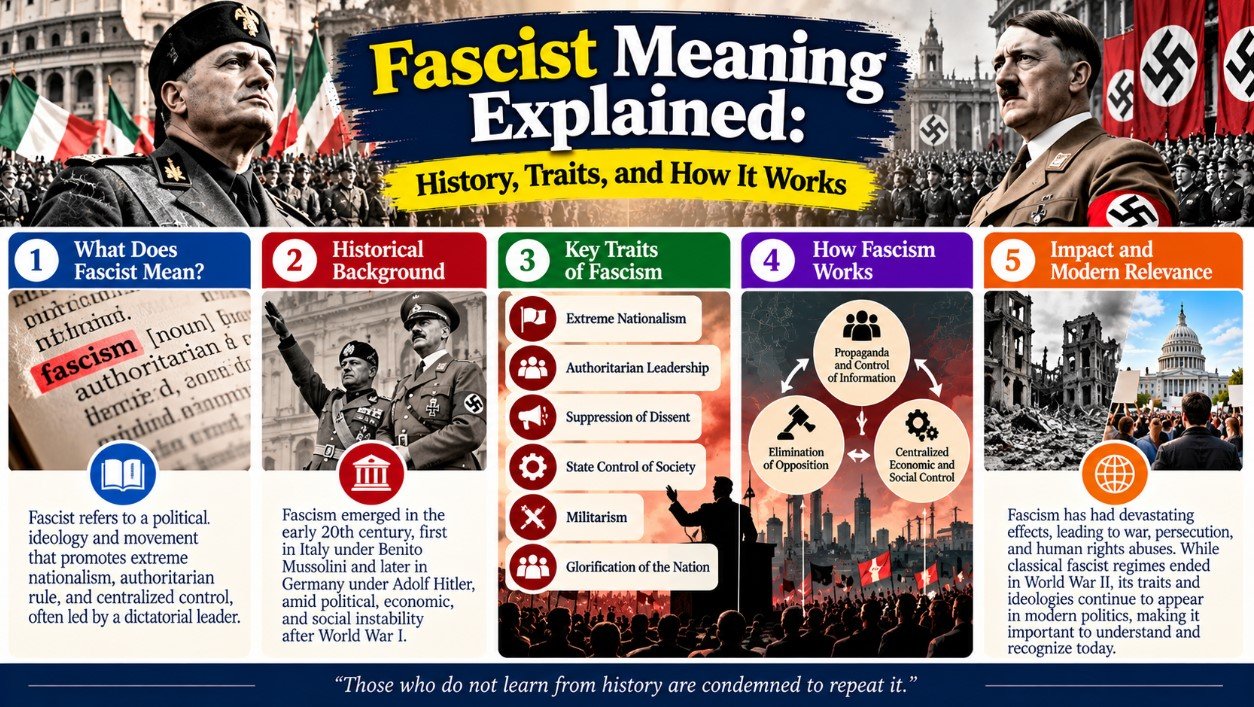
Fascist Meaning Explained: History, Traits, and How It Works
You hear the word thrown around in heated cable news debates, social media arguments, and protests almost every single day. Someone gets banned from a website, or a mayor passes a strict city rule, and critics immediately shout, “That’s fascist!” Because people use the label as a catch-all insult for anyone being bossy, the actual fascist meaning has gotten completely blurry.
To understand history and modern politics, we have to separate the playground insult from the actual political system. At its core, a fascist is a follower of fascism—a far-right, authoritarian, ultranationalist political ideology. It demands that individual citizens give up their personal freedoms to serve the glory and power of the nation, which is ruled by an all-powerful dictator.
When George Orwell wrote about politics back in 1944, he noticed that the word had already lost its sharp edge, turning into a general term for “something not desirable.” Today, political scientists like Robert Paxton and Roger Griffin work hard to give us a clear, factual framework so we can spot the real thing. By looking at how this movement started in Europe, how it runs an economy, and how it compares to other systems like communism, you can easily tell the difference between a tough law and true totalitarian rule.
What Is the Exact Fascist Meaning?
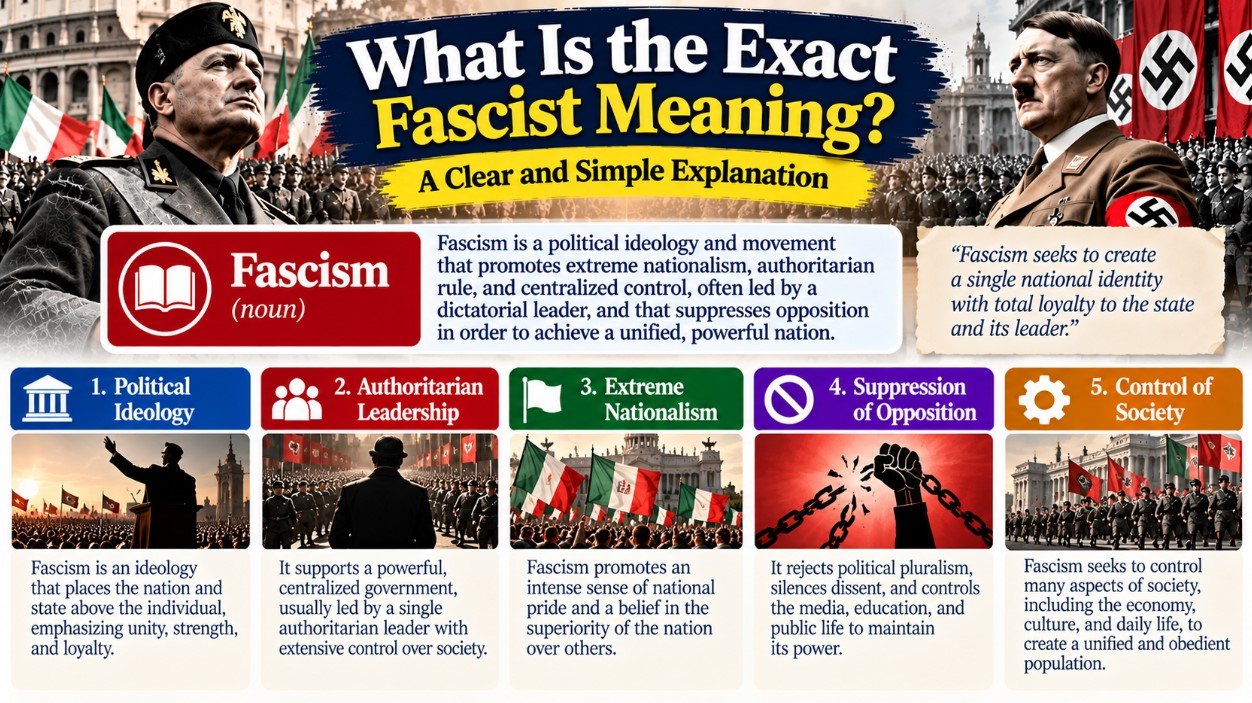
A fascist is someone who supports or practices a system of government led by a single dictator who holds complete power. Under this system, the government forcibly crushes all political opposition, controls industry and commerce, and promotes an aggressive, exclusionary form of nationalism—often tied to racial purity.
If you are looking for a quick definition for a featured snippet or study guide:
Fascist Meaning: A fascist is an advocate of a far-right, totalitarian political philosophy that places the nation and often a specific race above the individual. It features dictatorial rule, the violent suppression of dissent, strict state control over society, and aggressive militarism.
In a democratic country like the United States, the government exists to protect the rights of the individual citizen. You have the right to free speech, a fair trial, and a vote. Fascism flips this concept upside down. In a fascist state, the individual exists only to serve the government. Benito Mussolini, the founder of Italian fascism, summed this up with a famous slogan: “Everything in the State, nothing outside the State, nothing against the State.”
You are not seen as a separate person with natural rights. Instead, the regime views you as a single cell inside a giant living body—the nation. If a cell helps the body grow stronger, it is kept alive. If a cell questions the brain (the dictator) or slows the body down, it is treated like a disease and cut out.
Click Here: DEI Meaning in the USA
The Ancient Roots of the Word: From Rome to Milan
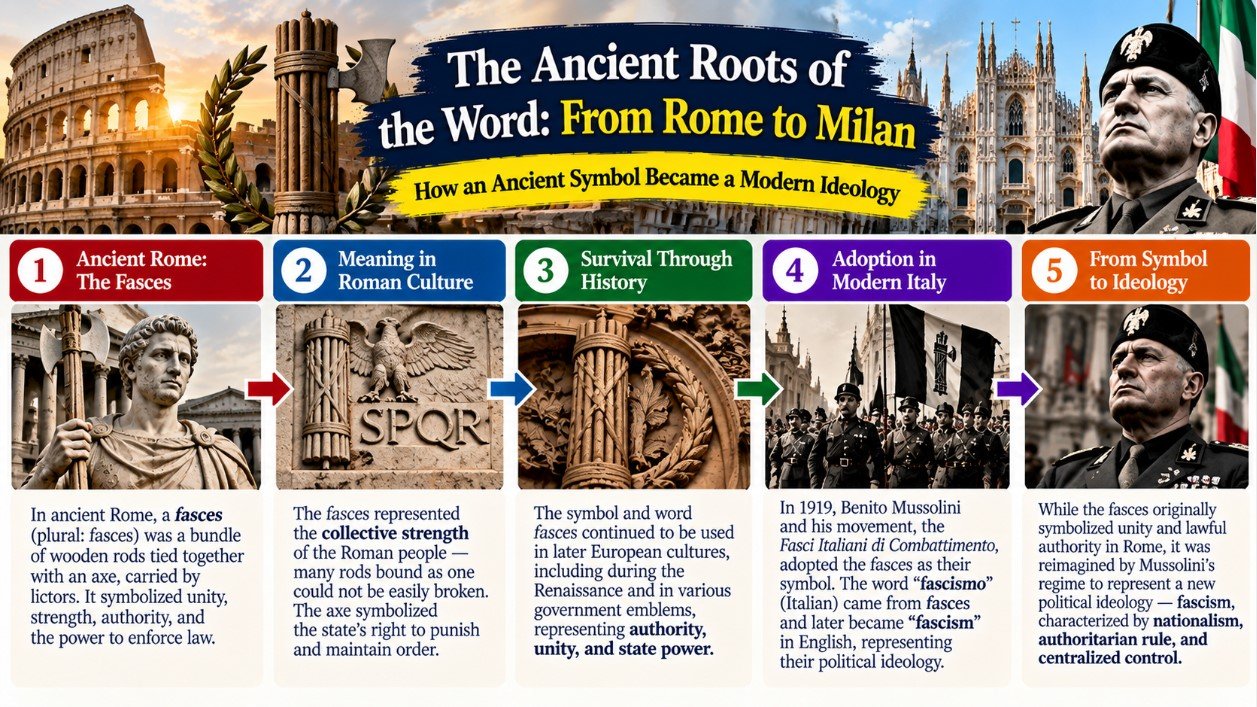
Words carry history, and the origin of the term “fascist” explains the entire philosophy behind the movement using a single visual metaphor.
The Roman Fasces
The word comes from the Italian term fascio, which means “bundle” or “sheaf,” and traces even further back to the Latin word fasces. In Ancient Rome, the fasces was a bundle of wooden rods tied tightly together around a bronze axe, with the sharp blade sticking out the side.
Guards called lictors carried these bundles in front of Roman magistrates and emperors. The symbol sent a two-part message to everyone watching on the street:
- Strength through unity: A single wooden stick is weak; you can snap it over your knee with bare hands. However, when you tie thirty sticks together into a tight bundle, nobody can break them.
- Supreme authority: The axe blade sticking out of the bundle represented the ruler’s power to punish lawbreakers, including the power to execute them on the spot.
From Labor Unions to Right-Wing Militias
During the late 1800s in Italy, various political clubs and peasant labor unions called themselves fasci (bundles) to show that workers were stronger when they stood together. At that point, the word did not have a right-wing meaning.
Everything changed in March 1919 in Milan, Italy. A former socialist journalist and World War I soldier named Benito Mussolini gathered a group of angry war veterans, nationalists, and street fighters. He called this new group the Fasci Italiani di Combattimento (Italian Fasces of Combat). Mussolini took the ancient Roman symbol of the bundled rods and axe, turned it into his official party emblem, and birthed the modern fascist meaning.
How Fascism Rose to Power in the 20th Century
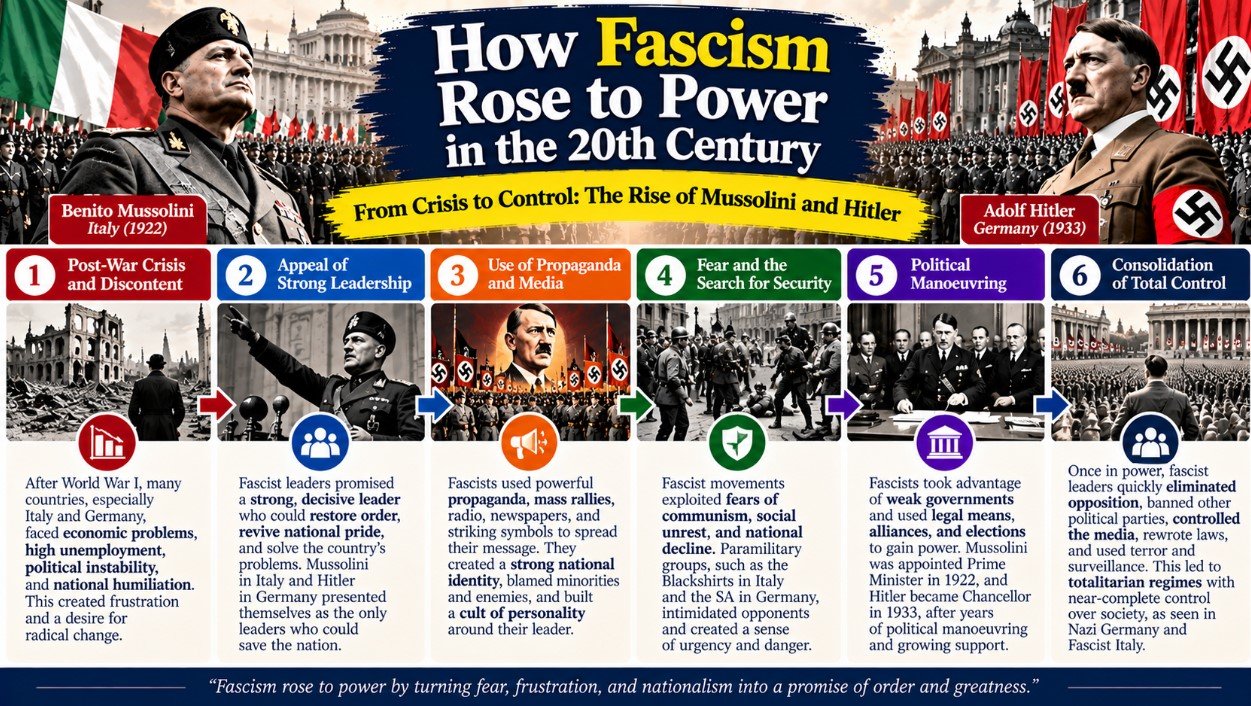
Fascism did not appear out of nowhere because people suddenly decided they hated freedom. It grew out of massive trauma, economic ruin, and fear following World War I.
1. Italy and the Blackshirts (1922–1943)
Although Italy fought on the winning side in World War I, the country was broke, hundreds of thousands of young men were dead, and citizens felt cheated out of land promised by the allies. Inflation wiped out family savings. At the same time, inspired by the 1917 Russian Revolution, Italian socialists and communists went on strike, taking over factories and farmland.
Middle-class business owners, landowners, and the Catholic Church panicked, fearing a communist takeover. Mussolini stepped into this chaos. He organized paramilitary gangs wearing black uniforms—known as the Blackshirts (Squadristi). These squads beat up striking workers, burned down socialist newspaper offices, and forced political opponents to drink castor oil.
In October 1922, Mussolini staged the March on Rome with tens of thousands of Blackshirts. Rather than sending the army to stop them, King Victor Emmanuel III got scared of a civil war and handed Mussolini the job of Prime Minister. Within three years, Mussolini shut down parliament, outlawed rival parties, and began calling himself Il Duce (“The Leader”).
2. Germany and the Nazi Party (1933–1945)
Across the Alps, Germany was in even worse shape. Defeated in World War I and crushed by the debts of the Treaty of Versailles, the young democratic Weimar Republic struggled to survive. When the Great Depression hit in 1929, six million Germans lost their jobs.
Adolf Hitler, leading the National Socialist German Workers’ Party (Nazi Party), copied Mussolini’s playbook and made it far more extreme. While Mussolini focused primarily on the glory of the Italian state, Hitler built his version of fascism around biological racism and virulent antisemitism. He blamed Jewish people, communists, and democrats for Germany’s defeat in the war—a conspiracy theory called the “stab-in-the-back myth.”
Using his own street thugs, the Brownshirts (SA), Hitler intimidated voters while promising to restore German pride and put bread on the table. Appointed Chancellor in January 1933, Hitler used the Reichstag Fire just weeks later as an excuse to suspend civil liberties. He took the title of Führer, built concentration camps for political enemies, and launched a genocidal campaign known as the Holocaust, murdering six million Jews and millions of others before his regime was destroyed in World War II.
3. Spain, Japan, and Other Variants
Historians often debate which other regimes fit the exact fascist definition during this era:
- Spain under Francisco Franco: During the Spanish Civil War (1936–1939), General Franco merged the fascist Falange party with conservative monarchists and traditional Catholic groups. Once he won, Franco gradually sidelined the radical fascists in favor of a traditional, conservative military dictatorship that lasted until his death in 1975.
- Imperial Japan: During the 1930s, Japan developed a system often called “Emperor-system fascism,” emphasizing extreme militarism, state control, and racial superiority over other Asian nations, though it kept its traditional imperial structure rather than installing a street-level dictator like Mussolini.
The 7 Core Pillars of Fascist Ideology
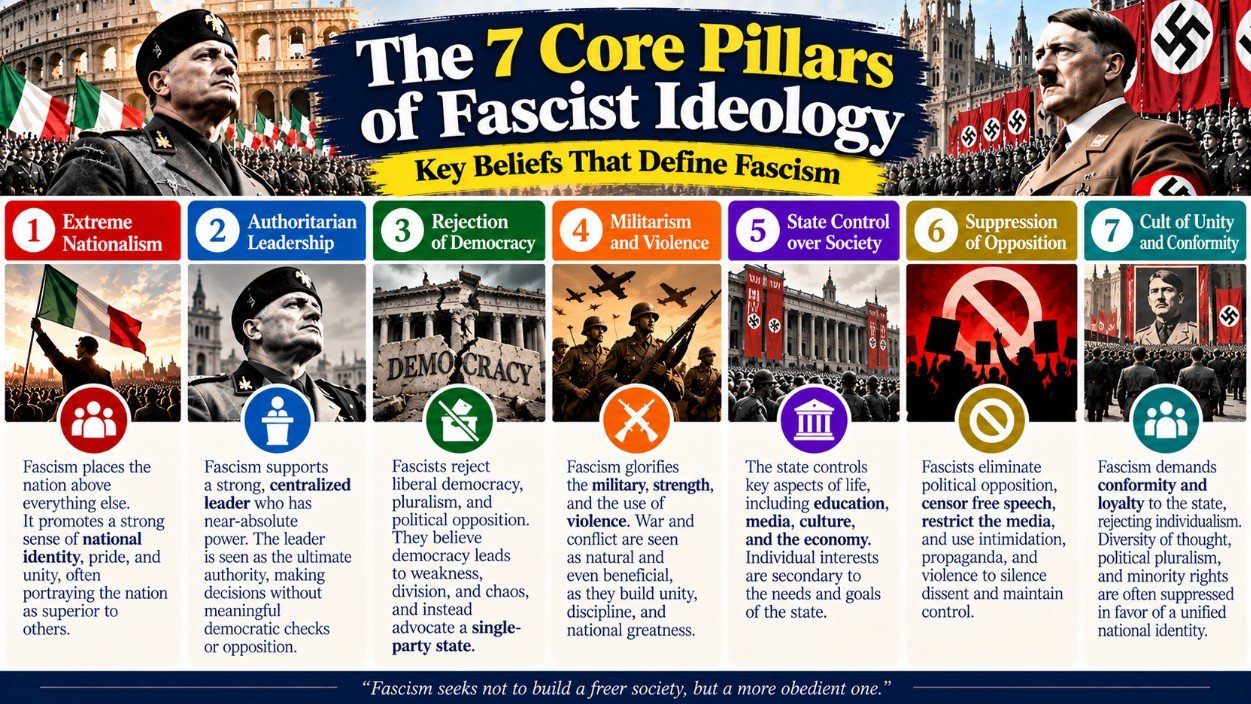
Because fascist leaders care more about action and emotion than writing thick philosophy books, their rules can shift from country to country. However, political scientists agree that seven core pillars define the true fascist meaning.
1. Ultranationalism and the Myth of Rebirth
Patriotism is being proud of your country; ultranationalism is believing your country is superior to all others and has the right to dominate them. British historian Roger Griffin points out that fascism relies on “palingenetic ultranationalism”—a fancy term for a myth of national rebirth. The leader tells citizens: “Our country used to be a great empire, then weak traitors and outsiders ruined it, and only I can make it rise from the ashes.”
2. The Cult of the Leader
A fascist regime cannot function with a normal president who takes advice from a cabinet. It requires a single, charismatic strongman (Il Duce, Der Führer) who is presented as a national savior. State propaganda posters, radio broadcasts, and schoolbooks paint the leader as a tough, tireless genius who never makes a mistake and embodies the willpower of the entire population.
3. Totalitarianism and Police Terror
In a normal dictatorship, the ruler mostly leaves you alone as long as you stay out of politics and pay your taxes. Fascism aims to be totalitarian. The state wants to control your job, your church, your hobbies, and even your family life. Secret police forces—like the Gestapo in Nazi Germany or the OVRA in Italy—encourage neighbors and children to spy on each other, crushing any whisper of disagreement.
4. Scapegoating and “Us vs. Them” Politics
Fascist movements unite their followers by giving them a shared enemy to hate. They divide the world into “Us” (the pure, hardworking native citizens) and “Them” (ethnic minorities, immigrants, Jewish people, Romani people, LGBTQ+ individuals, socialists, and liberals). By blaming every economic hiccup or social problem on these groups, the dictator deflects blame away from his own bad policies.
5. Militarism and the Glorification of Violence
Most political systems view war as a tragic last resort. Fascism views peace as boring and weak, and war as the highest form of human achievement. Young boys and girls are enrolled in state youth groups—like the Hitler Youth or the Italian Balilla—where they march with rifles and learn that dying on the battlefield is the noblest goal in life.
6. Disdain for Democracy and Liberal Values
Fascists openly mock parliaments, voting rights, free newspapers, and compromises. To a fascist, debating a bill in Congress for three months is a sign of decay. They believe that enlightenment values like human equality and individual liberty make a country soft.
7. Obsession with Traditional Gender Roles
Fascist regimes enforce strict rules for men and women. Men are expected to be hyper-masculine warriors and factory workers. Women are pushed out of professional jobs and told their patriotic duty is to stay home and have as many babies as possible to grow the future army. In both Italy and Germany, the state handed out gold, silver, and bronze medals to mothers who gave birth to large numbers of children.
How a Fascist Economy Actually Works
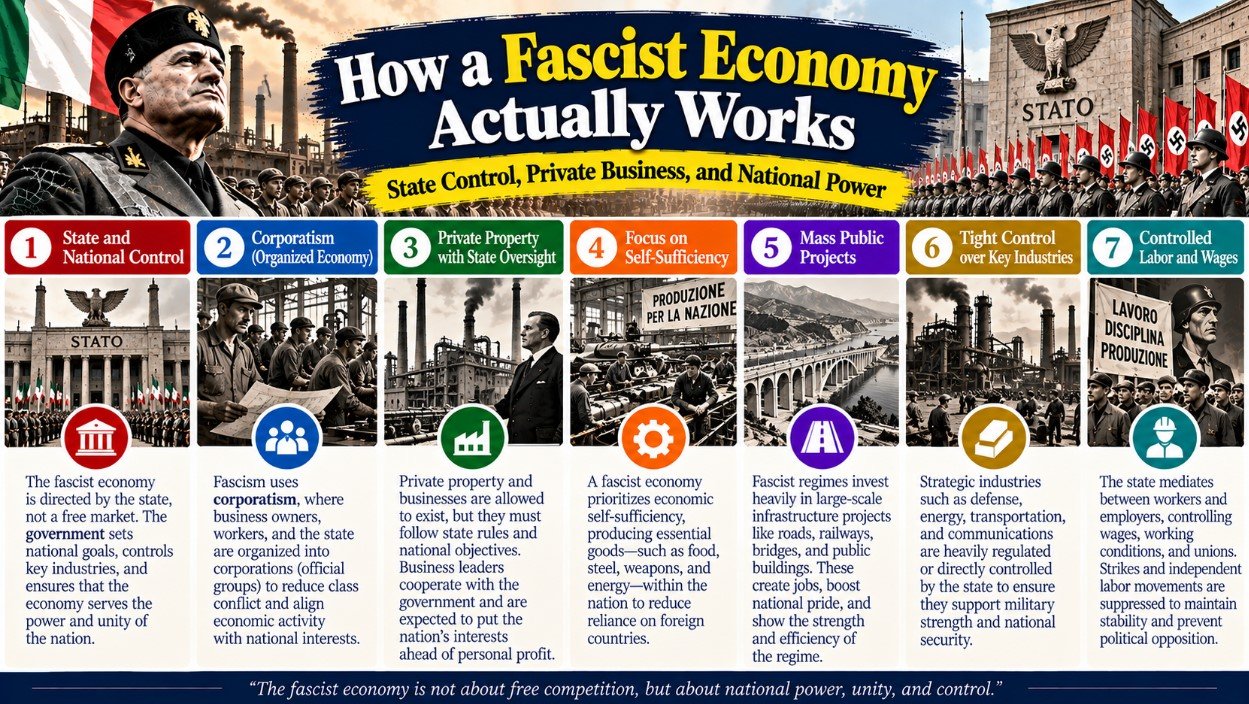
One of the biggest arguments on the internet today is whether fascism is capitalist or socialist. After all, the word “Nazi” was short for the National Socialist German Workers’ Party.
Historians and economists are crystal clear on this: Hitler used the word “Socialist” as a marketing trick to steal working-class voters away from the German Communist and Social Democratic parties. Once in power, one of the first things both Mussolini and Hitler did was ban independent labor unions, outlaw strikes, and lock real socialists in prison camps.
The “Third Way”: State-Directed Capitalism
Fascists called their economic model a “Third Way”—an alternative to both Western free-market capitalism and Soviet communism. In practice, it worked like crony capitalism on steroids, also known as corporatism.
- Private Property Stays Intact: Unlike communists in the Soviet Union, who seized every factory and farm and made them government property, fascists allowed private business owners to keep their titles, deeds, and profits. Famous companies like Krupp, IG Farben, Siemens, and Fiat made massive fortunes under fascist rule.
- The Catch—Total Obedience: You got to keep your factory, and the government guaranteed your workers could never go on strike or ask for higher wages. In exchange, you had to produce whatever the dictator demanded—usually tanks, uniforms, chemicals, and weapons. If a business owner refused to cooperate with the regime’s military goals, the state simply took his business away and handed it to a loyal party member.
- Autarky (Self-Sufficiency): Fascist economies try to stop buying goods from foreign countries so they won’t be vulnerable to trade blockades during a war. Because no country has all the oil, rubber, and food it needs inside its own borders, this desire for autarky inevitably forces the fascist country to invade its neighbors to steal their raw materials and slave labor.
Fascism vs. Communism vs. Socialism vs. Authoritarianism
Because authoritarian governments often look similar on the surface—with secret police, parades, and gulags or camps—people frequently mix them up. However, their goals, economic setups, and views on society are completely different.
| Feature | Fascism | Communism (Marxist-Leninist) | Democratic Socialism | Standard Authoritarianism |
| Political Spectrum | Far-Right | Far-Left | Center-Left / Left | Varies (Usually Right or Non-Ideological) |
| Core Focus | The Nation or Race | The Working Class (Proletariat) | Social & Economic Equality via Democracy | Staying in Power & Order |
| View on Social Classes | Keeps classes; demands rich and poor work together for the state. | Wants to destroy all classes by eliminating private wealth. | Uses high taxes and welfare to narrow the gap between rich and poor. | Protects the wealthy elite and military leaders in charge. |
| Private Property | Allowed, as long as owners obey the dictator’s national goals. | Abolished; the state owns all factories, land, and businesses. | Allowed, alongside public ownership of utilities or healthcare. | Allowed; often relies on corrupt deals with the ruler’s family. |
| Scope of Control | Totalitarian (controls work, family, culture, and thoughts). | Totalitarian (in historical examples like Stalin’s USSR). | Democratic (protects free speech, free press, and multi-party elections). | Limited (controls politics, but leaves private and religious life alone). |
| View on Internationalism | Hates global cooperation; wants to conquer neighbors. | Claims all workers worldwide should unite across borders. | Supports international alliances, human rights, and global trade rules. | Focuses on its own borders; rarely tries to conquer the world. |
| Historical Examples | Mussolini’s Italy, Hitler’s Nazi Germany. | Stalin’s Soviet Union, Mao’s China. | Modern Nordic models (partial), UK Labour Party post-WWII. | Pinochet’s Chile, modern military juntas, absolute monarchies. |
Why Fascist Regimes Appeal to People—and Why They Fail
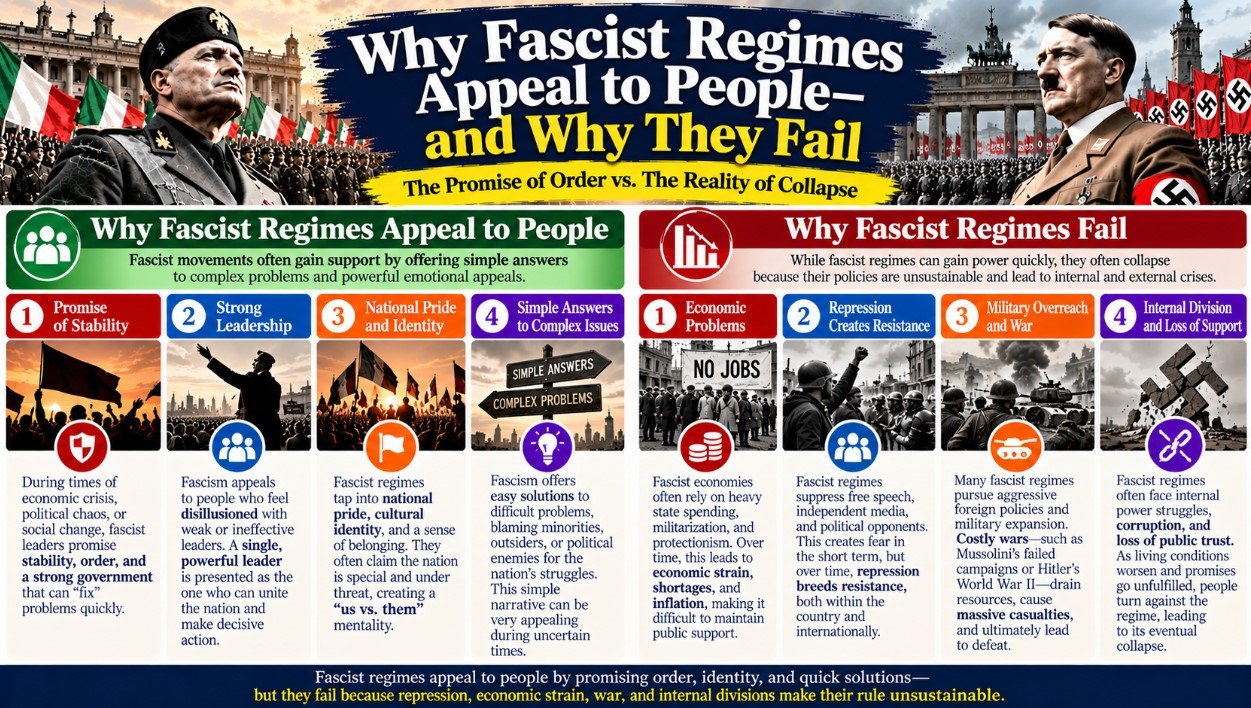
It is easy to look back at history books and wonder how millions of educated citizens in Italy and Germany cheered for ruthless dictators. To understand the fascist meaning completely, we have to look at what these regimes promised their citizens—and why those promises always ended in disaster.
Perceived Advantages (Why People Supported It)
- Fast Action in a Crisis: When a country is paralyzed by hyperinflation, mass unemployment, and bickering politicians, a dictator who steps in and builds highways (like the Autobahn), launches public works, and puts people back to work overnight looks like a miracle worker.
- Law and Order on the Streets: For citizens terrified of violent street crime, riots, and political chaos, fascist regimes restored quiet to neighborhoods by locking up criminals and protesters alike—leading to the famous myth that “Mussolini made the trains run on time.”
- Psychological Belonging: For people feeling lonely, poor, and humiliated after losing a war, fascism offered a powerful sense of pride. Wearing a uniform, marching in torchlight parades, and hearing that you belong to a “master race” or a reborn empire gave millions of ordinary people a thrilling sense of purpose.
The Fatal Flaws (Why It Always Collapses)
- Zero Guardrails Against Bad Decisions: In a democracy, if a president comes up with a terrible plan, Congress, the courts, or the free press will point out the mistakes. In a fascist state, anyone who tells the dictator the truth gets fired or shot. Surrounded by “yes-men,” leaders like Hitler and Mussolini made catastrophic military blunders—like invading the Soviet Union in the middle of winter—that destroyed their own countries.
- An Economy Built on Plunder: Because fascist economies spend monstrous sums of money on the military to keep unemployment down, they quickly run out of cash. The only way to pay the bills is to invade neighboring countries and loot their banks and factories. This guarantees that a fascist regime will eventually start a war big enough to unite the rest of the world against it.
- Destruction of Talent and Innovation: By persecuting minorities, banning “degenerate” books, and forcing scientists to follow political dogma, fascist states drive out their smartest minds. For example, Albert Einstein, Enrico Fermi, and dozens of other brilliant physicists fled fascist Europe for the United States—where they helped the Allies build the very weapons that defeated the Axis powers.
- Human Misery and Genocide: Above all, the system requires constant terror, torture, and mass murder to survive, leaving a legacy of millions of dead civilians, bombed-out cities, and generational shame.
Click Now: Nonchalant Meaning
How Scholars Spot Fascism: Umberto Eco and Robert Paxton
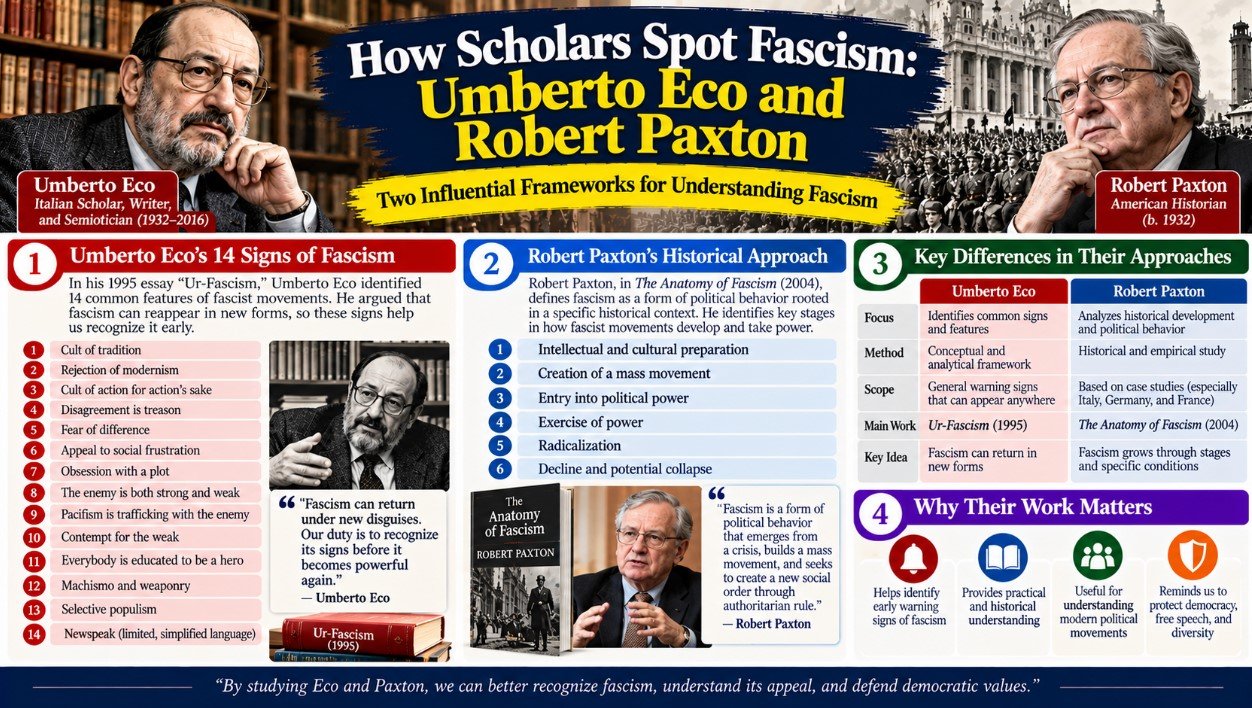
Because modern politicians rarely put on a Blackshirt uniform and openly call themselves fascists anymore, historians have created checklists to identify the movement when it wears a modern disguise. Two of the most respected frameworks come from Umberto Eco and Robert Paxton.
Umberto Eco’s “Ur-Fascism” (Eternal Fascism)
Umberto Eco was an Italian novelist and scholar who actually grew up under Mussolini’s regime as a young boy. In his famous 1995 essay “Ur-Fascism,” Eco explained that you do not need every single Nazi or Italian rule in place for fascism to start growing; even a few of these warning signs can allow the movement to take root:
- The Cult of Tradition: Believing that all truth was already discovered in the distant past, and rejecting modern social progress.
- Fear of Difference: Treating racial, cultural, or religious diversity as a threat to national purity.
- Appeal to a Frustrated Middle Class: Mobilizing middle-class citizens who feel squeezed by economic hardship or scared that lower-class groups are gaining too much influence.
- Obsession with a Plot: Convincing followers that the nation is under siege from a secret, powerful conspiracy (often mixing internal minorities with foreign enemies).
- The Enemy Is Both Too Strong and Too Weak: Fascist propaganda always paints its enemies as sneaky, all-powerful puppet masters who control the world, while simultaneously claiming those same enemies are weak, inferior degenerates whom the state can easily crush.
- Newspeak: Using dumbed-down, repetitive slogans and shrinking people’s vocabulary so citizens cannot think critically about complex problems.
Robert Paxton’s “Five Stages” of Fascism
Robert O. Paxton, a renowned professor at Columbia University and author of The Anatomy of Fascism, argues that we should judge fascism by what it does rather than what it says, because fascist leaders lie constantly to get votes. Paxton breaks the lifecycle of fascism into five distinct stages:
- Stage 1: Intellectual Exploration: Angry thinkers and writers complain about the failures of democracy and dream up a radical national rebirth. (Happens in almost every country, including democracies).
- Stage 2: Rooting in the Political System: The movement becomes a real political party that wins seats because mainstream politicians are deadlocked and failing to solve major crises.
- Stage 3: Arrival in Power: This is the most critical lesson from history. Neither Mussolini nor Hitler seized power through a violent military coup. Both were legally invited into power by traditional, conservative politicians and businessmen who thought they could “tame” the fascists and use them as a tool to defeat the left.
- Stage 4: Exercising Power: Once inside the government, the dictator dismantles the courts, police, and press from within, sidelining the conservatives who helped him get the job.
- Stage 5: Radicalization or Entropy: The regime either loses steam and turns into a boring, stagnant dictatorship (like Franco’s Spain), or it goes into overdrive, launching total war and genocide until it self-destructs (like Nazi Germany).
Modern Usage: Why Do People Use the Word So Loosely Today?
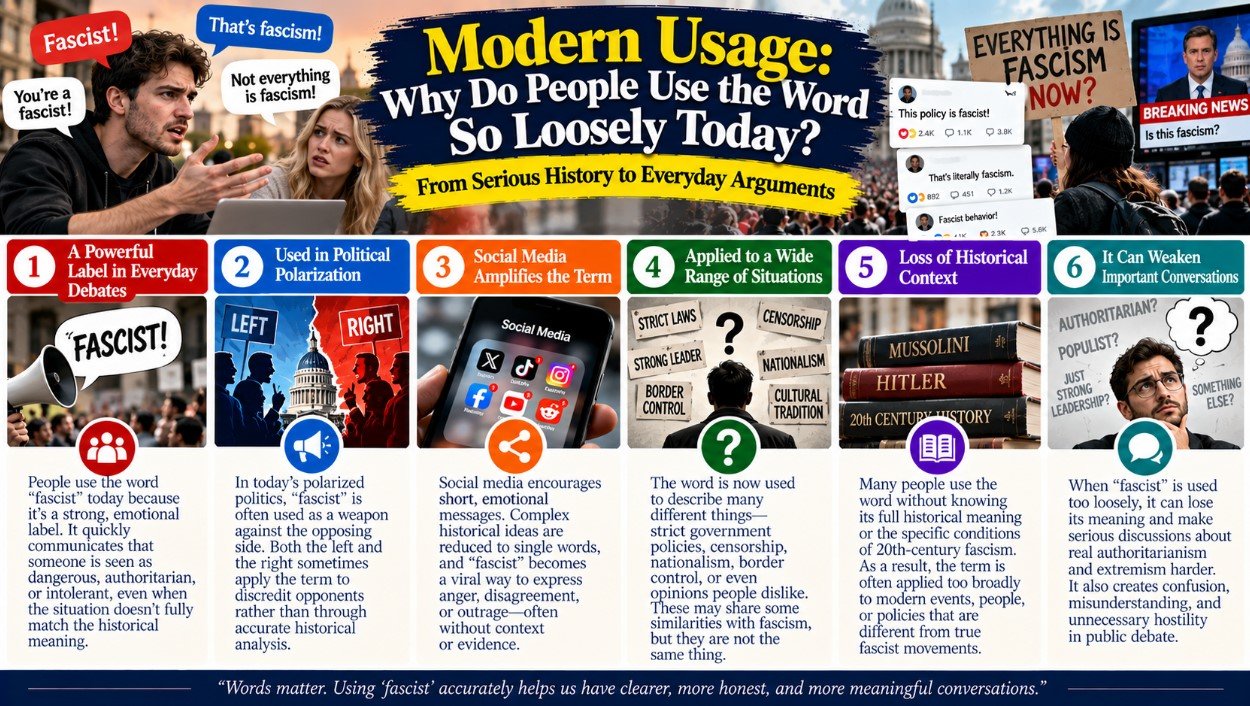
If you turn on the news in the United States today, you will hear people on the political left call right-wing populists “fascists” over strict immigration policies or challenges to election rules. Five minutes later, you will hear people on the political right call left-wing politicians “fascists” over vaccine mandates, environmental regulations, or speech codes on college campuses.
Why the Word Gets Stretched
There is a simple psychological reason people reach for this word: since 1945, fascism—and Nazism in particular—has stood as the ultimate symbol of evil in Western culture. Calling your political opponent “wrong” or “misguided” doesn’t get clicks or stir up anger. Calling them a “fascist” turns a disagreement over tax policy or public health into a life-or-death battle between good and evil.
Populism vs. Authoritarianism vs. Fascism
To think clearly about current events without falling for exaggeration, political scientists suggest keeping three separate labels in mind:
- Right-Wing Populism: A political style that pits “ordinary, forgotten citizens” against “corrupt elites” and favors tight borders and America-first trade policies, but still operates within elections and constitutional courts.
- Illiberal Democracy / Authoritarianism: When an elected leader tries to bend the rules—like packing the Supreme Court, harassing independent journalists, or redrawing voting maps—to make it almost impossible for the opposing party to win. Countries like modern Hungary under Viktor Orbán are often placed here by analysts.
- Neo-Fascism: Actual modern fringe groups—such as white supremacist militias, skinhead gangs, and neo-Nazi organizations—that openly reject the U.S. Constitution, celebrate political violence, and call for an ethno-state based on racial purity.
When we call a parking ticket, a mask rule, or a standard conservative tax bill “fascist,” we accidentally do real neo-fascists a huge favor. If everything is fascist, then nothing is. Saving the word for movements that genuinely use paramilitary violence, worship a dictator, and aim to destroy democracy altogether keeps our political language honest—and helps us spot real danger if it ever arrives at the doorstep.
Learn More: DEI Meaning in Politics
Frequently Asked Questions (FAQs)
1. What does fascist mean in simple terms?
In plain English, a fascist is someone who supports a far-right dictatorship where the government controls almost every part of life, individual rights do not exist, political opponents are jailed or killed, and the country’s race or nationality is treated as superior to everyone else in the world.
2. Is fascism left-wing or right-wing?
Historians and political scientists universally classify fascism as far-right. Why? Because left-wing ideologies push for radical equality and the removal of social hierarchies, while fascism believes in strict social hierarchies—where elites rule the masses, strong nations conquer weak nations, men dominate women, and one race or nationality stands above all others. Furthermore, fascists historically rose to power by teaming up with conservative elites to violently crush left-wing labor unions, socialists, and communists.
3. How do you pronounce “fascist”?
It is pronounced FASH-ist (/ˈfæʃɪst/). The “sc” in the middle makes a soft “sh” sound, just like in the word “conscious” or “fascinate.”
4. What is the difference between a Nazi and a fascist?
Think of Nazism as a specific, hyper-extreme brand of fascism. All Nazis are fascists, but not all fascists are Nazis. Under Mussolini, Italian fascism worshiped the State first; for the first fifteen years of Mussolini’s rule, Italian Jews were even allowed to join the Fascist Party (until Mussolini copied Hitler’s racial laws in 1938). Nazism, on the other hand, put biological race first. To Hitler, the government was just a tool to preserve and expand the “Aryan” race and exterminate Jewish people and other groups.
5. What does “Antifa” mean, and how does it relate to fascism?
Antifa is short for “anti-fascist.” The name goes back to the 1920s and 1930s in Europe, when left-wing groups formed street defense leagues (like Antifaschistische Aktion in Germany) to physically fight Mussolini’s Blackshirts and Hitler’s Brownshirts. Today, Antifa is not a single organization with a president or headquarters; it is a loose network of far-left, often anarchist activists who believe in confronting white supremacists and far-right groups directly in the streets rather than relying on police or laws.
6. Are there any fascist countries left in the world today?
Following the defeat of Germany and Italy in 1945, and the transitions to democracy in Spain and Portugal in the mid-1970s, there are no officially fascist countries left in the world today. While countries like North Korea practice extreme racial nationalism and total dictatorship that closely mimics fascism, and Russia under Vladimir Putin displays strong ultranationalist and militaristic traits, no modern government openly claims the fascist label.
7. Can a democracy turn into a fascist state legally?
Yes, and history shows that is actually the most common way it happens. Neither Mussolini nor Hitler took over by storming the capital with an army and overthrowing the government by force. Both participated in elections, built coalitions with mainstream conservative politicians, were legally appointed to their jobs by the head of state, and then passed emergency laws through parliament to legally abolish democracy from the inside.
8. Why did Mussolini choose the bundle of sticks as his symbol?
Mussolini wanted to connect his modern political party to the ancient glory of the Roman Empire. By choosing the Roman fasces—a bundle of wooden rods tied around an axe—he visually communicated that individual Italians were weak on their own, but unbreakable when tied together under the absolute life-and-death authority of a single ruler.
9. How does fascism view religion?
Fascism has a complicated, opportunistic relationship with religion. In theory, fascism wants the state to be the citizen’s only religion. However, in practice, dictators knew they needed the support of religious voters. Mussolini signed the Lateran Treaty in 1929, making Catholicism the state religion of Italy and creating Vatican City in exchange for the Pope’s political neutrality. Hitler promoted “Positive Christianity” early on to win over German churches, though he later jailed pastors—like Dietrich Bonhoeffer—who dared to criticize Nazi policies.
Putting the Fascist Meaning in Perspective
Understanding the true fascist meaning is about more than passing a history test or winning an argument online. When we look back at the 20th century, we see that fascism is not just a random collection of strict laws or rude politicians. It is a specific, dangerous system that feeds on economic despair, national humiliation, and the fear of outsiders.
By recognizing its core ingredients—the myth of national rebirth, the worship of a single infallible leader, the use of paramilitary violence, and the subordination of individual liberty to the state—you can cut through modern political noise. You can spot the difference between ordinary democratic disagreements that require debate, and genuine authoritarian threats that history warns us never to ignore.