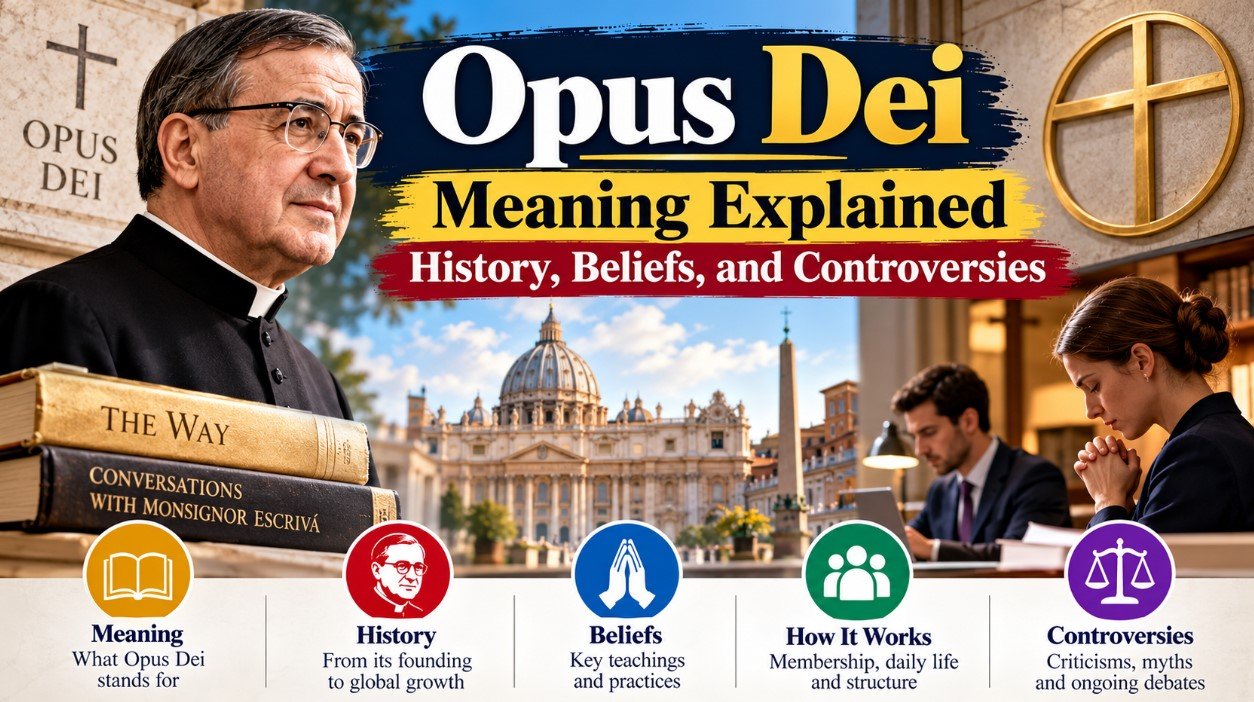
Opus Dei Meaning Explained: History, Beliefs, and Controversies
Opus Dei is a Catholic institution known for its emphasis on spiritual growth, personal holiness, and finding God in everyday life. The Latin phrase Opus Dei translates to “Work of God,” reflecting its central belief that ordinary activities, including work, family responsibilities, and daily routines, can become meaningful expressions of faith. Founded in Spain in 1928 by Catholic priest Josemaría Escrivá, Opus Dei Meaning has grown into an international organization within the Catholic Church.
Despite its religious mission, Opus Dei has attracted public attention and debate over the years. Its traditional spiritual practices, organizational structure, expectations of members, and portrayal in popular culture have raised questions about what the institution actually believes and how it operates. These discussions have also contributed to misunderstandings about its purpose and role in modern society.
In this guide, you’ll discover the meaning of Opus Dei, explore its origins and core beliefs, learn how membership works, and examine the controversies surrounding the organization. Whether you’re researching its Catholic roots or trying to separate popular portrayals from documented facts, this article will help you understand Opus Dei Meaning more clearly.
What Is the Meaning of Opus Dei?
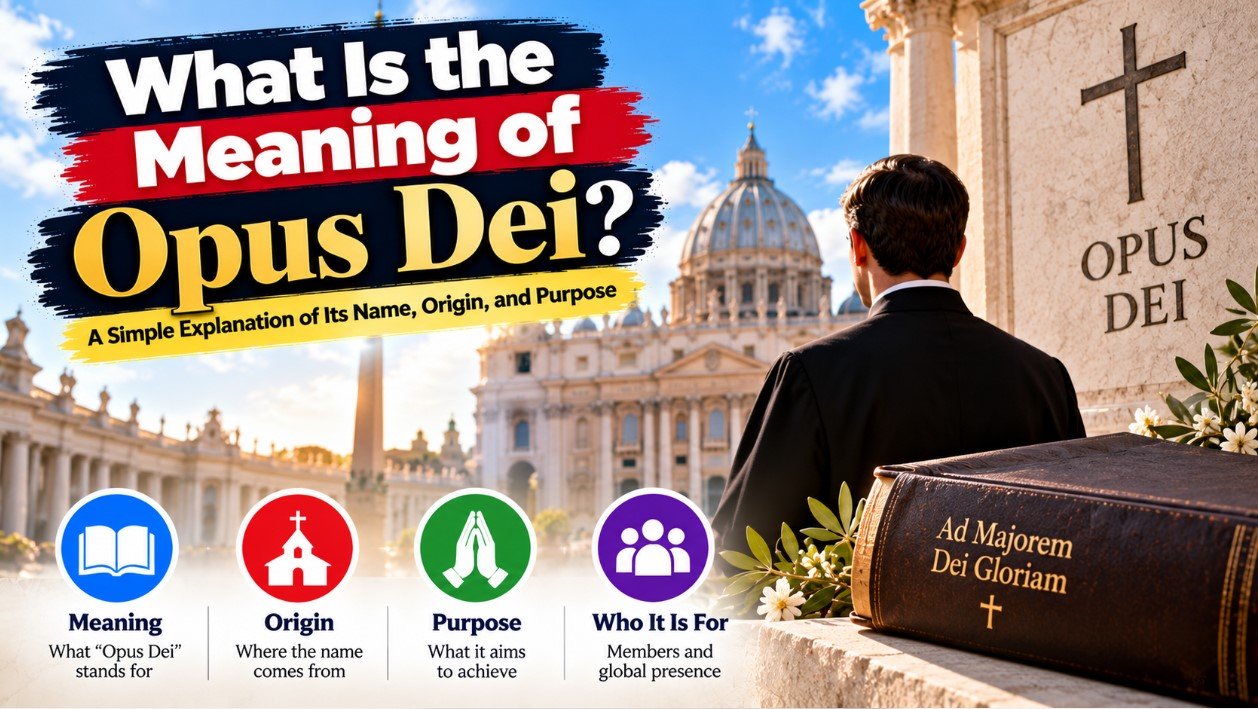
The Latin phrase Opus Dei Meaning translates directly to “Work of God.” Within the Catholic Church, its formal title is the Prelature of the Holy Cross and Opus Dei. It is an institution whose core mission centers on helping ordinary people find holiness in their daily routines, professional careers, family obligations, and social activities.
┌────────────────────────────────────────────────────────┐
│ LATIN: “OPUS DEI” │
│ Translates to: “Work of God” │
└───────────────────────────┬────────────────────────────┘
│
┌────────────────────┴────────────────────┐
▼ ▼
Formal Ecclesial Title: Central Spiritual Mission:
Prelature of the Holy Cross Universal Call to Holiness
and Opus Dei Through Daily Secular Work
Unlike monks or nuns who withdraw from secular society behind monastery walls, members of Opus Dei remain fully immersed in regular life. They work as schoolteachers, bus drivers, lawyers, engineers, and doctors. The foundational message is simple: you do not need to take religious vows of poverty or enter a seminary to live a life devoted to God. Instead, ordinary labor becomes a form of continuous prayer when completed with competence, integrity, and love.
Click Here: Body Count Meaning
Historical Background: St. Josemaría Escrivá
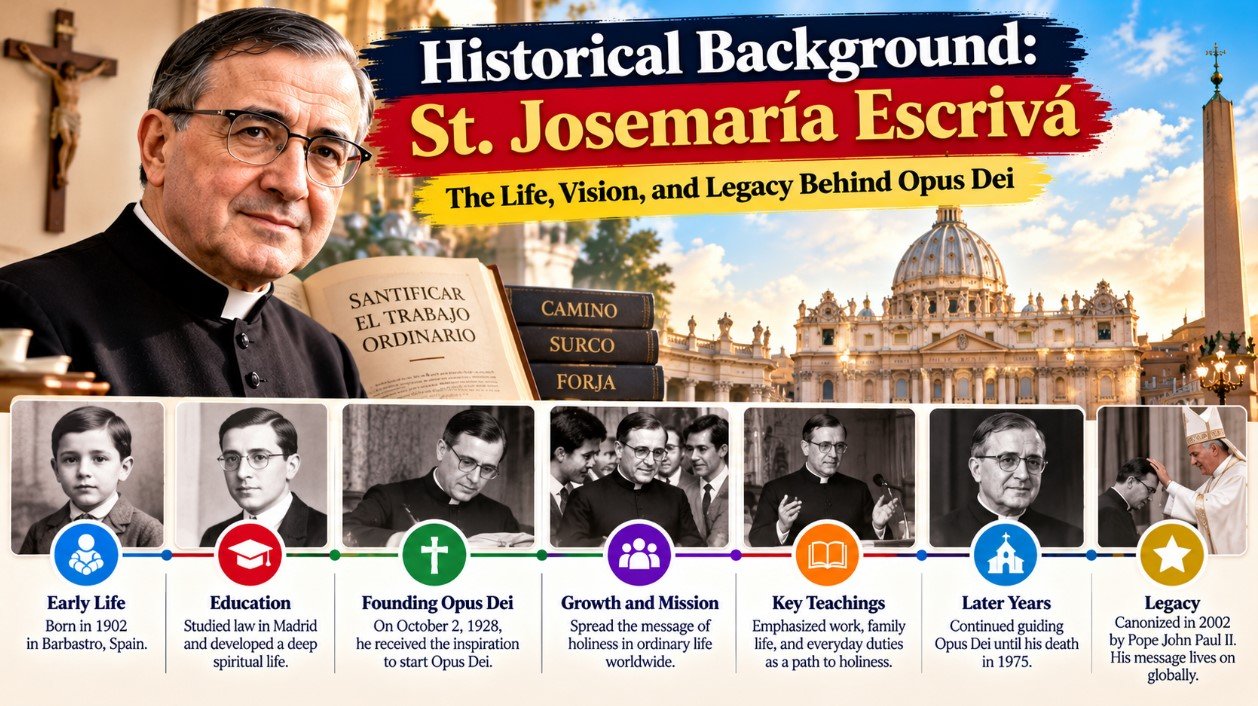
Opus Dei began in Madrid, Spain, on October 2, 1928. A young Roman Catholic priest named Josemaría Escrivá de Balaguer was attending a spiritual retreat when he experienced what he described as a divine illumination. He felt a deep calling to remind everyday Christians that their ordinary secular activities possessed profound spiritual value.
1928: Founded in Madrid by Josemaría Escrivá
│
1930: Escrivá extends the apostolate to include women
│
1936–1939: Spanish Civil War forces early members underground
│
1943: Priestly Society of the Holy Cross founded to ordain clergy
│
1946: Escrivá moves headquarters to Rome to internationalize the mission
│
1950: Pope Pius XII grants definitive worldwide approval
│
1982: Pope John Paul II establishes Opus Dei as a Personal Prelature
│
1992 / 2002: Escrivá beatified (1992) and canonized as a Saint (2002)
During the 1920s, popular religious thought often treated true holiness as an exclusive path reserved for ordained priests and cloistered nuns. Escrivá challenged that mindset. He argued that the kitchen, the workshop, the hospital, and the boardroom were holy ground. In 1930, he opened the apostolate to women, ensuring the message reached every corner of society.
The organization endured severe trials during the Spanish Civil War (1936–1939), as religious persecution forced Escrivá and his early companions to hide and operate underground. Following the war, Opus Dei Meaning expanded across Spain and into broader Europe. Escrivá moved the headquarters to Rome in 1946, seeking global integration within the universal Church.
Pope John Paul II held a deep affinity for Escrivá’s pastoral vision. In 1992, he beatified the founder, and on October 6, 2002, he officially canonized him as Saint Josemaría Escrivá in St. Peter’s Square before a crowd of several hundred thousand people.
Core Spiritual Pillars and Theological Mission
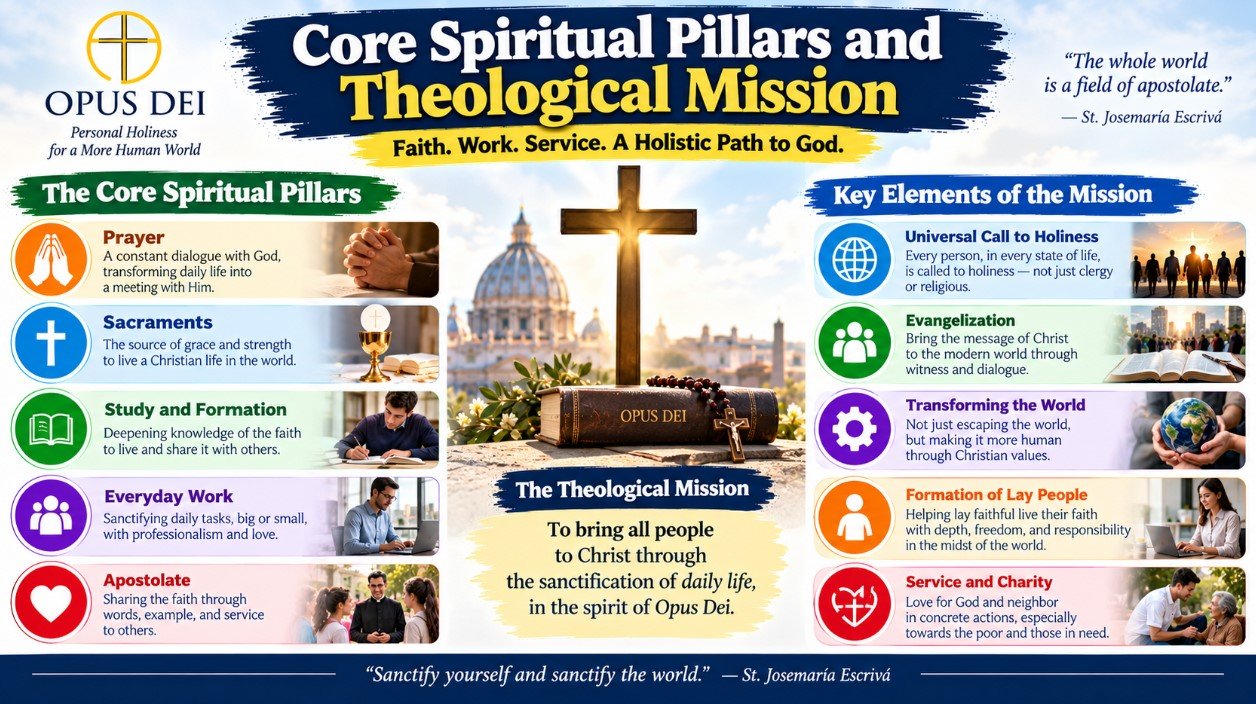
The spirituality of Opus Dei rests on five main theological pillars:
DIVINE FILIATION (Foundation)
Awareness of being an authentic child of God
│
┌────────────────┼────────────────┐
▼ ▼ ▼
SANCTIFYING UNITY PRAYER &
WORK OF LIFE SACRAMENTS
Transforming daily Merging faith Interior life fueling
work into prayer with actions daily resilience
1. Divine Filiation
Divine filiation means knowing, accepting, and living with the conviction that you are a true child of God. Escrivá identified this truth as the psychological and spiritual foundation of the Christian life. When people recognize their divine heritage, fear dissolves, optimism takes root, and everyday problems feel manageable.
2. Sanctification of Work
The central practical teaching of Opus Dei Meaning involves a three-step formula for secular labor:
- Sanctifying your work: Doing your job with exceptional technical competence, ethics, and focus, rather than settling for mediocrity.
- Sanctifying yourself in your work: Allowing the daily discipline, patience, and problem-solving demanded by your profession to build your moral character.
- Sanctifying others through your work: Using your professional interactions to show kindness, mentor colleagues, and lead through humble example.
3. Unity of Life
Escrivá warned against a “double life”—the tendency to act devoutly at Sunday Mass while acting selfishly, ruthlessly, or dishonestly in business on Monday morning. Unity of life demands total consistency. Faith, work, family obligations, and leisure must form a single, harmonious existence.
4. Life of Prayer and Sacraments
Work cannot become prayer without genuine spiritual nourishment. Members maintain steady interior lives centered on regular reception of the Eucharist, frequent Confession, Scripture meditation, and personal quiet time with God.
5. Freedom and Personal Responsibility
Opus Dei Meaning emphasizes secular freedom. Members enjoy the exact same political, economic, and social freedom as any other citizen. The organization takes no official political stances; members make up their own minds and take full personal responsibility for their civic choices.
Learn More: DEI Meaning in Politics
Organizational Structure: What Is a Personal Prelature?
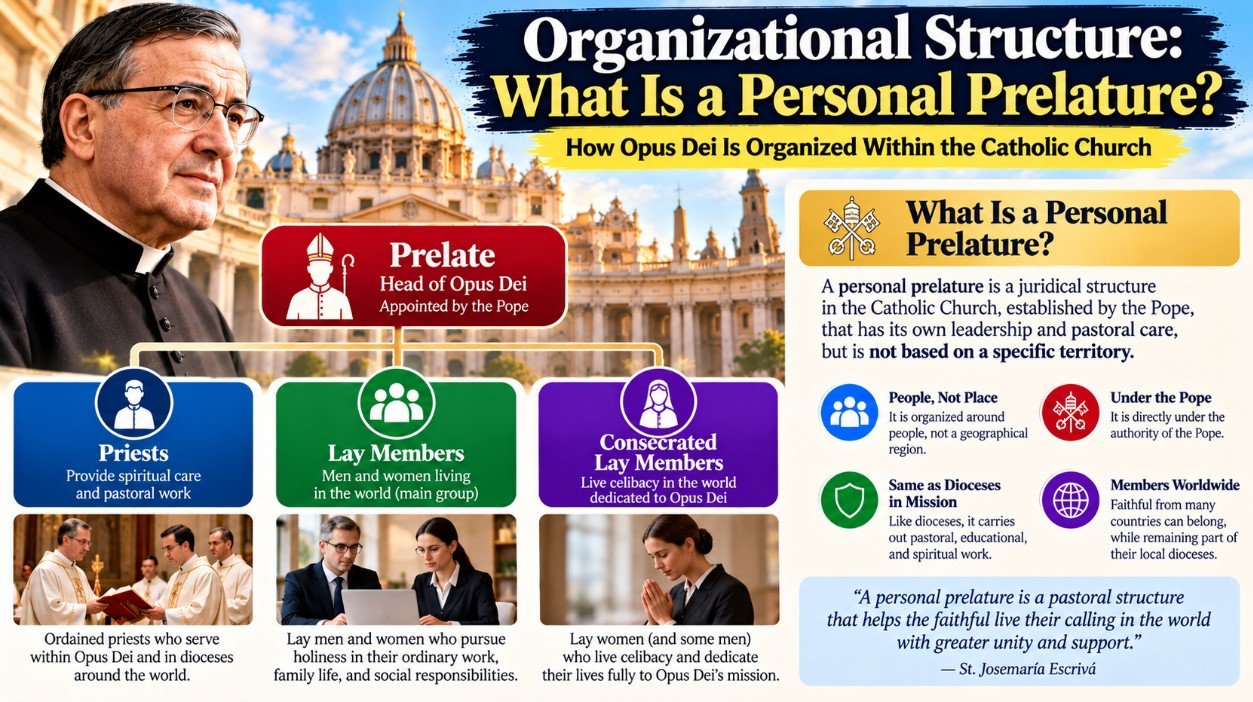
In 1982, Pope John Paul II designated Opus Dei as the Catholic Church’s first personal prelature through the apostolic constitution Ut Sit.
TRADITIONAL TERRITORIAL DIOCESE PERSONAL PRELATURE (OPUS DEI)
┌─────────────────────────────┐ ┌─────────────────────────────┐
│ Defined strictly by bounds │ │ Defined by pastoral mission │
│ on a geographic map. │ │ regardless of geography. │
│ │ │ │
│ Includes all Catholic │ │ Operates worldwide, │
│ residents within a city │ │ coordinating clergy and │
│ or regional territory. │ │ lay members side-by-side. │
└─────────────────────────────┘ └─────────────────────────────┘
A standard diocese is defined by geographic lines: everyone living inside that county or district answers pastorally to the local bishop. In contrast, a personal prelature is organized around a specific pastoral mission, unbound by geography. It consists of a prelate (the head official), clergy, and lay men and women working together.
Lay members remain full parishioners of their home geographic parishes and answer to their local diocesan bishop for general Catholic obligations. The prelate guides only what concerns the specific ascetical and apostolic duties of Opus Dei.
Categories of Membership
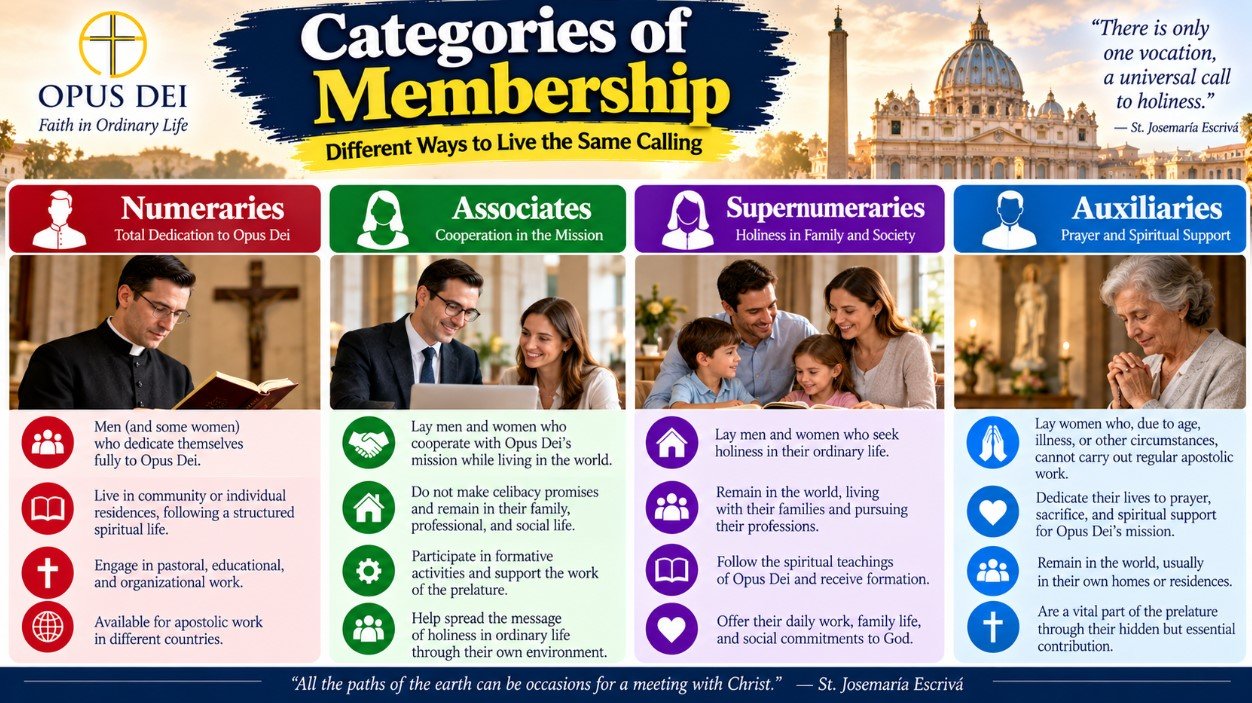
Opus Dei includes approximately 93,000 members worldwide. About 98% are laypeople, while roughly 2% are priests. Men and women participate with equal standing, organizing their activities and residences in separate branches.
┌────────────────────────────────────────────────────────────────────────┐
│ TOTAL MEMBERSHIP (~93,000) │
├──────────────────────────────────────┬─────────────────────────────────┤
│ SUPERNUMERARIES (~70%) │ NUMERARIES (~20%) │
│ • Married men and women │ • Celibate; live in centers │
│ • Live in standard family homes │ • Hand over surplus income │
│ • Fully self-supporting │ • Maintain regular professions │
├──────────────────────────────────────┼─────────────────────────────────┤
│ ASSOCIATES (~8–9%) │ NUMERARY ASSISTANTS (~1–2%) │
│ • Celibate members │ • Celibate women │
│ • Live with family or independently │ • Focus on hospitality and care │
│ • Often balance family duties │ of internal residences │
└──────────────────────────────────────┴─────────────────────────────────┘
Note: Priests (~2%) come from the ranks of celibate male members.
Supernumeraries
Supernumeraries make up roughly 70% of the total roster. These are married or single men and women living standard domestic lives. They raise families, work conventional jobs, and finance their own households. They apply the spirituality of Opus Dei Meaning to parenting, marriage, and workplace commitments.
Numeraries
Numeraries account for roughly 20% of the membership. They are celibate laypeople who usually live together in designated Opus Dei residential centers. They balance two responsibilities:
- They work ordinary secular jobs in academia, business, medicine, or the arts.
- They dedicate their free hours to running youth clubs, leading retreats, and providing spiritual direction.
Numeraries pass their surplus salary back to the prelature to support its operational apostolates, retaining only what they need for modest daily living expenses.
Associates
Associates are celibate members who choose not to live in residential centers due to personal obligations, such as caring for elderly parents or managing demanding professional travel. They commit to the same celibacy and spiritual practices as numeraries while living independently.
Numerary Assistants
Numerary assistants are celibate women who dedicate their professional work to managing the hospitality, housekeeping, and domestic life of Opus Dei residential centers. They treat home economics and hospitality as their primary sanctified profession.
Clergy and Cooperators
The Priestly Society of the Holy Cross is an association of priests tied directly to Opus Dei. It includes priests ordained from the ranks of secular numerary and associate members, as well as diocesan priests who join to receive ongoing spiritual guidance while remaining under their local bishops.
Cooperators are non-members who support Opus Dei projects through financial donations, volunteer labor, or prayer. Remarkably, cooperators do not even have to be Catholic; Protestants, Orthodox Christians, Jews, Muslims, and non-believers can join this support network.
Daily Life, Routines, and Spiritual Plans
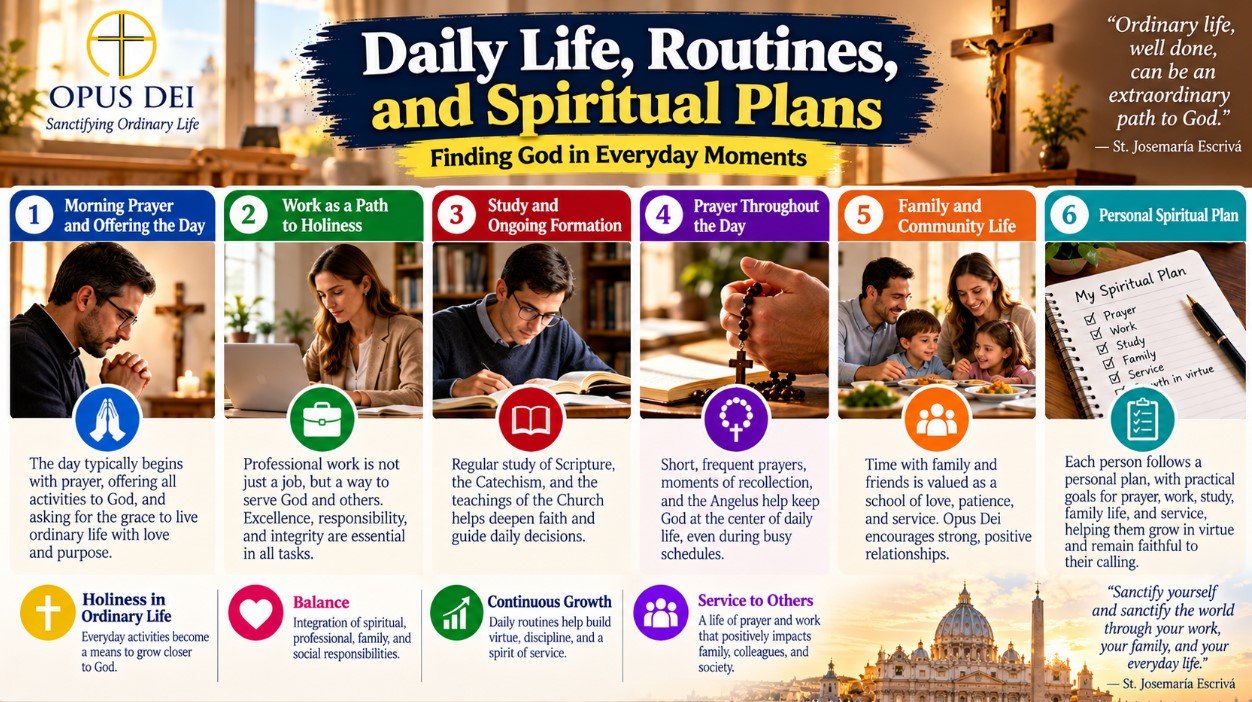
Members maintain what Saint Josemaría called the “Plan of Life” (the norms of piety). This structured daily spiritual routine keeps members grounded in their faith:
MORNING:
├─ The “Heroic Minute” (jumping out of bed immediately upon waking)
├─ Morning Offering prayer
├─ 30 minutes of silent, meditative mental prayer
└─ Daily Catholic Mass and Holy Communion
THROUGHOUT THE DAY:
├─ The Angelus prayer (at noon)
├─ Praying the Holy Rosary (five decades)
├─ 15 minutes of spiritual reading (Scripture and classic theology)
├─ Midday brief examination of conscience
└─ Continuous practice of God’s presence during secular work
EVENING:
├─ 30 minutes of silent mental prayer
├─ Night examination of conscience
└─ Final night prayers before retiring
This discipline turns chaotic schedules into structured interior peace. Members do not abandon their jobs to complete these steps; they build them naturally around commute times, lunch breaks, and early mornings.
Separating Fact from Fiction: Pop Culture vs. Reality
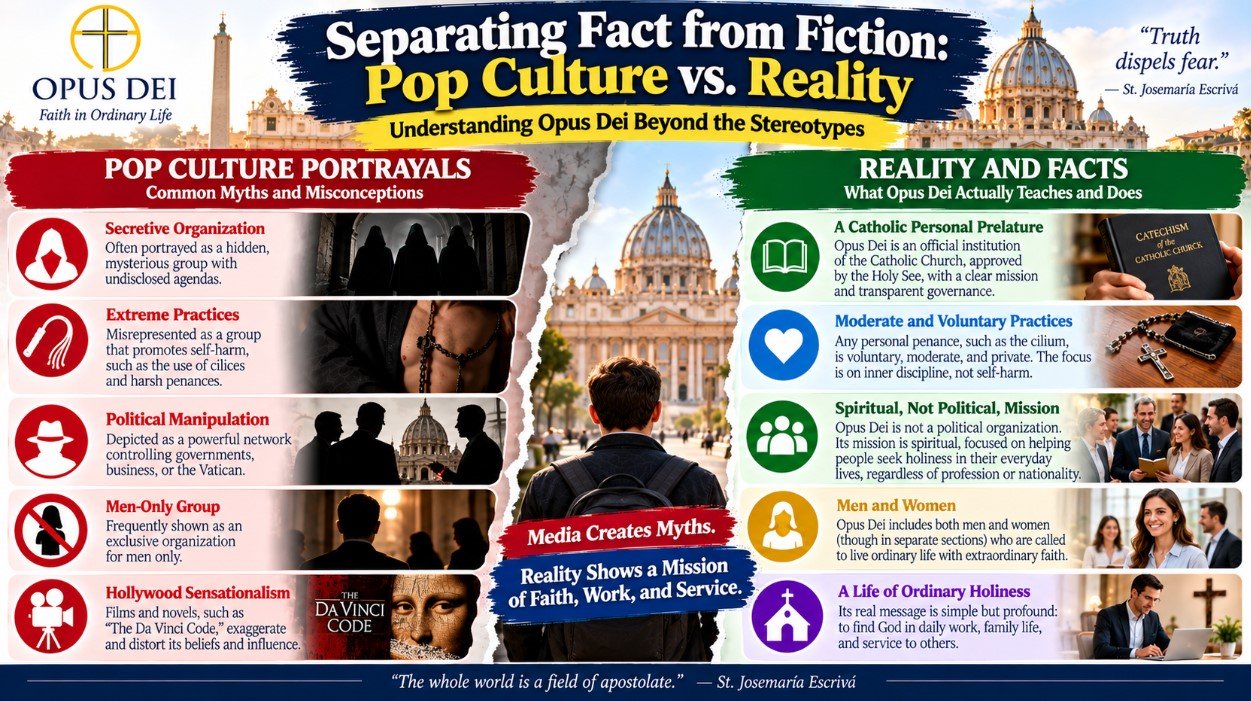
Opus Dei stepped into intense global media attention following the release of Dan Brown’s 2003 bestselling thriller, The Da Vinci Code, and its 2006 film adaptation. The novel depicted Opus Dei Meaning as a sinister, power-hungry cult led by corrupt leaders who dispatched a murderous, albino monk to cover up historical Church secrets.
That portrayal was pure fiction.
THE DA VINCI CODE (FICTION) REALITY OF OPUS DEI (FACT)
─────────────────────────────────── ───────────────────────────────────
Monks carrying out covert missions. There are no monks in Opus Dei;
members are secular laypeople.
Assassins, conspiracies, blackmail. Members run literacy drives,
high schools, and universities.
Shadowy banking manipulations. Audited, open non-profit entities
under local statutory laws.
Forced recruitment and isolation. Voluntary vocation pursued through
lengthy discernment.
There are zero monks in Opus Dei. Monks belong to monastic orders (such as the Benedictines, Cistercians, or Trappists) who take solemn vows and live isolated behind cloistered abbey walls. Opus Dei consists overwhelmingly of regular laypeople who vote, pay mortgages, wear jeans, work corporate jobs, and raise children.
The organization has no interest in hidden political conspiracies. Its real-world operations center on ordinary educational and social apostolates:
- The University of Navarra in Pamplona, Spain (along with its world-class medical school and hospital).
- IESE Business School, consistently ranked among the world’s leading MBA programs.
- Midtown Educational Center in Chicago, providing tutoring and character development to at-risk inner-city youth.
- Strathmore University in Nairobi, Kenya, promoting higher education and ethics across East Africa.
Corporal Mortification: Understanding the Tradition
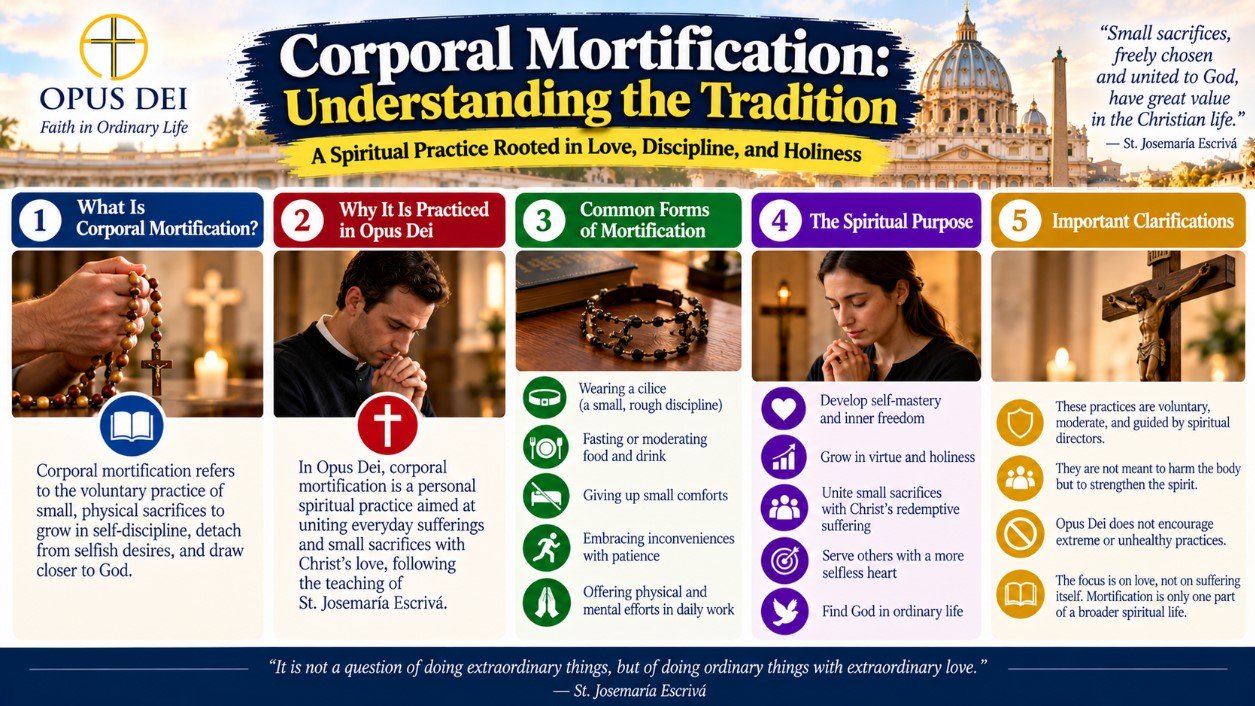
The issue that attracts the most outside curiosity is corporal mortification. Critics often point to these penances as evidence of fanaticism. To evaluate this fairly, one must understand its context within wider Catholic history.
Voluntary penance has existed in Christianity for two millennia. Saint Paul wrote in 1 Corinthians 9:27, “I punish my body and slave-drive it, lest after preaching to others I myself should be disqualified.” Saint Francis of Assisi, Saint Thomas More, Mother Teresa, and Pope John Paul II all used traditional physical mortifications to conquer self-centeredness and unite their daily aches with the sufferings of Christ on the Cross.
LEVELS OF MORTIFICATION IN OPUS DEI
ORDINARY (95% of focus – Practiced by ALL members)
- Biting your tongue instead of complaining
- Finishing hard work tasks when tired
- Eating less of what you prefer at dinner
- The “Heroic Minute”: waking instantly without hitting snooze
- Keeping a kind, cheerful demeanor during stressful commutes
│
▼
TRADITIONAL PENANCES (Voluntary – Practiced ONLY by celibate members)
- The Cilice: Small wire chain worn around upper thigh for ~2 hours/day
- The Disciplines: Small corded whip used briefly once a week
Celibate numeraries and associates carry on two specific traditional practices:
- The Cilice: A small, light wire chain worn around the upper thigh for roughly two hours a day (excluding Sundays and feast days). It causes discomfort and leaves temporary surface indentations, but it does not puncture the skin, draw blood, or cause bodily harm.
- The Disciplines: A small whip made of braided cotton cords used on the shoulders or back for a minute or two once per week while reciting a short prayer.
Supernumeraries—who make up the vast majority of Opus Dei Meaning—do not use the cilice or the disciplines. For almost all members, mortification looks completely ordinary: taking cold showers, skipping cream in their morning coffee, listening patiently to an annoying client, or finishing an exhausting project without complaint.
Click Now: DEI Meaning in the USA
Opus Dei vs. Traditional Religious Orders
To understand Opus Dei’s unique place in the Catholic Church, compare it to traditional religious orders like the Jesuits and Franciscans:
| Characteristic | Opus Dei | Jesuits (Society of Jesus) | Franciscans (Order of Friars Minor) |
| Canon Law Classification | Personal Prelature | Religious Order | Religious Order |
| Core Membership | 98% secular laypeople, 2% priests | Primarily priests and consecrated brothers | Priests and consecrated friars |
| Vows Taken | No vows (members make contractual agreements) | Solemn vows of Poverty, Chastity, and Obedience | Solemn vows of Poverty, Chastity, and Obedience |
| Living Arrangements | Ordinary family homes (70%) or lay centers (20%) | Religious communities and residences | Monasteries, friaries, or shared houses |
| Primary Spiritual Arena | The secular workplace and domestic family life | Academic institutions, missions, and parishes | Service to the poor, parishes, and preaching |
| Clothing / Habit | Ordinary modern secular clothing | Clerical collar or cassock (for priests) | Distinct brown woolen habit with rope cincture |
| Target Identity | Everyday workers sanctifying ordinary jobs | Intellectual, missionary, and theological pioneers | Radical simplicity, poverty, and fraternity |
Internal Criticisms, Reforms, and Recent Vatican Changes
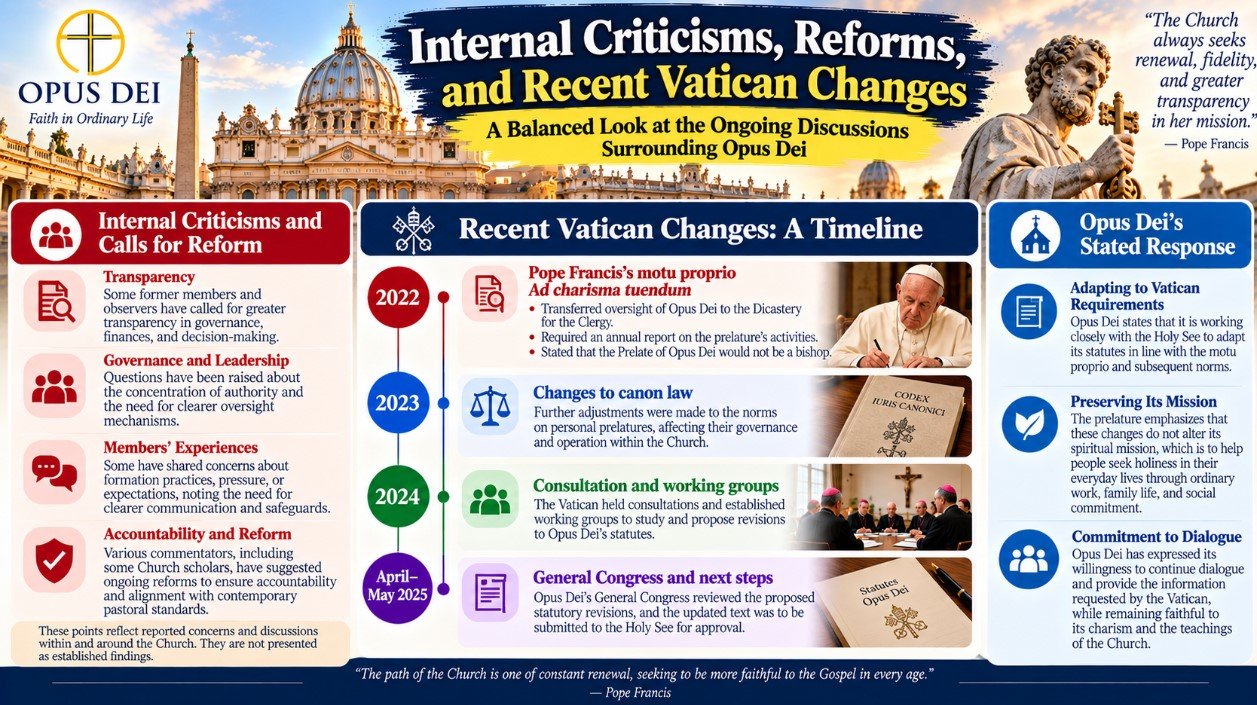
No objective study of Opus Dei can ignore the persistent criticisms raised by former members, secular investigative journalists, and Church observers.
SUMMARY OF HISTORICAL CRITICISMS
Aggressive Recruiting ──► Young people targeted at high schools/camps
Information Control ──► Reading materials screened; mail inspected
Spiritual Direction ──► Confession blended with authority structures
Alienation from Family ──► Numeraries discouraged from attending events
Common Criticisms
- Aggressive Recruitment of the Young: Former members have alleged that Opus Dei centers ran high-pressure recruitment campaigns targeting teenagers and university students through youth programs, summer camps, and tutoring clubs.
- Control over Personal Information: In past decades, numeraries were required to submit personal incoming and outgoing letters to center directors for screening. Reading lists and library books were strictly monitored and censored.
- Blurred Lines in Spiritual Guidance: Critics noted that spiritual directors were frequently direct internal superiors. This made it difficult for members to share personal doubts without worrying it would affect their standing inside the group.
- Distance from Families: Families of young numeraries sometimes felt shut out, as their children were discouraged from attending extended family vacations or social gatherings so they could focus on internal center work.
Responses and Institutional Evolution
Opus Dei’s leadership has addressed many of these concerns over the past twenty years:
- Screening policies for mail have been abandoned in step with modern privacy expectations.
- The Vatican clarified the separation between sacramental confession and administrative leadership.
- Recruitment standards now place heavy emphasis on emotional maturity and prolonged discernment. Candidates must spend years in formation before making final, permanent commitments.
Recent Vatican Reforms under Pope Francis
Between 2022 and 2023, Pope Francis issued two apostolic letters (Ad charisma tuendum and modifications to Canon Law) that restructured how Opus Dei fits into the Vatican hierarchy:
- Department Oversight: Opus Dei was moved from the Dicastery for Bishops to the Dicastery for the Clergy, highlighting the role of its priests in supporting the lay apostolate.
- Episcopal Rank: The head of Opus Dei will no longer be consecrated as a Bishop. This change protects Escrivá’s original vision of an organization rooted in lay spirituality rather than clerical prestige.
- Annual Reporting: The prelature must submit an annual operational report directly to the Holy See, rather than the five-year report previously required.
Pros and Cons of the Opus Dei Spiritual Path
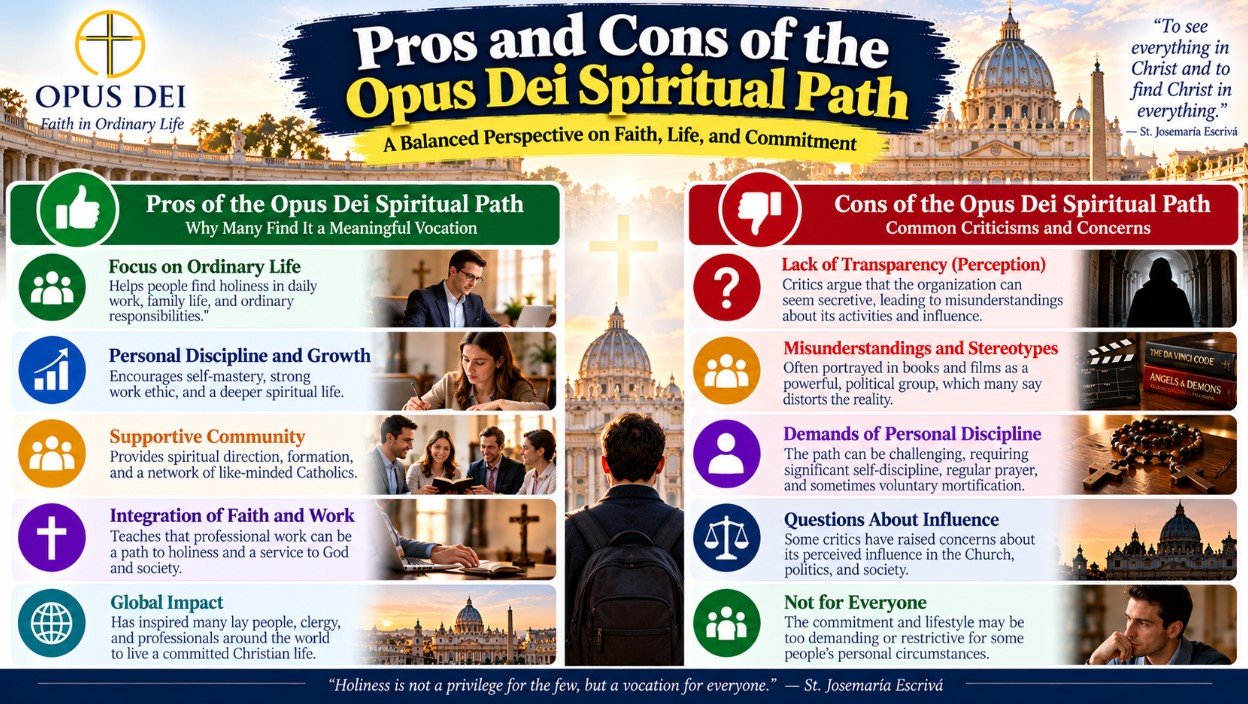
WEIGHING THE VOCATION
POTENTIAL ADVANTAGES POTENTIAL DRAWBACKS
───────────────────── ───────────────────
- Clear spiritual structure • Heavy daily time demands
- Deep, lifelong community • High emotional expectations
- Elevates career into prayer • Center life can feel rigid
- Excellent educational backing • Conservative culture
Pros
- Meaning in Daily Life: It transforms mundane work into a source of purpose. Washing dishes, drafting emails, or balancing budgets becomes spiritually meaningful.
- Structured Daily Routine: In a distracted, chaotic world, the Plan of Life gives people steady habits of prayer, quiet reflection, and moral focus.
- Warm, Lifelong Community: Members gain a reliable network of friends, mentors, and peers who share their faith and values across the globe.
- High Ethical Standards: It challenges professionals to resist corruption, pursue excellence, and practice genuine integrity in competitive fields.
Cons
- Demanding Time Commitments: Juggling professional work, family obligations, and two hours of daily spiritual routines can be exhausting.
- Rigid Center Life for Numeraries: Celibate members living in centers follow strict house rules, surrender their personal privacy, and turn over their earnings.
- Conservative Culture: People with progressive social or political views often feel out of place in Opus Dei’s traditional environment.
- Emotional Weight: The strong focus on perfection and personal excellence can sometimes lead to anxiety, guilt, or burnout for scrupulous members.
Frequently Asked Questions (FAQs)
1. Is Opus Dei a cult inside the Catholic Church?
No. Opus Dei is a fully recognized, canonical institution of the Catholic Church. It operates under the authority of the Pope and the Vatican’s Dicastery for the Clergy. While critics sometimes cite its tight discipline and past recruitment methods, its theological doctrines mirror official Catholic teaching.
2. Can non-Catholics join Opus Dei?
Non-Catholics cannot become full members because membership requires participation in Catholic sacraments. However, non-Catholics, non-Christians, and non-believers can become Cooperators. They support educational, cultural, and charitable projects without altering their own religious beliefs.
3. Do Opus Dei members live in monasteries?
No. There are no monasteries in Opus Dei. Married members live in their own homes with their families. Celibate members live either independently or in shared urban residential centers. These centers look like ordinary houses or apartment complexes and are located directly inside regular neighborhoods.
4. What is the “Heroic Minute”?
The Heroic Minute is an ascetical practice created by Saint Josemaría Escrivá. It simply means getting out of bed the very instant your alarm goes off in the morning—without hitting the snooze button. Members treat this brief act of self-discipline as their very first spiritual victory over laziness each day.
5. Why was Opus Dei called “God’s Bankers” or linked to high finance?
During the mid-20th century, especially in Franco’s Spain during the 1950s and 1960s, several highly trained economists who happened to be members of Opus Dei were appointed as government ministers. These technocrats helped modernize the Spanish economy. Because members work in prestigious professional fields like finance and law, outside observers mistakenly assumed the organization controlled coordinated business networks. In truth, members manage their careers individually.
6. Do members practice flagellation every day?
No. Physical penances are used strictly by celibate members (numeraries and associates), who make up roughly 20-30% of the total roster. The vast majority—married supernumeraries—do not practice them. Those who do use the disciplines (a small corded whip) limit the practice to a minute or two once a week, not daily. It is a symbolic penance, not self-harm.
7. How does someone join Opus Dei?
Joining requires a prolonged process of vocational discernment lasting several years:
- An individual attends retreats, talks, and spiritual direction for an extended period.
- If they sense a calling, they write a letter requesting admission (the “whistling” stage).
- After at least six months, they may be admitted to an initial period of formation.
- Only after several more years of discernment can they make a formal, definitive commitment.
8. Can members leave Opus Dei if they change their minds?
Yes. Members make temporary commitments that must be renewed annually during their early years. If someone decides this path is no longer their vocation, they simply do not renew their annual agreement and can leave in good standing. Those who have made a final, permanent commitment must request a formal canonical dispensation from the prelate.
9. What is Saint Josemaría Escrivá’s best-known book?
His most famous work is The Way (Camino), first published in 1934 under the title Spiritual Considerations. It is a collection of 999 short, direct spiritual maxims designed to spark personal meditation on character, prayer, discipline, and everyday duty. It has sold millions of copies worldwide in dozens of languages.
10. Does Opus Dei control its own political party?
No. Opus Dei explicitly forbids itself from taking institutional stances on partisan politics, economics, or public policy. Members hold diverse personal political views across the democratic spectrum and are strictly expected to make their own political choices with complete personal freedom and accountability.
The Enduring Legacy of Opus Dei
At its core, the meaning of Opus Dei comes down to its name: the “Work of God.”
Strip away the sensationalism of Hollywood thrillers and the controversies surrounding its mid-20th-century history, and you find a vibrant spiritual movement that helped redefine modern Catholicism. It dismantled the old assumption that spiritual greatness belonged only to cloistered monks and ordained priests.
By teaching that a cluttered desk, a noisy classroom, a shared family meal, and an honest day’s wage can be just as holy as an altar, Opus Dei gave millions of everyday believers a way to live their faith with purpose, dignity, and quiet passion.