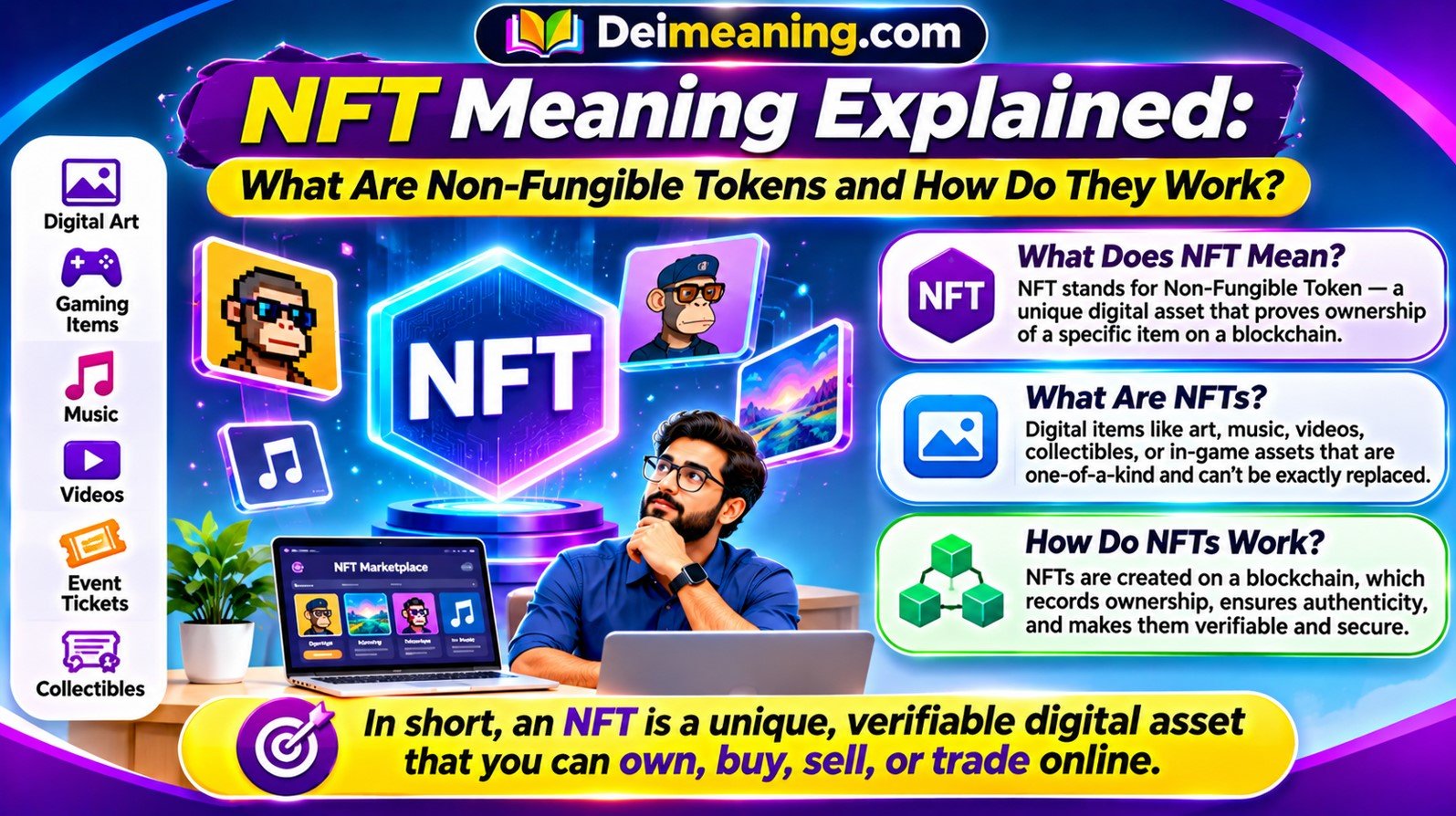
NFT Meaning Explained: What Are Non-Fungible Tokens and How Do They Work?
Imagine buying an original painting like Leonardo da Vinci’s Mona Lisa. Anyone can purchase a print, snap a photo, or download an identical poster from the internet. Yet, only the Louvre Museum in Paris holds the authentic canvas with its documented history and genuine provenance.
In the digital world, proving ownership used to be nearly impossible. A photo, MP3 file, or video clip could be copied millions of times with zero loss in quality. Each duplicate looked identical to the original file.
That dynamic changed with the arrival of the NFT.
Understanding the NFT meaning requires looking beyond pixelated avatars and multimillion-dollar digital art headlines. Non-fungible tokens represent an evolution in how society tracks ownership, provenance, and authenticity in a connected world. Whether applied to digital art, concert tickets, real estate deeds, or video game gear, NFTs turn loose internet data into verifiable digital property.
This comprehensive guide breaks down the true NFT meaning, explains the underlying technology in plain English, examines real-world applications, weighs benefits against risks, and answers common questions about digital asset ownership.
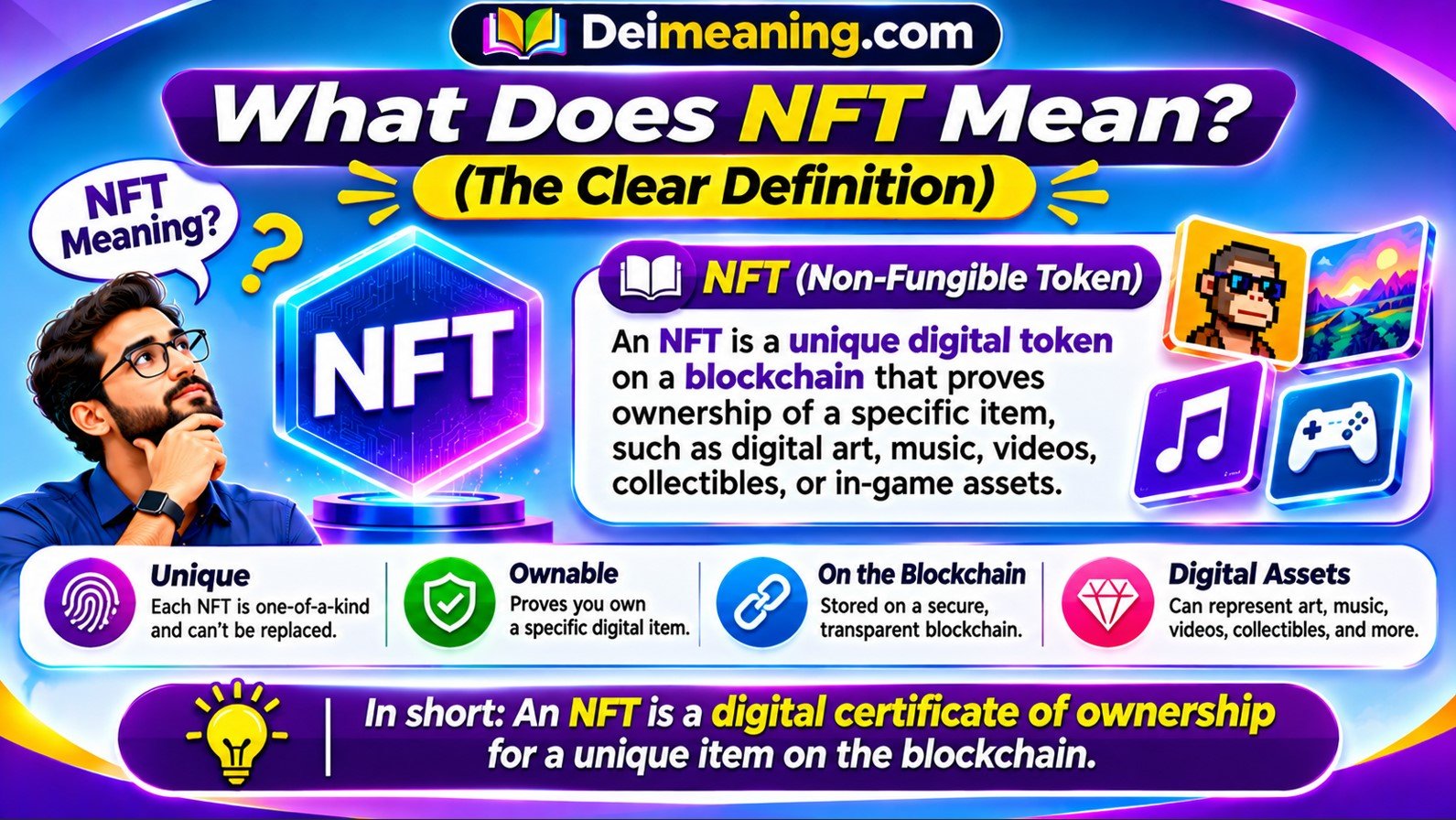
What Does NFT Mean? (The Clear Definition)
Featured Snippet Definition:
NFT stands for Non-Fungible Token. An NFT is a unique, cryptographic asset recorded on a blockchain that verifies ownership, authenticity, and origin of a specific item—either digital (such as art, music, or in-game items) or physical (such as real estate or luxury goods). Unlike cryptocurrencies, each NFT has a distinct digital signature and cannot be traded on a 1-to-1 equal basis.
Read More: DEI Meaning
To break that definition down further:
- Non-Fungible: The item is one-of-a-kind, irreplaceable, and non-interchangeable. It cannot be swapped for an identical copy because no identical twin exists.
- Token: A digital certificate of ownership recorded securely on a decentralized computer network known as a blockchain.
When you buy an NFT, you are not buying the copyright to the artwork or holding an exclusive physical copyright license unless explicitly specified in the contract. Instead, you are buying a cryptographic certificate of authenticity linked to that specific file or asset.
Fungible vs. Non-Fungible: Understanding the Core Difference
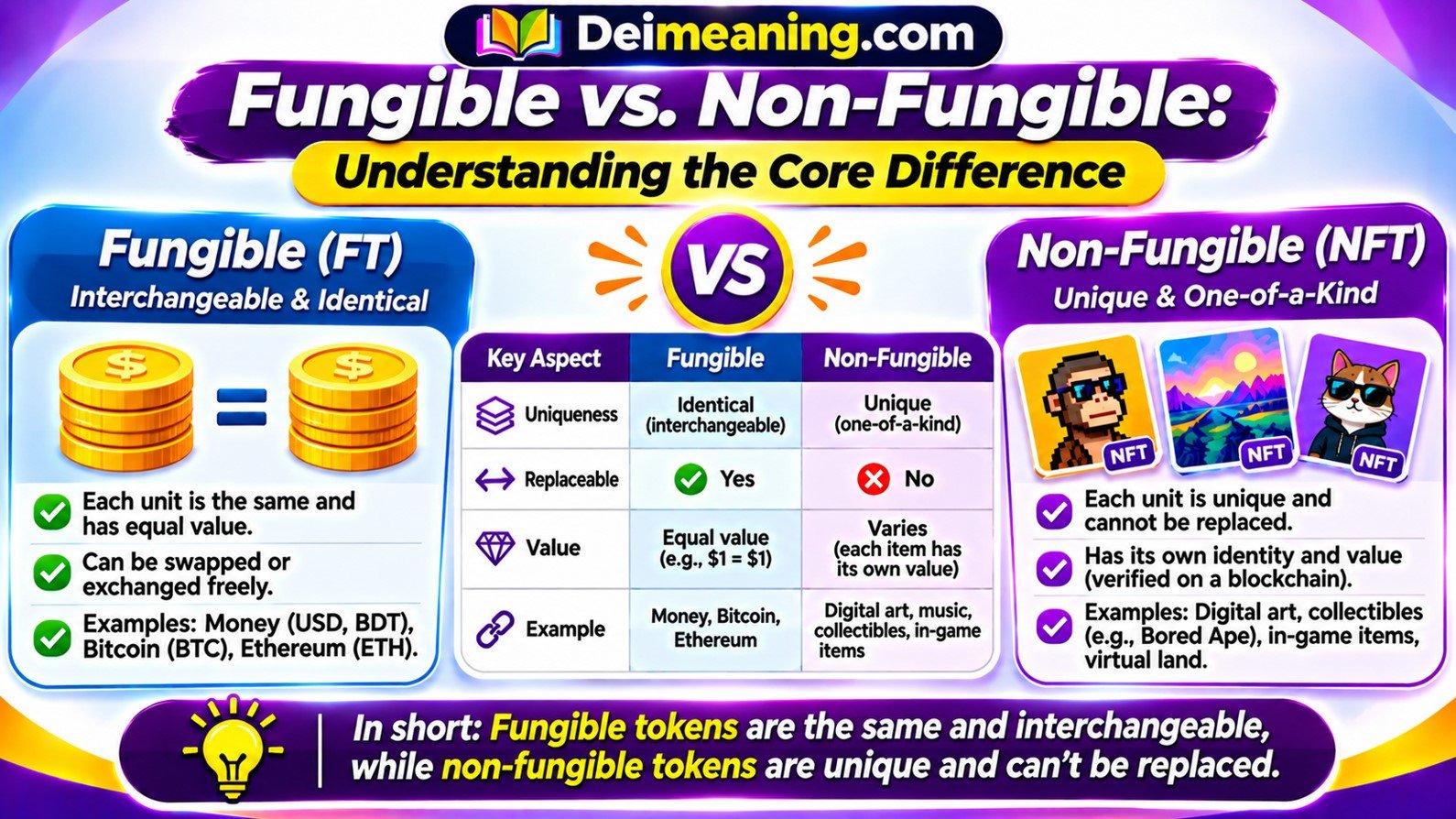
To grasp non-fungibility, consider everyday objects and currency.
Fungible Assets
A dollar bill is fungible. If you lend a ten-dollar bill to a friend, you do not expect that specific, numbered piece of paper back. Any ten-dollar bill works because each ten-dollar bill holds identical value and utility.
The same rule applies to commodities like gold, crude oil, and cryptocurrencies such as Bitcoin (BTC) or Ethereum (ETH). One Bitcoin in your digital wallet carries the exact same market value and characteristics as one Bitcoin in someone else’s wallet.
Non-Fungible Assets
A handcrafted acoustic guitar signed by your favorite musician is non-fungible. If a friend borrows that guitar, you would not accept an ordinary guitar off a store shelf as a replacement. The scratches, the autograph, the tonal wood, and the sentimental history make it unique.
Other non-fungible items include:
- The deed to your residential house.
- A driver’s license or passport.
- A signed baseball card graded a perfect 10.
- An original oil painting on canvas.
Non-fungible tokens translate this principle of singular, provable uniqueness into digital data structures.
How Do NFTs Actually Work?
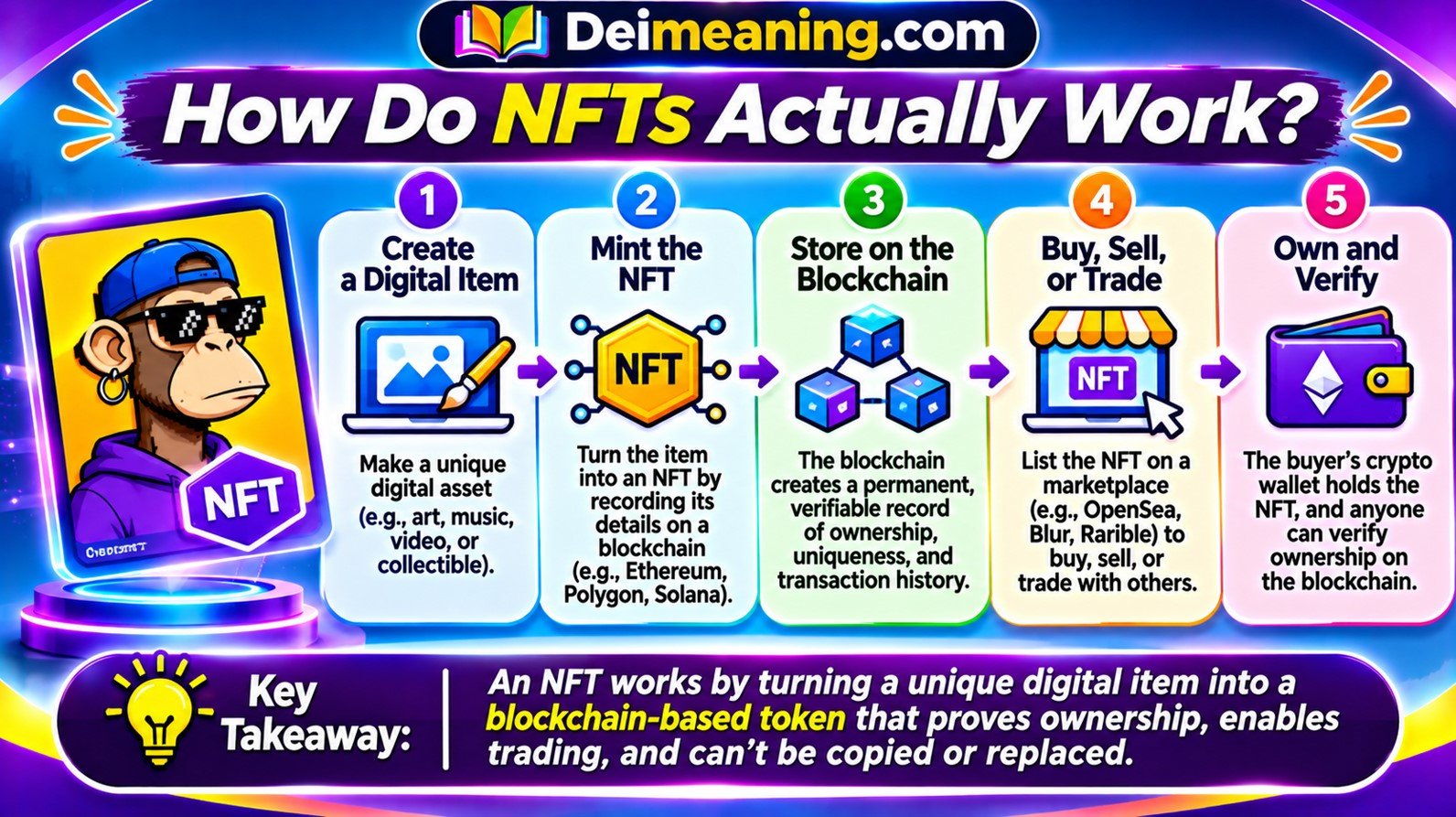
NFTs may sound abstract, but they function on three concrete building blocks: distributed ledgers, algorithmic smart contracts, and the minting procedure.
The Role of Blockchain Technology
A blockchain is a public, decentralized database maintained by thousands of computers worldwide rather than a single company like Google or Amazon. Every time a transaction occurs, the network registers it, bundles it into a block with other transactions, and locks it using cryptography.
Because no single entity controls the ledger, nobody can erase your transaction, alter ownership history, or forge past purchase dates. When an NFT is minted or transferred, the entire network updates to display your public wallet address as the verified holder.
Smart Contracts Explained
NFTs run on self-executing software programs known as smart contracts.
A smart contract contains hardcoded rules, conditions, and automated actions. It handles:
- Minting: Generating the unique token ID and binding it to metadata.
- Transferring: Moving the asset from seller to buyer once payment criteria are satisfied.
- Automated Royalties: Distributing a set percentage (often 5% to 10%) of all secondary sales back to the original creator’s wallet automatically.
The most widely adopted smart contract standards include ERC-721 (the original standard for singular, unique assets on Ethereum) and ERC-1155 (a multi-token standard that lets developers batch fungible and non-fungible assets together to save network fees).
Minting: From Raw File to Token
Minting is the process of converting a digital file into a permanent blockchain entry.
- Creation: An artist designs an image, records an audio track, or generates a 3D model.
- Metadata Setup: The creator bundles key data, including the asset title, description, artist name, and a file link pointing to decentralized storage solutions like IPFS (InterPlanetary File System) or Arweave. Blockchains rarely store heavy image files directly due to high storage fees; instead, they record this tamper-proof metadata.
- Publishing: The creator pays a network fee (often called a “gas fee”) to execute the smart contract on networks such as Ethereum, Solana, or Polygon.
- Token Generation: The network generates a distinct Token ID tied to the creator’s wallet address. The NFT is now live and tradable.
A Brief History: From Colored Coins to Mainstream Awareness
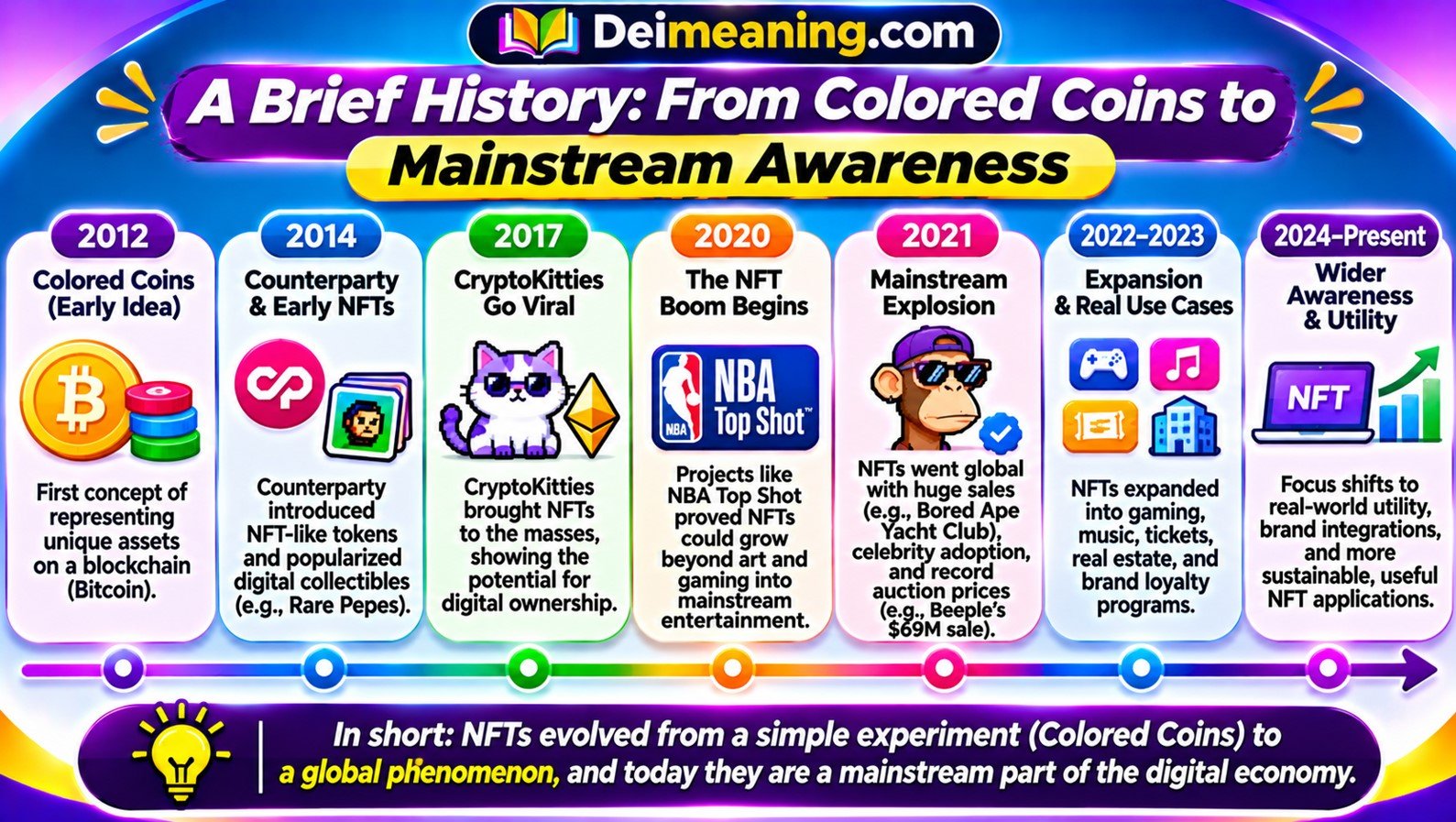
The technological foundation of NFTs dates back earlier than the boom of recent years.
- 2012–2014 (Colored Coins): Developers experimented on the Bitcoin network by attaching tiny units of metadata to satoshis (Bitcoin fractions). These “Colored Coins” represented real-world assets like coupons and equities on a decentralized ledger.
- 2014 (Quantum): Artist Kevin McCoy and technologist Anil Dash minted Quantum, a generative video clip, on the Namecoin blockchain. Many historians recognize it as the very first true digital art NFT.
- 2017 (CryptoPunks and CryptoKitties): Larva Labs launched CryptoPunks, an experimental collection of 10,000 uniquely generated 24×24 pixel art characters on Ethereum, released for free. Later that year, the game CryptoKitties allowed players to breed and trade virtual cats, famously congesting the entire Ethereum network due to overwhelming demand.
- 2021 (The Beeple Breakthrough): Digital artist Mike Winkelmann (known professionally as Beeple) sold his collage Everydays: The First 5000 Days at Christie’s auction house for $69.3 million. This landmark sale catapulted NFTs into mainstream media, corporate boardrooms, and household dinner discussions.
- Post-2022 to the Present (Utility Era): After the initial speculative bubble deflated, developers shifted focus away from hype-driven profile pictures toward functional utility: institutional tokenization, digital identity, transparent logistics, and verifiable membership.
Key Characteristics of Non-Fungible Tokens
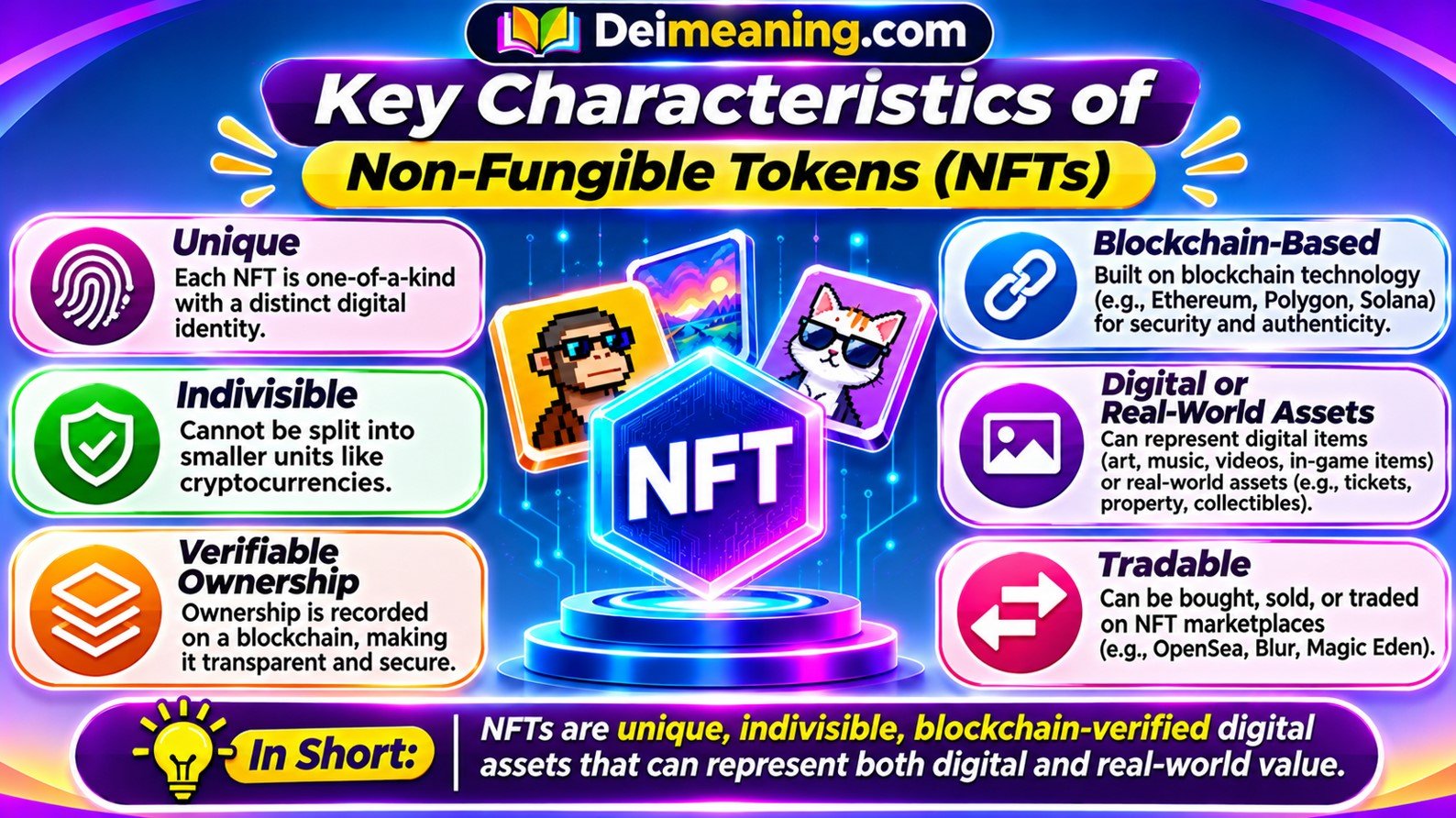
Every genuine NFT shares five fundamental properties that distinguish it from standard digital files:
- Uniqueness: Every token possesses an unalterable Token ID and contract address. Even in an edition of 100 identical images, token #1 is distinct from token #2.
- Indivisibility: Most NFTs cannot be split into smaller fractions. You cannot trade half an art token or a third of a concert ticket (though experimental fractionalization protocols exist for collective investment).
- Provenance and Traceability: Anyone can view the complete chain of custody on a public block explorer like Etherscan. You can trace an asset directly back to the moment the original creator minted it.
- Interoperability: Because NFTs follow shared open standards (like ERC-721), they can move across different marketplaces, digital wallets, decentralized apps, and virtual platforms without platform-exclusive restrictions.
- Scarcity: Creators set hard supply limits in the smart contract. Once set, no one can print additional tokens outside the programmed parameters.
Real-World Use Cases for NFTs
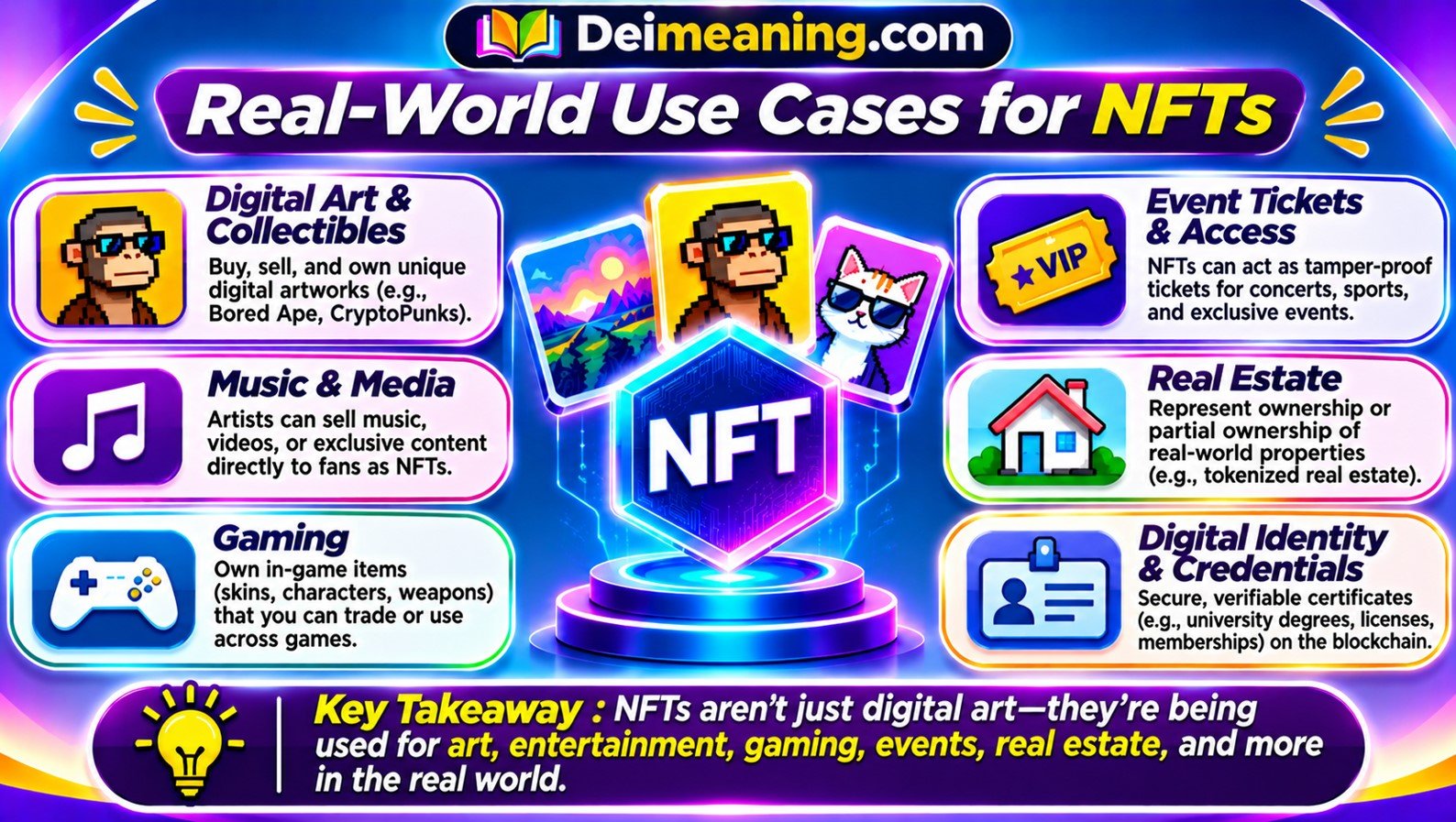
While digital art captured early headlines, the fundamental technology behind non-fungible tokens applies across numerous global industries.
+—————————————————————–+
| NFT ECOSYSTEM UTILITY |
+—————————————————————–+
| [ Art & Collectibles ] —> Digital Provenance & Creator Rights |
| [ Gaming Assets ] —> Player Ownership & Interoperability |
| [ Music & Media ] —> Direct-to-Fan Streaming & Royalties|
| [ Event Ticketing ] —> Anti-Scalping & Verifiable Passes |
| [ Real Estate & RWA ] —> Fractional Deeds & Clear Custody |
+—————————————————————–+
Digital Art and Collectibles
Before NFTs, digital artists struggled to monetize their work because anyone could right-click, save, and distribute digital illustrations for free. NFTs provided artists with verifiable digital scarcity. Renowned institutions like the Museum of Modern Art (MoMA) and Sotheby’s now display and curate digital works backed by blockchain certificates.
Gaming Assets and Virtual Worlds
Traditional video games trap your purchases inside a walled garden. If you spend $100 on weapon skins or outfits inside a traditional game, the game publisher retains total ownership. If the publisher shuts down its servers or bans your account, those assets disappear.
In blockchain-based games, your avatars, weapons, land plots, and items reside in your private crypto wallet as NFTs. You can:
- Sell rare items to other players for real-world currency on secondary marketplaces.
- Transfer items between compatible game worlds.
- Retain your assets even if the game studio ceases development.
Music, Media, and Royalties
The modern streaming model pays independent musicians fractions of a cent per stream, with middlemen taking substantial cuts. Musicians can release albums or audio stems as NFTs directly to their fan bases.
Smart contracts automate royalty distributions: whenever a fan resells an exclusive music token, the platform deposits the designated percentage directly into the artist’s wallet instantly, bypassing managers, labels, and collection agencies.
Ticketing and Event Access
Ticket fraud, scalping bots, and predatory resale markups plague the live entertainment industry. Minting concert, sports, and conference tickets as NFTs solves several major problems:
- Fraud elimination: Gate staff scan cryptographic proofs that cannot be photocopied or faked.
- Price caps: Smart contracts can enforce resale price ceilings, preventing scalpers from charging 500% over face value.
- Perks: Event organizers can reward ticket holders with digital memorabilia, future discounts, or backstage access years after the event ends.
Real Estate, Identity, and Physical Assets
Tokenizing Real World Assets (RWAs) is one of blockchain technology’s fastest-growing sectors.
- Property Deeds: Representing property titles as NFTs streamlines real estate transfers, lowers escrow fees, and establishes clean title histories free of clerical errors.
- Supply Chain Authentication: Luxury brands like Rolex, Prada, and Louis Vuitton attach cryptographic tags to luxury watches and designer bags. Buyers scan an embedded NFC chip to view the matching NFT, verifying that the item is not a counterfeit.
- Digital Identity: Medical records, professional credentials, university degrees, and government IDs can be issued as non-transferable NFTs (often referred to as Soulbound Tokens), preventing resume padding and identity theft.
Click Now: Pookie Meaning
Fungible vs. Non-Fungible Tokens: Direct Comparison
To evaluate where digital assets fit within your portfolio or workflow, review the functional differences below:
| Feature | Fungible Tokens (e.g., BTC, ETH, USD) | Non-Fungible Tokens (e.g., Digital Art, Deeds) |
| Interchangeability | Fully interchangeable with identical units | Completely unique; cannot be swapped 1-to-1 |
| Divisibility | Divisible into smaller units (e.g., satoshis, cents) | Non-divisible under standard token designs |
| Value Basis | Uniform value across all units at any given moment | Individual value based on scarcity, utility, and demand |
| Token Standards | ERC-20, SPL (Fungible) | ERC-721, ERC-1155, Metaplex |
| Primary Use Cases | Currency, store of value, medium of exchange, payments | Property rights, art, identity, tickets, collectibles |
| Supply Dynamics | Millions to billions of identical units | Typically single items or strictly numbered limited runs |
How to Buy, Sell, and Store NFTs Safely
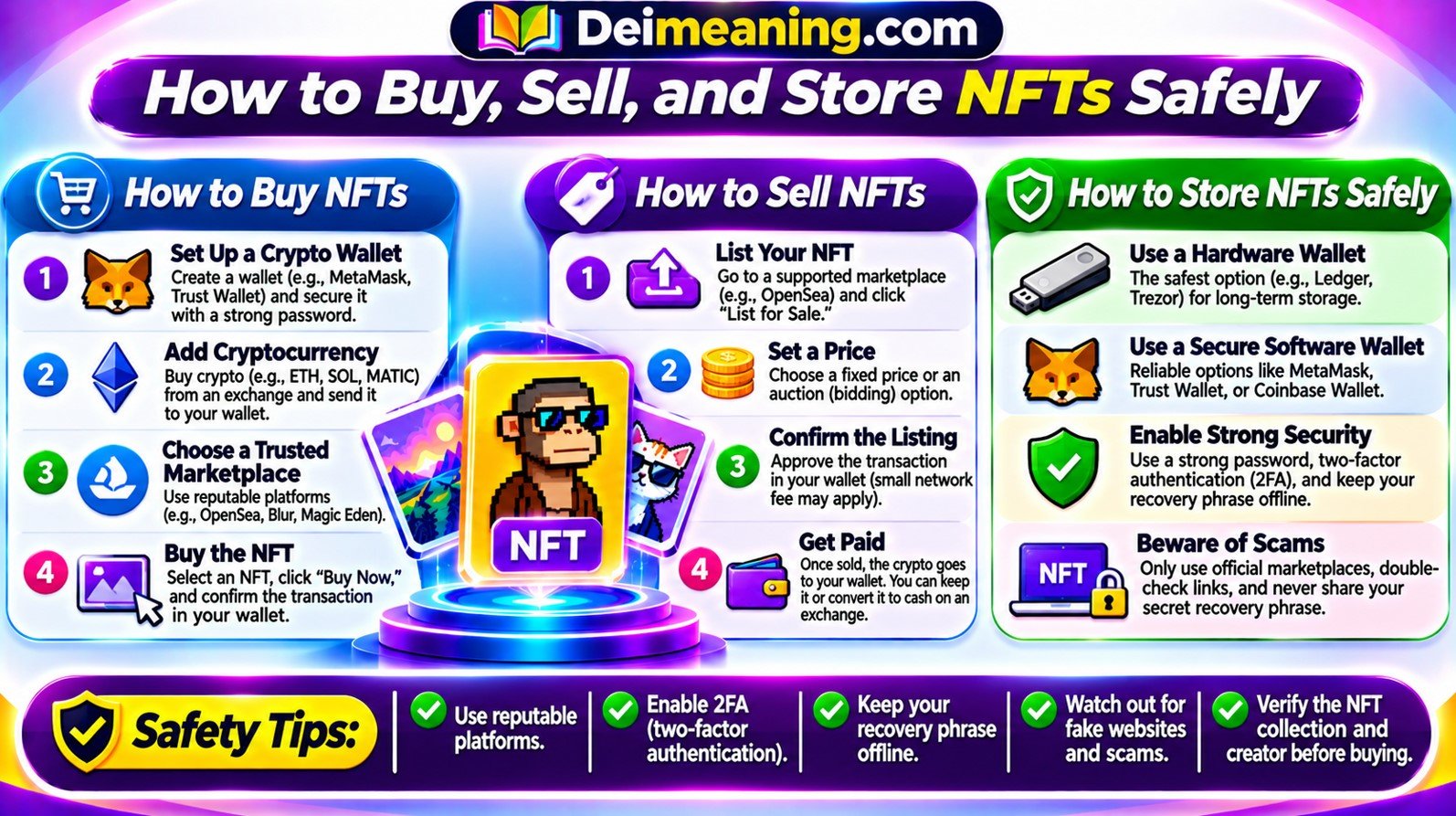
Entering the NFT ecosystem requires basic preparations to protect your assets from unauthorized access.
1. Set Up a Self-Custodial Crypto Wallet
You need a Web3 wallet that supports non-fungible tokens. Popular, reputable options include:
- MetaMask: The standard browser extension wallet for Ethereum and EVM-compatible chains.
- Phantom: A fast, user-friendly wallet built primarily for the Solana network.
- Coinbase Wallet: A clean mobile and desktop self-custody option for beginners.
Safety Rule: When creating a wallet, write down your 12-to-24-word seed phrase (secret recovery phrase) on physical paper with a pen. Store it in a secure location like a fireproof lockbox. Never save your seed phrase in email drafts, screenshots, notes apps, or cloud storage.
2. Fund Your Wallet With Cryptocurrency
Most NFT marketplaces do not accept direct credit card payments for every transaction (though fiat on-ramps are expanding). You must purchase cryptocurrency on a regulated exchange (such as Coinbase or Kraken) and transfer it to your private wallet address:
- Buy Ethereum (ETH) for Ethereum-based platforms.
- Buy Solana (SOL) for Solana-based platforms.
- Buy Polygon (POL) for low-fee secondary assets.
3. Connect to an Established Marketplace
Browse popular, verified platforms:
- OpenSea: The oldest and broadest multi-chain marketplace.
- Magic Eden: The leading marketplace for Solana assets and cross-chain gaming.
- Blur: A professional trading platform designed for high-volume Ethereum art and asset traders.
- SuperRare / Foundation: Curated, invitation-only platforms for high-end digital fine art.
Always double-check the URL before connecting your wallet to prevent phishing attacks.
4. Cold Storage for High-Value Assets
If you collect valuable NFTs, avoid leaving them in software wallets connected to active web browsers. Move long-term assets to a hardware wallet (cold storage device) such as a Ledger or Trezor. Hardware wallets store your private keys offline, protecting your tokens even if your computer encounters malware.
The Pros and Cons of NFTs
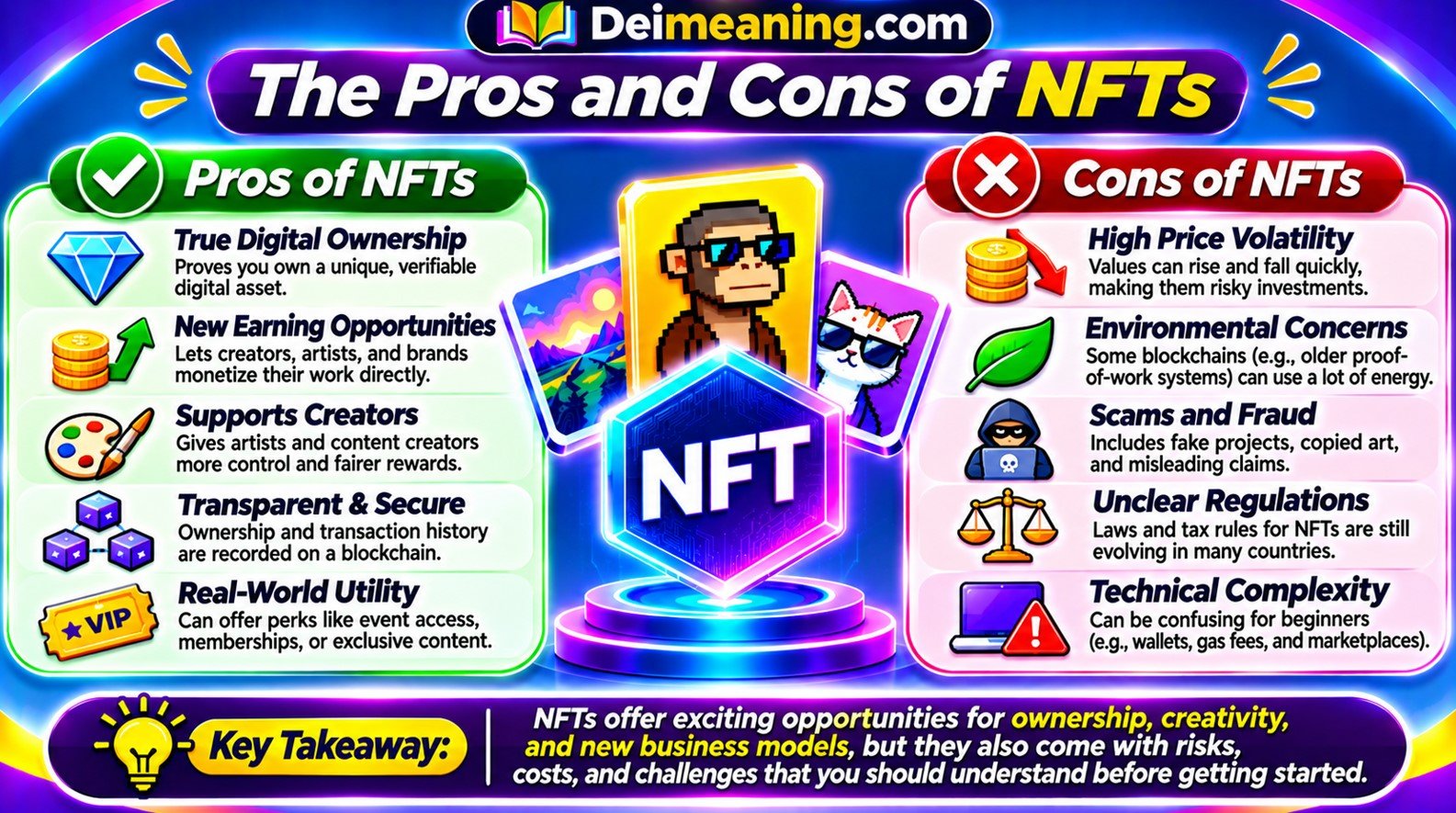
Before participating in the digital asset market, assess both its structural benefits and its notable drawbacks.
The Advantages (Pros)
- Direct Creator Monetization: Artists sell directly to a global audience, removing galleries, distributors, and agents who take large cuts.
- Automated Secondary Royalties: Creators receive ongoing revenue streams from secondary resales through automated smart contracts.
- Immutable Provenance: Buyers can verify the authenticity, production date, and complete ownership history of an item within seconds.
- Enhanced Liquidity for Illiquid Assets: Tokenization allows fractionalization of real estate and fine art, letting smaller investors trade shares of high-value physical property.
- Programmable Utility: Tokens serve dual roles as digital collectibles and functional gate keys for physical events, software licenses, and private communities.
The Disadvantages (Cons)
- High Market Volatility: NFT prices fluctuate wildly. Many speculative projects from peak market cycles have lost over 90% of their monetary value.
- Prevalence of Scams and Exploits: Phishing websites, malicious contract signatures, and social engineering scams remain persistent hazards for unprepared users.
- Lack of Broad Legal Clarity: Copyright laws, intellectual property rights, and cross-border digital taxation rules are still evolving in many jurisdictions.
- Irreversible Transactions: If you send an NFT to the wrong public address or approve a malicious transaction, no bank or customer support team can reverse the transfer.
- Technical Barrier to Entry: Managing private keys, gas fees, and network bridging presents a steep learning curve for everyday computer users.
Common Misconceptions and Scams to Avoid
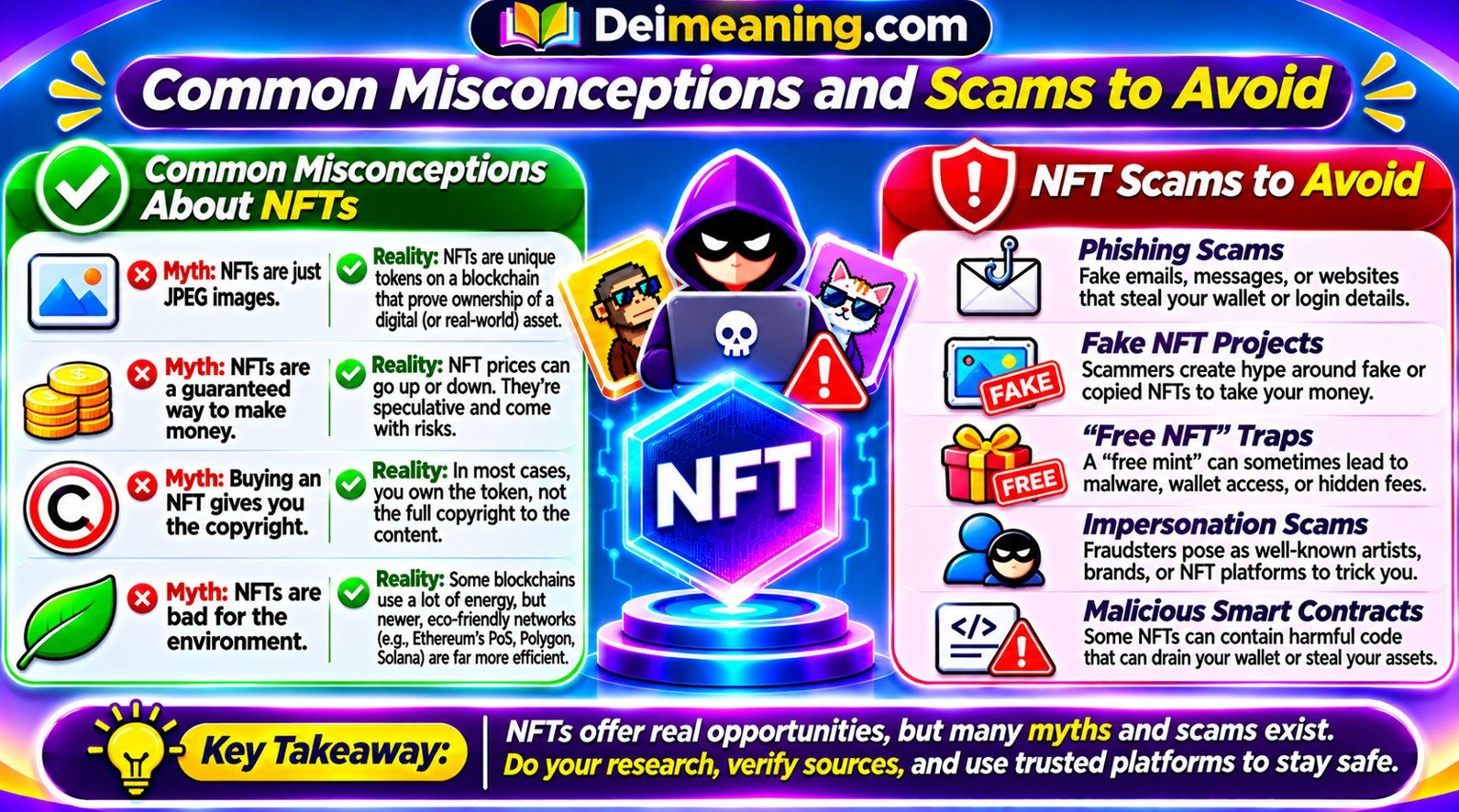
The rapid rise of NFTs generated significant public misunderstanding. Separating marketing hype from reality is essential.
Misconception 1: “Right-Clicking and Saving an Image Defeats the NFT”
Anyone can download, screenshot, or print a picture of a rare comic book or a high-resolution file of the Mona Lisa. However, saving that file does not convey ownership, authentic provenance, or access rights. You own an arrangement of pixels on your hard drive; the token holder owns the cryptographically verifiable property title recognized by the creator and the market.
Misconception 2: “Buying an NFT Automatically Grants Commercial Copyright”
Purchasing an NFT does not automatically transfer legal intellectual property (IP) rights or trademark ownership unless the artist explicitly states so in writing. In most standard art transactions, you acquire personal display rights—comparable to buying a physical painting from an art gallery. Some collections, such as the Bored Ape Yacht Club, explicitly grant broad commercial rights to holders, but that is a deliberate choice by the creators, not an automatic legal rule.
Scams to Guard Against
- Phishing Links: Fake accounts on platforms like X (formerly Twitter) and Discord post fraudulent links promising “free mints” or “airdrops.” These links lead to malicious websites designed to drain your wallet funds upon connection.
- Rug Pulls: Developers generate hype around an upcoming project, collect millions of dollars in minting fees, and abandon the project without delivering the promised roadmap, games, or features.
- Wash Trading: Bad actors buy and sell the same asset repeatedly between private wallets they control to artificially inflate transaction volume and price history, tricking novice buyers into overpaying.
The Environmental Question: Proof of Work vs. Proof of Stake
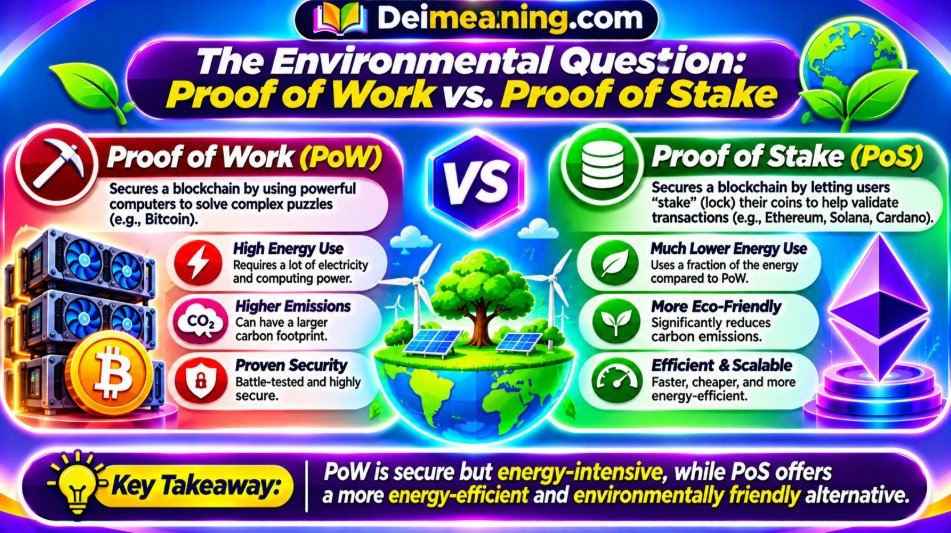
Early media coverage frequently criticized NFTs for consuming massive amounts of electrical power, comparing blockchain networks to the carbon footprint of entire nations.
That criticism stemmed from Proof of Work (PoW), the original consensus mechanism used by Bitcoin and early Ethereum. In Proof of Work, computers solve energy-intensive mathematical puzzles to validate transactions and secure the network.
However, the technological landscape has evolved:
In September 2022, Ethereum executed The Merge, transitioning its entire consensus mechanism from Proof of Work to Proof of Stake (PoS). Instead of energy-hungry mining rigs, Proof of Stake secures the blockchain using validators who lock up (“stake”) cryptocurrency collateral.
Key Fact: Ethereum’s move to Proof of Stake reduced its energy consumption and carbon emissions by more than 99.95% overnight.
Modern blockchains commonly used for NFTs—including Ethereum, Solana, Polygon, Cardano, and Avalanche—operate on energy-efficient Proof of Stake architectures. Minting an NFT today consumes roughly the same amount of electricity as sending an email or making a debit card purchase at a grocery store checkout.
Learn More: Body Count Meaning
Frequently Asked Questions (FAQs)
1. What does NFT stand for?
NFT stands for Non-Fungible Token. “Non-fungible” means unique, non-interchangeable, and one-of-a-kind. “Token” refers to a secure digital certificate stored on a decentralized public blockchain.
2. Can an NFT be copied?
A person can copy the digital image, video, or audio file associated with an NFT using a simple right-click or screen capture. However, they cannot duplicate the underlying cryptographic token, its historical transaction record, or its validated ownership entry on the blockchain ledger.
3. What gives an NFT its financial value?
An NFT derives value from the same factors that govern traditional collectibles, luxury goods, and art: scarcity, consumer demand, cultural relevance, historical provenance, creator reputation, and practical utility (such as VIP access, commercial rights, or gaming functionality). If nobody wants the underlying asset, its value drops to zero regardless of its uniqueness.
4. Why do some people pay millions for digital pictures?
High-profile sales typically reflect a mix of speculative investment, high-net-worth collecting, status signaling, and bets on digital culture. Early generative collections like CryptoPunks carry historical significance within internet subcultures, drawing comparisons to early works of modern art. However, multimillion-dollar sales represent a tiny fraction of total market activity.
5. Do I own the copyright to the artwork if I purchase an NFT?
Usually, no. In most cases, purchasing an NFT gives you personal ownership of that specific token and the right to display or resell it. The original artist retains the intellectual property, reproduction rights, and commercial copyright unless the smart contract or sales agreement explicitly transfers full IP rights to the buyer.
6. What is a “gas fee” in the context of NFTs?
A gas fee is a transaction payment made to the computer network validators who process, record, and secure your transaction on the blockchain. Gas prices vary based on network traffic. When many people trade simultaneously, gas fees rise; during quiet network hours, fees decline.
7. Can physical items be turned into NFTs?
Yes. Physical items can be linked to NFTs using NFC chips, QR codes, or digital twins. High-end watchmakers, apparel companies, and wine distributors use NFTs to verify physical authenticity and track ownership through supply chains. Real estate developers also tokenize physical property deeds to streamline real estate purchases.
8. Are NFTs a safe financial investment?
NFTs carry significant financial risk. They are volatile, illiquid assets that can drop in market value quickly. Unlike stocks or dividend-paying funds, an NFT’s resale price depends entirely on finding a buyer willing to pay more than your purchase price. Always conduct thorough research, avoid investing money you cannot afford to lose, and prioritize assets that offer practical utility over pure price speculation.
Conclusion: The Road Ahead for Digital Ownership
The phrase NFT meaning represents far more than an internet buzzword or speculative collectibles. At its core, the non-fungible token solves a fundamental challenge that existed since the dawn of the internet: how to establish authentic, provable property rights in a digital environment.
While speculative bubbles dominated early headlines, the underlying infrastructure has matured. Blockchains have become energy-efficient, transaction fees have dropped, and developers are prioritizing functional utility over short-lived hype.
As our work, entertainment, and social lives continue moving into digital spaces, verifying who made an asset, who owns it, and where it originated is essential. Whether securing a home deed, entering a stadium, tracking a rare watch, or supporting independent creators, non-fungible tokens provide the foundation for digital property rights in the modern era.